The short version
HOTMA compliance for housing programs is not one rule set. It is several, and which one you follow depends on the funding stream paying for the unit. The same household, with the same income and the same savings account, is treated differently in a CoC Rapid Rehousing program than in a HOPWA program down the street or living at the same property. That is not a mistake anyone made. It is what the regulations say.
Three of the most-talked-about HOTMA changes do not apply to CoC or ESG at all. The asset cap that makes a household ineligible, the bar on assisting a household that owns real property, and the fixed-income shortcut people call “triennial recertification” apply to one CPD program, HOPWA, and to none of the others.
One change is already required, and you are late if you have not made it. The 29 federally mandated income exclusions took effect January 31, 2024. They do not wait for 2027.
The reason you and your staff have bad information is not carelessness. HUD’s PIH and MF divisions wrote a 10-attachment implementation notice for public housing authorities and multifamily owners in 2023, and said in that notice that CPD would issue its own. Nearly three years later, it has not. Everything the sector knows about HOTMA is mostly learned from the PIH guidance and consultants from the PHA space, because that is the only guidance there is.
Rules that differ by funding stream cannot be solved by training. You have to build the right rule into the process each program follows, so the funding stream decides which rule applies before anyone has to remember that it should.
What HOTMA is, in one paragraph
HOTMA, the Housing Opportunity Through Modernization Act of 2016, changed how HUD-assisted programs count a household’s income, what they subtract from it before calculating a household’s rent, and how they treat savings and property. HUD wrote the rules in a February 2023 regulation. For HUD Community Planning and Development (CPD)-funded programs, the deadline to be following them is January 1, 2027, though you have been allowed to start any time since January 1, 2024.
That is the easy part, and it is where most explanations stop. The hard part is the question this article exists to answer: which of these rules is yours?
Why the same law lands differently in different programs
Because most HOTMA rules live in a part of the regulations that were written for someone else, and your program only has to follow them if your own rules say so.
Here is the plain version. HUD put the HOTMA definitions in a section of the Code of Federal Regulations called 24 CFR part 5. Part 5 is the rulebook for Section 8 and public housing. It says so directly. One of its own paragraphs reads, “This section applies to the Section 8 (tenant-based and project-based) and public housing programs.”
CoC, ESG, HOME, HOPWA, HTF, and CDBG are not Section 8 or public housing. They are CPD programs, and each has its own rulebook: part 578 for CoC, part 576 for ESG, part 92 for HOME, and so on. A part 5 rule applies to your program only if your rulebook points at it by name.
Think of it like a lease that references a separate set of building rules. If your lease says, “the quiet hours policy applies,” you are bound by quiet hours. If it says nothing about the parking policy, you are not bound by the parking policy, even though both are printed in the same building handbook, and even though your neighbor across the hall is bound by both.
Three things follow from that, and they produce three different answers:
Sometimes your rulebook points at a whole section. The CoC Program’s rule says income “must be calculated in accordance with 24 CFR 5.609,” so all of section 5.609 comes along, including parts most summaries never mention.
Sometimes it points at one paragraph and stops. CoC’s rule also says “and 24 CFR 5.611(a).” Paragraph (a) is the list of deductions. Paragraphs (c) through (e) are the hardship exemptions. CoC got (a). CoC did not get (c) through (e). A single letter in a citation is the difference between a hardship process your program runs and one it has no authority or need to run.
And sometimes your rulebook says nothing at all. Parts 576 and 578 never mention section 5.618, which is where the asset cap and the real-property bar live. That silence is the answer: those rules do not apply to the CoC or ESG programs.
What this means on Monday morning: before you apply any HOTMA rule to a household, do not ask what HOTMA says. Ask what your own program’s regulation says about that rule.
What changes for every program that uses the Part 5 definitions
All of these reach you, because they live inside the income definition your program already applies.
How income is counted. CoC, ESG, HOPWA, and HOME-ARP must use the part 5 definition of annual income. HOME, HTF, and CDBG choose between that definition and an IRS-based one. Wherever the part 5 definition is used, its own 28 exclusions come with it, including education savings accounts, state Medicaid payments that support a household member with a disability to stay in the unit, loan proceeds, civil rights settlements, and a broad exclusion for one-time income. That last one has a trap in it: income from contract work, day labor, or seasonal work is not excluded, even when the amount and timing vary from month to month. Those 28 are written into the regulation itself. The 29 federally mandated exclusions noted above are a separate list HUD publishes by notice, and they apply on top of the 28.
The deduction amounts, which now change every January. The dependent deduction is $500 in 2026 and $525 in 2027. The elderly-or-disabled household deduction is $550, then $575. HUD publishes the new figures the previous year, which means the numbers your staff trains on this fall are not the numbers they must use on the deadline.
The medical deduction threshold, which moved from 3% to 10%. This is the change most likely to reduce a household’s deduction and raise its rent. Two related deductions get collapsed into one in most trainings, and they are not the same. Unreimbursed health and medical expenses are available only to an elderly or disabled household. Attendant care and auxiliary apparatus expenses are available for any household member who is a person with a disability, to the extent those costs let someone in the household work and are capped at the earnings they make possible. The 10% floor applies to the two of them added together. The practical effect: many elderly and disabled households with ongoing but moderate medical costs will fall below the floor and lose the deduction entirely.
How savings and property are counted. Necessary personal property is excluded, as are retirement accounts and the value of an ABLE account. That one is worth flagging, because ABLE frequently gets described as an income exclusion when it is an asset exclusion. Non-necessary personal property is excluded only while its combined value stays at or below $52,787 in 2026 and $54,898 in 2027. Once it crosses that line, the entire combined value counts, not just the amount above it. Where net assets exceed the same threshold and the actual return cannot be determined, income is imputed at HUD’s published passbook savings rate: 0.40% in 2026, 0.38% in 2027.
There is a gap in that last rule worth knowing about. The regulation excludes “necessary” personal property and counts “non-necessary” personal property, and then never defines either term. Two reasonable coordinators will draw that line in different places. In a multi-provider system, that is not a hypothetical.
And one change is already required. The 29 federally mandated income exclusions published January 31, 2024 are in force now and cannot be deferred to 2027. HUD reminded CPD grantees of this in the December 2025 extension notice, telling them to apply the exclusions “even if they have not yet implemented the HOTMA final rule.” A wrinkle worth knowing: the January 2024 exclusions notice’s own list of covered programs names parts 92, 93, and 574 but not parts 576 or 578. CoC and ESG are covered anyway. HUD said so on a HUD Exchange guidance page, which states the notice “applies to HUD programs regardless of the definition of annual income used to determine eligibility for assistance.”
What changes only for some programs
Before asking which hardship exemption applies, ask whether your program calculates adjusted income at all. For three of the seven, it does not.
The CoC Program does. Both the occupancy charge in leasing models and the rent contribution in a rental assistance model run on adjusted income, using the deductions in 5.611(a). HOPWA does and takes more of the HOTMA machinery than any other CPD program. HOME does in three situations only: tenant-based rental assistance (HOME TBRA), Low HOME Rent units, and over-income tenants.
ESG does not. There is no ESG tenant rent calculation; income is an eligibility test, not a rent input. HTF does not, and its regulation says so outright: “The HTF program does not require that adjusted income be used or calculated by HTF grantees.” HOME-ARP does not. CDBG does not; the phrase does not appear in its regulations.
Where a program does not calculate adjusted income, every question downstream of it (deductions, hardship exemptions, the medical threshold) is moot.
The hardship exemptions do not reach CoC or ESG
They are real, they are complicated, and for the two largest homeless assistance programs they are simply not in play.
Part 578 borrows paragraph (a) of the deduction rule and nothing else. ESG has no adjusted income for them to attach to. HOME participating jurisdictions may offer them, at their option, for tenant-based rental assistance and Low HOME Rent units, but not for over-income tenants. HOPWA grantees may offer them, at their option.
For the programs that do run them, three things are worth highlighting, because they show up in almost every training deck in a garbled form:
The phase-in is not open to everyone. It is available only to a household that was already receiving the medical deduction because its costs exceeded 3% of income as of January 1, 2024, a date that has now passed, and one we could find no HUD explanation of for a grantee starting in 2027.
The general hardship is not “medical costs above 5% of income.” The household must show that its qualifying costs went up, or that a change in circumstances the responsible entity has defined in policy caused the hardship. The 5% figure is the relief you grant, not the test you apply.
And there is a one-way door most people miss. A household can move from the phase-in to the general hardship at any time. It can never move back. The sentence that says so is buried in the phase-in paragraph, not the general hardship paragraph, which is why almost nobody finds it. Because the phase-in is a durable benefit that steps down on a schedule and the general hardship is a richer benefit that expires every 90 days, a household that takes the general hardship early may be trading down, and it’s easy to miss.
One more that is not a HOTMA change at all. The minimum rent hardship shows up on nearly every HOTMA slide deck. It has been in the regulations since March 2000, and it applies only where a program charges a minimum rent, which CoC and ESG do not.
The asset cap and the real-property bar reach just one CPD program
This is the change with the clearest risk of denying assistance to a household that qualifies for it.
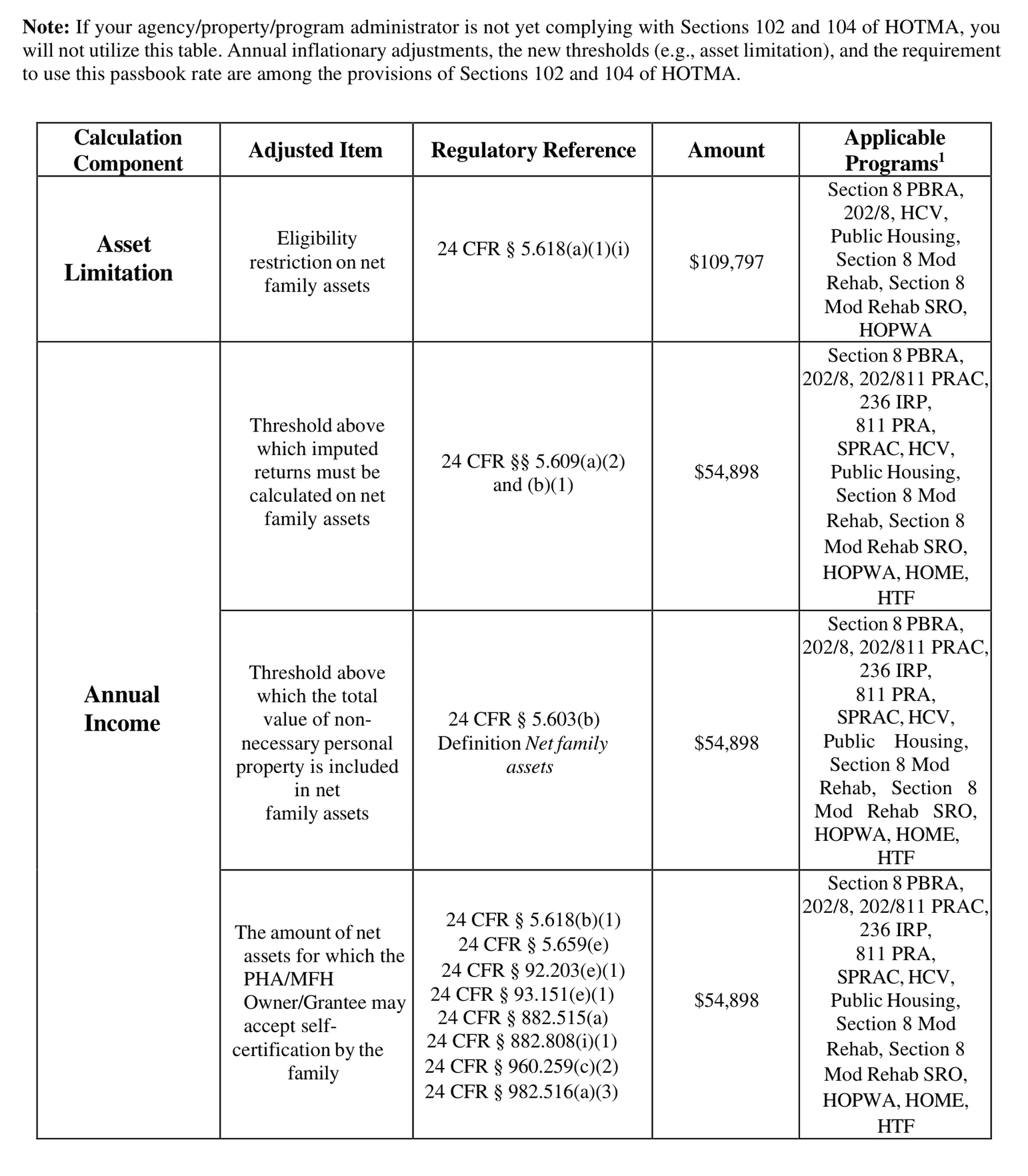
The rule makes a household ineligible when its net assets exceed a cap ($105,574 in 2026, $109,797 in 2027), or when it owns real property it could reasonably live in. And the section containing it limits itself to Section 8 and public housing.
Among CPD programs, only HOPWA is subject to it, and only because part 574 reaches out and cites it by name. HUD said part of this directly in an April 2024 notice: “The asset limitation does not apply to the 202/811 PRAC, 236, 811 PRA, CDBG, HOME, HOME-ARP, HTF, or SPRAC programs.” That list does not mention CoC or ESG. For those two, the answer comes from the silence of parts 576 and 578. HUD’s own annual value tables carry the same answer: the asset-limitation row lists the Section 8 and public housing programs, plus HOPWA, and nothing else.
For a CoC or ESG provider the translation is two sentences. You will count assets differently starting on your compliance date. You will not deny a household for having too many of them.
There is no such thing as triennial recertification
Not in CoC, not in ESG, not in HOME, and not, strictly speaking, anywhere.
The provision people are describing lets an administrator apply the annual cost-of-living adjustment to a household’s fixed income sources instead of redetermining everything, when at least 90% of income is fixed. It does not replace the annual reexamination. The three-year cycle inside it is captioned “Triennial verification” and governs how often you need third-party documentation. Annual reexamination, triennial verification. Those are different things.
It also does not reach most of CPD. The part 5 version is a Section 8 and public housing provision, and parts 576, 578, 92, 93, and 570 never mention it. HOPWA is the exception, and it wrote its own version rather than borrowing one.
A CoC or HOME provider that moves a fixed-income household to a three-year examination cycle is not ahead of the curve. It is out of compliance with its own program’s schedule, and the household may sit at the wrong rent for two years before anyone notices.
What does not change
Your examination schedule. HOTMA did not touch it, and it is what a monitoring team will measure you against.
CoC has two schedules, not one, and people conflate them constantly. For rental assistance, examination is required initially and at least annually, with adjustments as changes in income come to light. For occupancy charges in leasing models, examination is required initially, and the participant may request a review when household composition changes or income drops. If you run both a leasing program and rental assistance, you are running both schedules.
ESG re-evaluates at least every three months for homelessness prevention and at least annually for Rapid Rehousing. HOME examines annually, with source documents at least every sixth year where the participating jurisdiction allows self-certification. HTF works the same way. HOPWA reexamines annually. CDBG has no ongoing recertification at all.
Household composition changes do not trigger a recertification for CPD programs. In April 2026, HUD required an interim reexamination whenever a household member is added or removed, whether or not it changes income, subject to an optional written-policy exception for changes in the last three months of a certification period. That requirement lives in a notice addressed to public housing authorities and multifamily owners. It names no CPD program, and CPD has issued nothing parallel. CoC has had its own composition trigger since 2016, but only on the occupancy-charge side, and it is participant-initiated rather than mandatory.
The guidance gap, and why it exists
We’re suffering from bad HOTMA information because the only detailed HOTMA guidance HUD has published was written for a different set of programs.
In September 2023, HUD’s Office of Public and Indian Housing and its Office of Multifamily Housing jointly issued Notice PIH 2023-27 / H 2023-10, revised the following February. It runs to ten attachments: asset limitation, calculating income, deductions and expenses, fair housing requirements, household composition, income, income exclusions, inflationary adjustments, interim reexaminations, and verification. It has been amended, supplemented with FAQs, and paired with a discretionary policies list and a form instruction booklet. It is, by any measure, a serious piece of implementation support.
It is also addressed to public housing authorities and multifamily owners. It names no CPD program. And it contains this sentence: “CPD will issue separate guidance on how HOTMA impacts its programs.”
That was nearly three years ago. HUD said something similar in a December 2023 Federal Register notice, stating it “intends to issue supplemental guidance to HOME participating jurisdictions and HTF grantees.” As of August 2026, we could not locate either product on HUD Exchange, on hud.gov, or in the CPD notice series.
What CPD grantees have instead is three Federal Register notices about deadlines, a HUD Exchange news item, a HOPWA webinar series, and the CPD Income Eligibility Calculator. For CoC and ESG specifically, the two programs whose regulations most need interpretation because they borrow part 5 in pieces rather than wholesale, the Office of Special Needs Assistance Programs has published nothing. SNAPS was actively issuing notices through 2026, including one on CoC Program registration and one on Unified Funding Agency designation. Neither addressed HOTMA.
The concrete cost of that gap is measurable. The PIH notice tells its readers how to tell necessary from non-necessary personal property. CPD grantees got no equivalent, and the regulation itself does not define the terms. The phase-in hardship is anchored to January 1, 2024, and we could find no guidance on how that anchor works for a grantee starting three years later. The HOME-ARP notice still points at paragraph numbers the 2023 rule renumbered, so a reader who follows the cross-reference lands in the wrong place.
This is a capacity story more than a willingness story, and it is worth saying so plainly. HUD has been operating through a significant reduction in staff. The National Low Income Housing Coalition estimated in April 2025 that roughly 2,300 people, about 23% of the department’s workforce, had retired, been placed on administrative leave, or accepted a deferred-resignation offer in the first four months of that year alone. Later reporting put the reduction higher. CPD was reportedly targeted for the deepest cuts of any office in the agency, though what actually happened has not been confirmed publicly. Over the same period, SNAPS absorbed an extraordinary operational load from the CoC competition litigation: two FY2025 funding notices vacated by a federal court, a prior-year competition reopened under court order in January 2026, three separate rounds of renewal awards between March and May, a congressionally mandated non-competitive renewal, and then the FY2026 notice set aside in its entirety on August 7, 2026.
Update — September 24, 2026: The FY2026 competition is open, and applications are due September 30. On September 16, 2026 the U.S. Court of Appeals for the First Circuit granted HUD a stay pending appeal of the judgment that vacated the notice, so the vacatur is suspended and HUD can implement the notice again while the appeal proceeds (National Alliance to End Homelessness v. HUD, No. 1:26-cv-00436 (D.R.I.), ECF No. 40; appeal Nos. 26-1922 and 26-1923). The panel held that HUD had made a strong showing it is likely to succeed in arguing that the notice’s $1.3 billion set-aside is not a “bonus or other incentive” under 42 U.S.C. § 11386b(d), and found irreparable injury in the fact that HUD “only has until December 1, 2026 to make awards to applicants for Continuum of Care funds.” That December 1 date is the one to plan against. On September 18 HUD reopened the competition with a new application deadline of September 30, 2026 at 8:00 PM ET, leaving the notice otherwise unchanged apart from one technical correction. Separately, HUD published a notice seeking public comment on September 11, 2026 on activities it proposes to incentivize in the CoC Program, with comments due October 13, 2026. We will keep checking this and date each change.
The people who would have written the CPD guidance spent 2025 and 2026 keeping the money moving. That is the right priority. It also means the guidance may not be coming anytime soon, and planning as though it will is not a plan.
Where that leaves you: the regulation is the guidance. Every answer in this article came from reading the program’s own rulebook and following the cross-references. That is a defensible way to work. It is also not a reasonable thing to ask a housing coordinator carrying 40 households to do.
Why this gets harder in CoCs with multiple providers operating housing programs
Because the variance between your providers is not all error. A good deal of it is correct, and correct variance is the kind training cannot fix.
A single-agency program has one interpretation problem: read the rule, decide, train, execute. The lift is real, but the decision happens in one place.
A Continuum of Care does not work that way. CoC Program-funded Rapid Rehousing, Permanent Supportive Housing, ESG-funded Rapid Rehousing, and HOME tenant-based rental assistance may be operated by multiple agencies in the same community, each with its own staff, documentation practices, and reading of the rules. Locally funded programs add another layer: will they adopt HUD’s requirements for consistency, or keep their flexibility? Will we inspect one unit using habitability standards, one with HQS, and one with NSPIRE at the same property? How do we explain that to landlords, when centralized landlord engagement depends on giving them one answer?
Put HOTMA into that system and two things happen at once.
The first is ordinary inconsistent program execution: two program leaders reading the same guidance and arriving at different, internally consistent answers about where necessary personal property ends or which examination schedule governs a household whose unit is paid for by two funding streams.

The second is stranger and more consequential. The same household, with the same income and the same savings, is genuinely supposed to be treated differently depending on which funding stream pays for the unit. A CoC Rapid Rehousing household cannot be denied for assets above $105,574. A HOPWA household can. A HOME tenant-based household may be offered a hardship exemption. A CoC Permanent Supportive Housing household may not. No amount of staff training resolves that, because there is nothing to resolve. The rules differ.
That distinction matters for what you do next. If all the variance were error, more training would help. Because much of it is correct, the only thing that helps is making sure the right rule reaches the right enrollment every time, and that the file shows which rule was applied and why.
The challenge here is not effort. Program leaders and specialists are not applying the wrong asset rule because they do not care. They are applying it because someone handed them a HOTMA training built from the only guidance HUD published, and nothing in that training said “this part is not yours.”
What structured housing assistance program execution does in response
It moves the rule out of staff’s memory and into the process, so the participant’s funding stream decides which rule applies before anyone has to remember that it should.
There is a useful way to think about where a system sits. Most homelessness response systems move through four states as they mature: reactive, where each situation is handled as it arrives; aligned, where everyone has been trained on the same policy; structured, where the policy is built into the process people actually follow; and predictable, where the output is consistent enough that leadership can plan against it and a monitoring visit holds no surprises.
Training gets a system from reactive to aligned. It does not get it to structured, because alignment lives in people and people rotate. In a sector with the turnover ours has, a system that depends on what each program leader and their team remembers is a system that resets every time someone leaves.
This is the case for building the administration of rental assistance around the program rather than around the worker. Padmission Journey is the operational software our customers use to run eligibility determinations, income examinations and rent calculations, payments, inspections, and the documentation behind all of it. What matters for HOTMA is narrower and more specific than “it handles compliance.”
It applies the deduction set the participant’s program actually uses. A CoC enrollment gets the mandatory deductions and nothing else. A HOME tenant-based enrollment gets those plus the hardship process, if the participating jurisdiction adopted it. A HOPWA enrollment gets the broader set. An ESG or HTF enrollment gets no adjusted income calculation, because neither program has one.
It does not show a screen that does not apply. The asset cap and real-property questions appear on a HOPWA enrollment. They do not appear on a CoC enrollment, which is the point, because a screen that exists is a screen someone eventually fills in.
It keeps the annual figures current. The deduction amounts, thresholds, and passbook savings rate change every January. They change once, centrally, and take effect on the day they apply rather than whenever each provider’s policy manual catches up.
And it produces the record while the work happens. Which rule was applied, which program it came from, what the household reported, when the notice went out. Audit readiness is not something you assemble in the three weeks before a monitoring visit. It is a property of how the work was done.
What changes in practice is quieter than a feature list suggests. A team member processing an annual reexamination applies the right methodology because the process carries it, not because she remembered which rule attaches to which funding stream. A program director manages the exceptions the system surfaces instead of spot-checking whether staff applied the right process. A CoC executive can answer “are we consistent across providers” without reconstructing case files to find out.
Where this is heading: centralized rental assistance administration
CoCs that will handle the next rule change well are the ones that stopped administering rental assistance separately in each agency.
HOTMA is not an unusual event. It is what the next decade looks like. NSPIRE reaches CoC and ESG on October 1, 2026, and HOME and HTF in April 2027, which puts many communities on two compliance clocks at once. Income limits and deduction amounts now adjust every January. The CoC competition itself has had three funding notices set aside by a federal court since last November, though the ruling against the most recent was stayed on appeal on September 16, 2026, putting that notice back in force. Each of these lands on the same administrative surface, and each one arrives with a different scope, a different deadline, and, increasingly, different guidance depending on which office at HUD wrote it.
A system that absorbs each change agency by agency pays the cost every time. Twelve providers means twelve policy updates, twelve training sessions, twelve interpretations, and twelve documentation practices that a monitoring team will compare against each other. The cost is not just the work. It is that the community cannot answer basic questions about itself without a reconstruction project.
Centralizing housing assistance program execution changes the arithmetic. The rule gets interpreted once, by people who read regulations for a living. It gets built into the process once. It reaches every provider on the same day. And when a household moves between programs, from Rapid Rehousing to Permanent Supportive Housing or from an ESG-funded assisted tenancy to a CoC-funded one, the transition is a change in which rules apply, not a change in which system holds the record.
This is already the direction we’re headed. Communities are consolidating financial assistance administration at the CoC level, contracting it to a single fiscal agent, or standing up shared operations across a provider network. What they are buying is operational predictability: the ability to say what will happen when the next rule changes, before it changes.
Modern housing systems are designed, not improvised. HOTMA is a good test of which one a community has, because it is complicated enough that improvisation shows.
Questions practitioners are asking
Does the HOTMA asset limit apply to CoC programs?
No. The $105,574 net asset cap and the real-property ownership bar are in 24 CFR 5.618, which limits itself to Section 8 and public housing, and parts 576 and 578 never cite it. Among CPD programs only HOPWA is subject to it. What does apply to CoC is the asset counting framework: necessary property excluded, non-necessary property counted once its combined value passes $52,787 in 2026, and imputed income at the published passbook rate.
Do the HOTMA hardship exemptions apply to CoC or ESG?
No to both. CoC’s regulation borrows paragraph (a) of the deduction rule (the mandatory deductions) and not paragraphs (c) through (e), where the hardship exemptions live. ESG calculates no adjusted income at all, so there is nothing for an exemption to attach to. HOME participating jurisdictions and HOPWA grantees may adopt them at their option.
Which households qualify for triennial recertification under HOTMA?
None, because triennial recertification does not exist. The provision people mean is a shortcut for households whose income is at least 90% fixed: apply the cost-of-living adjustment instead of redetermining everything, with third-party verification of all income every three years. The annual reexamination stays. Among CPD programs only HOPWA has a version of it.
What is the HOTMA deadline for CoC and ESG programs?
January 1, 2027, and that is the outer bound, not a start date. Grantees have been permitted to comply any time since January 1, 2024. Public housing authorities and multifamily owners are on the same 2027 date, with carve-outs for Moving to Work agencies and agencies still using HUD’s Family Reporting Software.
What do we have to do right now, before 2027?
Apply the 29 federally mandated income exclusions, which took effect January 31, 2024 and cannot be deferred. Then decide on the income safe harbor, which lets you rely on a determination another means-tested federal program made in the past 12 months. It is optional and available today, but HUD requires you to update your program guidelines and put policies and procedures in writing describing how you will verify income under it before you start using it.
Does HOTMA apply to SSVF?
No. SSVF is a Department of Veterans Affairs program under 38 CFR part 62, not a HUD CPD program. An agency running SSVF alongside CoC or ESG will be operating two income determination frameworks after the compliance date.
Where do we send a question HUD has not answered?
CPD_HOTMA@hud.gov for CPD programs. Public housing authorities and multifamily owners use HOTMAQuestions@hud.gov. Two questions worth sending: how the January 1, 2024 anchor on the phase-in hardship works for a grantee implementing in 2027, and where HUD draws the line between necessary and non-necessary personal property for CPD programs.
What to do next
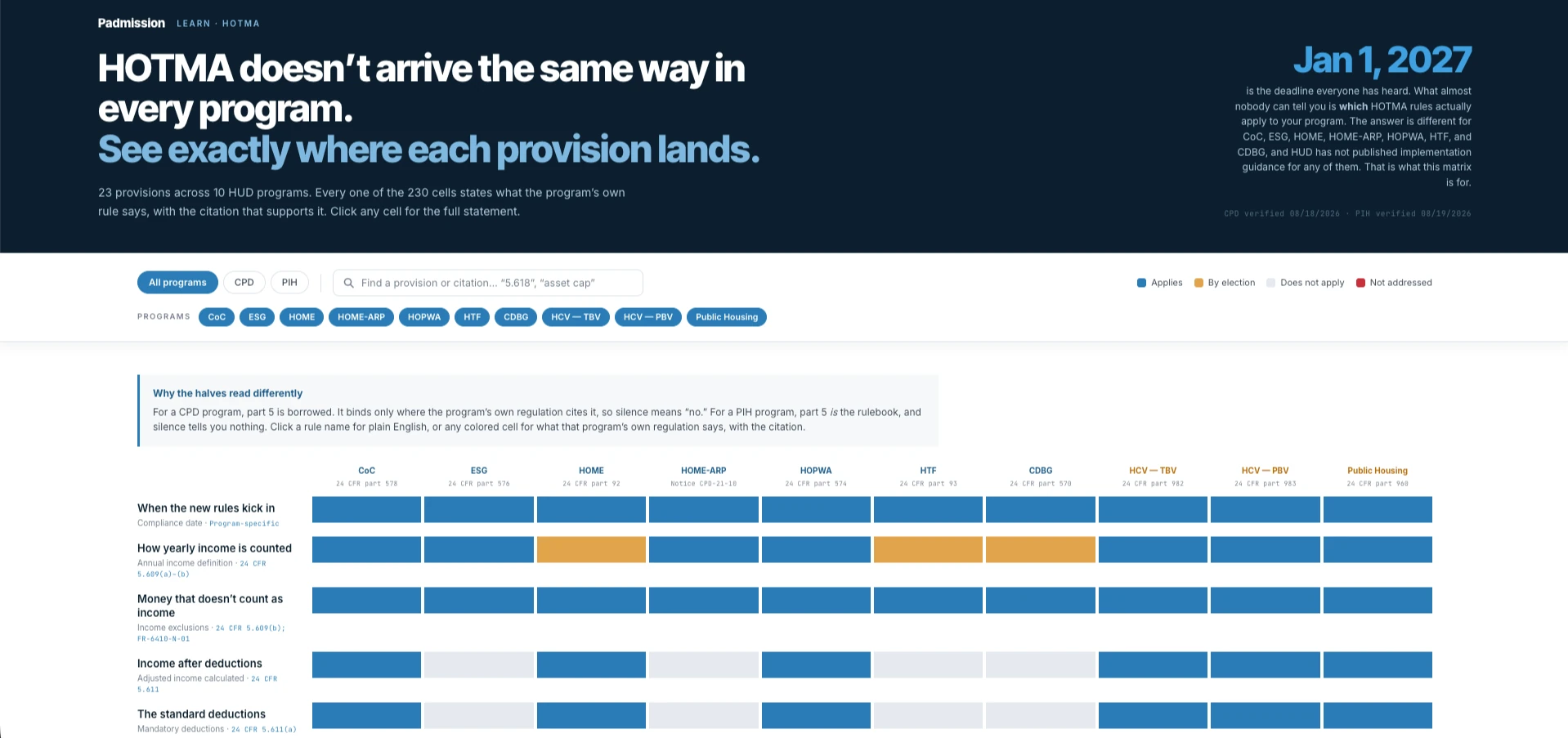
Start by finding out which rules are actually yours. We published a provision-by-program applicability matrix alongside this article, with a citation in every cell and a plain statement of whether each provision applies, is available at your option, or does not reach you. It covers CoC, ESG, HOME, HOME-ARP, HOPWA, HTF, and CDBG, and now the Housing Choice Voucher, project-based voucher, and public housing programs as well, for communities that administer both.
Take it to your compliance lead and your provider network and work through the rows that touch your programs. The rows to check first are the ones where a wrong answer affects a household: the asset cap, the real-property bar, the hardship exemptions, and your examination schedule.
Then ask the harder question, which is not about HOTMA at all. If a rule changed tomorrow, how long would it take to reach every provider in our system, and how would we know it had? If the honest answer involves a policy memo and hoping, the problem the next rule change will expose is not knowledge. It is structure.
If you want to talk through what coordinated program administration looks like across a provider network before January, we are glad to have that conversation.
Read next: centralized rental assistance administration, the system-level view of running rental assistance consistently across a distributed provider network. See also NSPIRE compliance for CoC and ESG programs and audit readiness in housing programs. Learn more about housing assistance program execution in Padmission Journey.
A note on sources, and on us
Every regulatory statement in this article was verified against the current text of the regulation or the HUD notice it comes from, on August 18 and 19, 2026. Where HUD has not answered a question, we say so rather than inferring an answer. Where a conclusion is our reading rather than HUD’s words, the matrix labels it that way.
This article is a regulatory summary prepared for planning purposes and is not legal advice. Confirm program-specific questions with your HUD CPD field office.
Sources
Regulations, current text as of August 2026
- 24 CFR part 5, subpart F: §§ 5.601, 5.603, 5.609, 5.611, 5.618, 5.628, 5.630, 5.657, 5.659
- 24 CFR 578.77 (CoC) · 576.401 (ESG) · 92.203 and 92.252 (HOME) · 93.151 and 93.302 (HTF) · 574.310 (HOPWA) · 570.3 (CDBG)
Federal Register
- 88 FR 9600 (February 14, 2023): HOTMA final rule, sections 102, 103, and 104
- FR-6410-N-01, 89 FR 6126 (January 31, 2024): Federally Mandated Exclusions From Income
- FR-6449-N-01, 89 FR 27440 (April 17, 2024): annual inflationary adjustment methodology
- 88 FR 85648 (December 8, 2023): first CPD compliance date extension
- FR 2024-31401 (December 31, 2024): CPD safe harbor implementation
- FR 2025-23989 (December 30, 2025): CPD compliance date extended to January 1, 2027
- FR 2025-18988 (September 30, 2025) and FR 2026-07176 (April 14, 2026): NSPIRE dates for CPD programs
HUD notices and guidance
- Notice PIH 2023-27 / H 2023-10: HOTMA sections 102 and 104 implementation guidance, Attachments A–J
- Notice PIH 2024-38 (December 17, 2024) and Notice PIH 2026-15 (May 14, 2026): PHA compliance dates
- Notice PIH 2026-09 / H 2026-05 (April 2026): interim reexaminations on household composition change
- Notice CPD-21-10: HOME-ARP program requirements
- HUD Exchange: CPD Guidance on Income Determinations (February 6, 2024)
- HUD CY2026 and CY2027 Inflation-Adjusted Values and Passbook Rate
Context
- National Low Income Housing Coalition: reporting on HUD workforce reductions, 2025
- HUD CoC Program Competition page: FY2025 and FY2026 competition status, the reopened FY2026 deadline, renewal award announcements (checked September 24, 2026)
- FR Doc. 2026-18555 — Notice of Research Justifying Additional Incentives for Certain Activities To Reduce Homelessness (September 11, 2026), comments due October 13, 2026
- National Alliance to End Homelessness v. HUD and State of Washington v. HUD (D.R.I. 2026)
- National Alliance to End Homelessness v. HUD, No. 1:26-cv-00436 (D.R.I.), ECF No. 40 — First Circuit order granting a stay pending appeal (September 16, 2026)