Landlord engagement represents one of the most underappreciated yet critical functions within homelessness response infrastructure. For Continuums of Care (CoCs)—the regional coordinators of federal homelessness funding—the capacity to cultivate and manage property owner relationships fundamentally determines whether rental assistance transforms into actual housing placements. Fragmented landlord engagement across multiple agencies severely constrains housing access.
Implementing centralized landlord engagement strategies expands available housing stock, improves search effectiveness, and boosts lease-up conversion rates throughout the system. This guide demonstrates how systemwide landlord engagement coordination can consolidate fragmented outreach into unified housing access infrastructure for homelessness response.
Why Centralized Landlord Engagement Determines System Success
Housing First programs achieve the strongest outcomes in homelessness intervention, converting public resources into “leases and sustained tenancies.” However, most CoCs encounter a different bottleneck: reliable unit access and consistent landlord relationships. Housing supply represents the foundation upon which everything else depends.
When supply becomes unstable, consequences cascade rapidly. Search timelines extend. Program utilization declines. Shelter beds turn over slower. The system stalls.
After Maricopa County implemented centralized engagement, TJ Reed, Human Services Assistant Director, observed: “Once there were more properties and units available for our provider partners to use, we knew we could start to dream bigger and fund with more confidence.”
What Centralization Actually Means
Centralization does not mean control—it means shared system assets.
When coordinated, property relationships transcend individual agencies, becoming visible across all providers. This reduces duplicated outreach and internal competition. Institutional knowledge persists beyond staff transitions. Smaller providers access opportunities they could not independently develop.
Landlord Engagement vs. Housing Search
These represent distinct but complementary functions:
- Landlord engagement creates housing opportunities
- Housing search connects participants to those opportunities
Centralizing search without strengthening landlord engagement simply redistributes limited units. Conversely, centralizing engagement without coordinated search leaves new opportunities unevenly distributed. The search side has its own sequence, set out in a seven-step housing search strategy for CoCs.
When Housing Supply Remains Limited
Communities where landlord engagement developed organically within individual programs face predictable challenges:
- Housing navigators maintain personal networks
- Programs guard landlord information
- Relationships become informally protected
- Competition emerges among providers for identical units
- Systems develop “pocket landlords” known to select agencies
This fragmentation creates counterproductive dynamics. When housing scarcity forces providers to compete against themselves, they withhold information and avoid introducing landlords to broader networks.
Housing Supply Constraints Shape Geographic Placement
Limited recruitment concentrates placements in identical neighborhoods. Participants repeatedly access the same properties, returning to familiar areas because those represent reliable availability within their agency.
Over time, scattered-site programs resemble de facto project-based models. Participant choice narrows. Geographic diversity declines. Properties become oversaturated. Without deliberate network expansion, systems recycle rather than increase supply.
Why Landlord Engagement Becomes System-Level Necessity
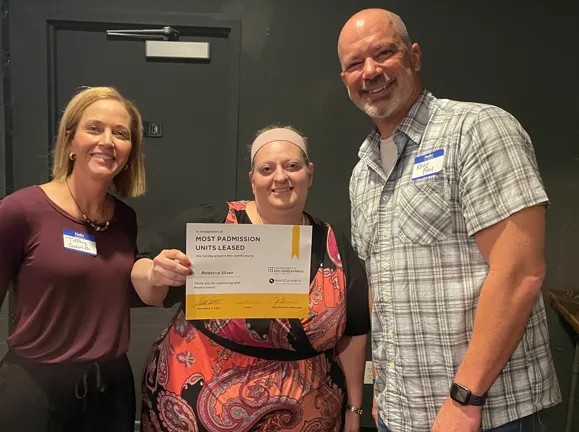
As housing programs expand, property partners disengage—not from opposition but from navigation difficulty.
Tiffany Gehrlich, RentConnect Manager at Strategies to End Homelessness, described Cincinnati’s pre-centralization reality: “If a property provider had open units and their limited contacts couldn’t use them, they went to market renters when we know there were other agencies that could have used them.”
Centralization represents a structural response. Rather than parallel outreach across dozens of providers, communities establish coordinated functions responsible for developing sustained property partnerships system-wide.
Evaluating Landlord Engagement Strategies
Practical evaluation considers one essential question: Does this approach encourage compounding property owner engagement or does it rely on individual provider recruitment?
High-performing systems consistently demonstrate these characteristics:
- They increase performance by adding expertise and capacity
- They tailor resources to actual business needs
- They make limited resources work harder
- They reduce complexity rather than shifting it
- They amplify human judgment
- They support consistent housing access over time
Property Owners as System Stakeholders
Sustainable engagement treats property partners as participants in system design, not recruitment targets.
Breya Birdsong, Vice President of Rental Assistance Programs at RDOOR Housing: “Landlords round out the rehousing team—they are not external to the process.”
High-performing systems gather feedback from participating and disengaged partners through surveys and listening sessions. These conversations surface operational friction around timelines, communication, documentation, and unresolved issues.
Partnering With Real Estate Associations
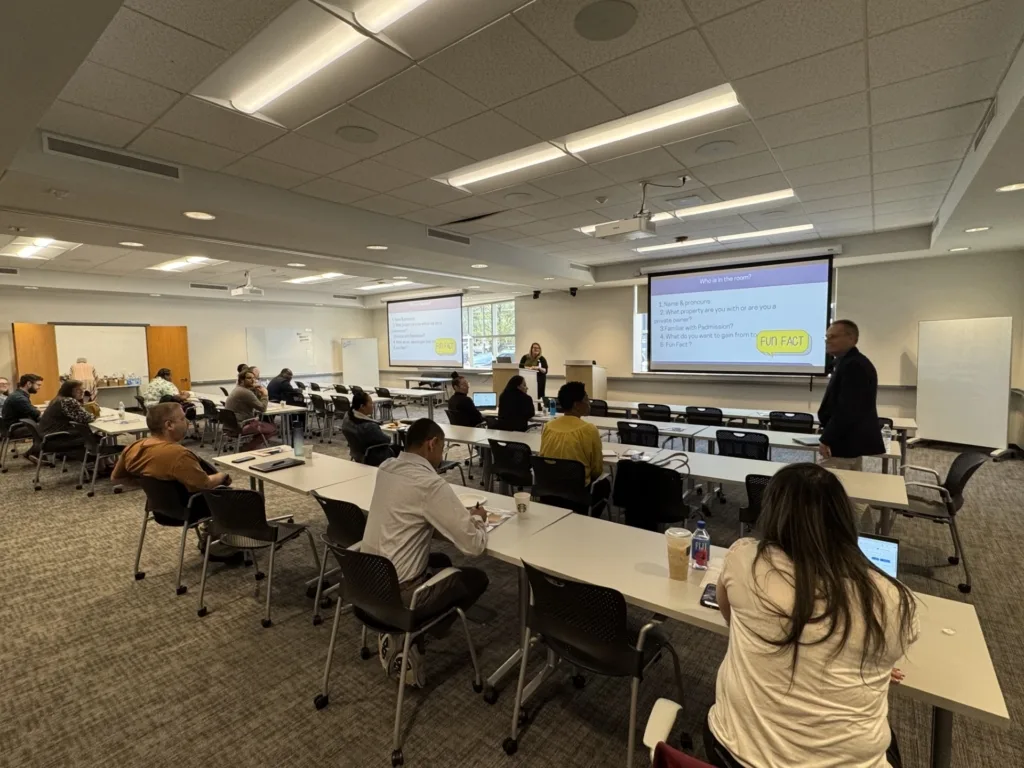
Local real estate and apartment associations represent substantial portions of professional rental housing markets. Organizations affiliated with the National Apartment Association provide direct access to property owners, portfolio operators, and leasing professionals managing thousands of units collectively.
Association partnerships enable CoCs to reach housing providers through trusted professional networks rather than property-by-property approaches. Association meetings and educational sessions explain program operations, address misconceptions, and establish contact points.
These relationships signal credible, organized system-level engagement. They create channels for ongoing communication about policy changes and success stories. They normalize program participation within the broader rental ecosystem and facilitate dialogue about inspections, payment timelines, and risk mitigation.
How Centralization Changes Daily Work
When engagement becomes coordinated, impacts appear in routine operations.
Property owners experience predictable communication and clear participation expectations. For housing navigators, search shifts from information-chasing to helping participants evaluate real options supported by shared inventory.
Kimberly Doty, Director of Housing at Partnership Home: “We can pick up where someone else has left off in connecting with a property.”
This structure reduces rework and enables programs to operate from shared information.
Professionalizing Landlord Engagement
Property owners operate businesses. Sustainable engagement responds with consistent business solutions rather than informality.
Many communities strengthen teams by hiring staff with property management or real estate experience. Professionals understanding property management practices, owner priorities, and market dynamics engage more effectively.
Property partners understand onboarding processes, realistic timelines, and problem-resolution approaches. Consistent communication allows trust to compound rather than reset with each interaction.
Understanding Property Partner Diversity
Property owners represent diverse audiences. Independent owner-operators prioritize simplicity and responsiveness. Mid-size companies value efficiency. Large portfolios emphasize compliance and consistent processes.
When systems fail recognizing these differences, supply concentrates among small property groups. Intentional segmentation enables broader market participation.
Identifying and Sustaining Housing Supply
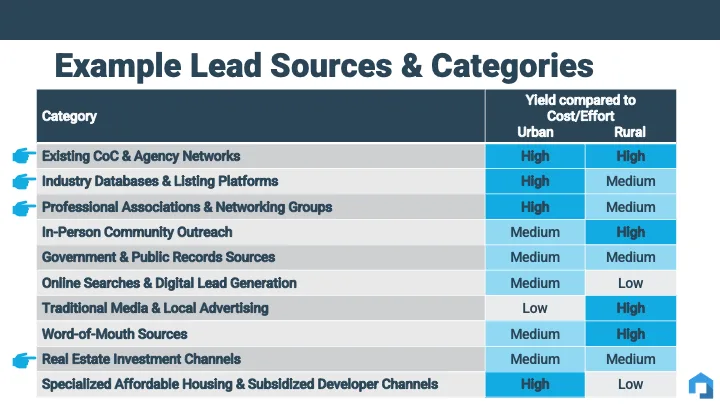
Centralized strategies only succeed as effectively as their housing supply recruitment and retention. This requires understanding which outreach sources produce active opportunities and sustained participation.
Different markets produce different recruitment patterns. Urban markets generate high lead volume but varying conversion rates. Rural markets produce fewer leads but potentially more stable relationships once established.
Common recruitment sources include:
- Online rental listings and platforms
- Property management companies
- Real estate brokers
- Apartment associations
- Existing partner referrals
- Community information sessions
Effective programs track which sources convert to lease-ups, produce long-term partners, and consume staff time without results. This enables focused effort allocation rather than anecdotal impressions.
Identifying Decision Makers
Effective engagement depends less on outreach volume than on reaching appropriate decision-makers. Many efforts stall because staff connect with contacts lacking participation authority.
Decision authority varies significantly. Independent owners decide directly. Larger portfolios distribute authority across regional managers, asset managers, or compliance teams. Leasing agents may lack approval power.
High-performing teams invest early in identifying actual decision-makers through direct questions, ownership research, or management hierarchy tracing. This information becomes institutional knowledge, allowing future outreach to begin at appropriate authority levels.
Identifying decision-makers signals respect for property business operations. Conversations focus on timelines, expectations, and partnerships rather than repeatedly explaining program details to unauthorized contacts.
Implementing Centralized Landlord Engagement
Implementation succeeds when providers, system leadership, and housing market partners understand how coordination tangibly changes work. Since centralization reshapes established practices, stakeholder engagement proves essential.
Developing Provider Buy-In
Provider participation represents the most critical implementation factor. Housing navigators and program teams have invested years building relationships and navigating markets. Centralization can feel threatening to those relationships.
Successful systems demonstrate how centralization strengthens relationships through shared visibility and reduced competition. Provider buy-in grows when staff observe reduced daily friction. Shared visibility means less verification time. Smaller organizations access opportunities previously unavailable. Work shifts from lead-chasing to preparing participants for informed evaluation.
Three communities have written up how that went in practice. RentSelect brought more than 90 landlords and 29,000 units onto one platform across 25+ partner agencies in Montgomery County, NMCEH cut housing search time from 90 days to 46 in Albuquerque, and the CNY CHANCE program in Syracuse designed theirs for system-level coordination from the start.
Implementation often begins with early-adopter providers who refine workflows before broader rollout, demonstrating practical improvements.
Securing Executive Support
Centralized landlord engagement requires visible system leadership support. CoC leadership, provider executives, public officials, housing coalitions, and housing authorities establish conditions enabling coordination.
Executive support matters because landlord engagement intersects multiple systems: housing programs, inspections, payments, and compliance. Cross-sector alignment ensures property partners experience consistent expectations.
Private sector engagement proves equally important. Property associations, large portfolio owners, and regional housing organizations influence property owner participation decisions. When these partners understand centralization goals and observe system investment in predictable communication and clear processes, they view participation as credible partnership rather than temporary initiative.
Leveraging Trusted Brands
Landlord engagement efforts gain traction operating under recognizable identities representing entire systems rather than disconnected program outreach.
Shared brands enable property partners understanding they interact with coordinated initiatives rather than multiple programs. They reinforce consistent communication, messaging, and expectations across agencies.
Some communities establish new initiatives; others leverage existing partnerships with property owner credibility. Branding clarifies rather than markets—helping property owners understand system operations and partnership identity.
Recognizable initiatives enable public progress communication, property partner celebration, and momentum building around landlord engagement.
When launching separate brands, administering organizations boost visibility through their channels. In Wichita, NEXTenant gained momentum after United Way of the Plains amplified its brand across social media, generating news coverage and 15 new property operator participants within one week.
Implementation succeeds when these elements reinforce one another. Provider alignment ensures effective supply utilization. Executive leadership creates consistency and accountability conditions. Public initiatives make participation understandable to housing markets.
Measuring System Strengthening
Effective systems measure outcomes rather than activity. Activity metrics—calls made, events attended—can appear productive while supply stagnates. Outcome metrics reveal actual access expansion, faster placement timelines, and broader housing market reach.
Threshold, Arizona’s centralized landlord engagement service, recruited 611 new property owners and operators, adding 1,648 available units across 118 ZIP codes—enabling 3,313 households to move from streets into housing. Lease-up conversion rose from 67.3% to 84.3%, and move-in timelines improved 27 days from 2021 baseline.
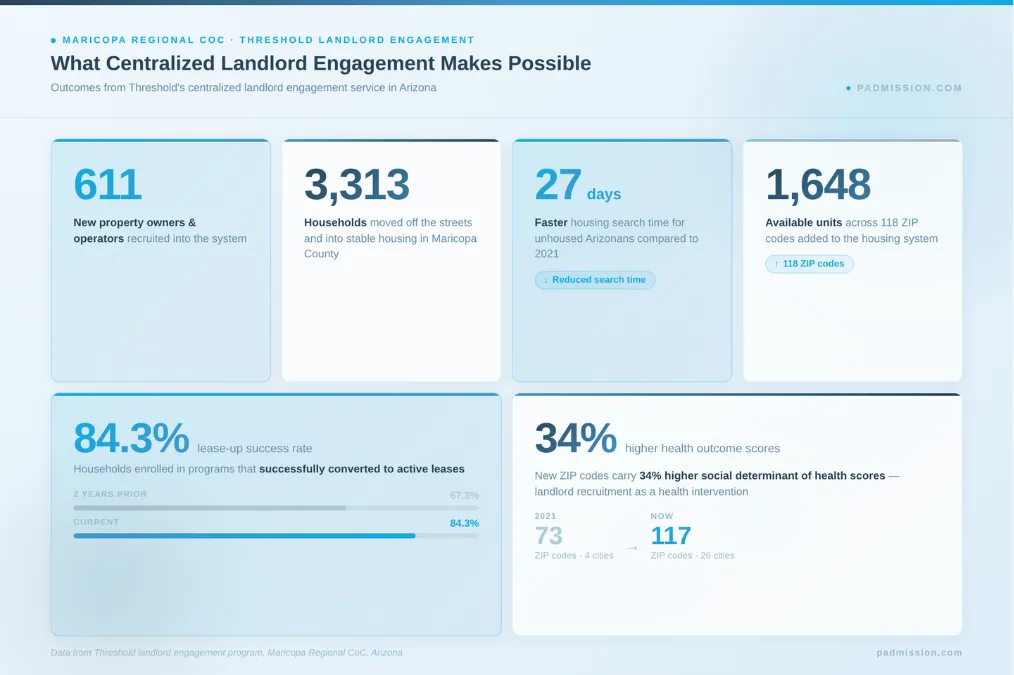
Geographic diversification represents critical measurement often overlooked. Neighborhood conditions—transportation access, employment, food availability, community services—powerfully predict long-term stability. Maricopa County identified expanding available property geographic footprint as core outcome. Threshold now connects participants to properties across 117 ZIP codes in 26 cities/municipalities compared to 73 ZIP codes across 4 cities in 2021. Newly added ZIP codes carried 34% higher social determinant health scores—making landlord recruitment a health intervention.
Useful measurement frameworks track six indicators:
- Active property partners over time
- Lead source and recruitment yield
- Reasons operators accept/decline participation
- Housing search duration
- Lease-up success rates against households enrolled
- Geographic placement diversification
Building Landlord Engagement as Permanent Function
Implementation establishes operational conditions. Over time, centralized practices should become stable, ongoing housing system functions—not campaigns.
Centralized landlord engagement represents the permanent entry point where property owners participate in housing programs.
Systems investing in predictable processes, shared records, and consistent communication shift from reactive scrambling to stable capacity building. Housing access grows evenly. Staff burnout decreases. Property partners experience professionalism rather than chaos.
These structural changes enable housing systems sustaining operations as expectations increase and markets tighten.
Landlord engagement strengthens provider environments without replacing provider work. When housing supply becomes coordinated and relationships sustained, programs focus on intended outcomes: moving people into housing and maintaining stability rather than navigating fragmented access.
The same argument applies on the assistance side of the house: see centralized rental assistance administration for how communities consolidate the program administration that follows a placement, and administering housing programs for what that work involves day to day.
How Padmission Connect Supports Centralized Landlord Engagement
Padmission Connect operationalizes centralized landlord engagement by providing landlord engagement teams shared records of property outreach, participation history, available units, and housing search activity across providers. This structure supports coordinated property engagement, broader housing access, and stronger continuity despite staff changes—without shifting local placement decisions or relationship ownership.
Key Principles & Takeaways
-
Landlord engagement functions as housing infrastructure, not program activity. Treating engagement as a system function with shared records and coordinated outreach converts it from variable into stable foundation.
-
Centralization expands access without shifting local decision-making. The goal ensures housing opportunity visibility, relationship persistence beyond staff tenure, and smaller provider access to independent development-level supply.
-
Property owners represent system stakeholders, not recruitment targets. Their operational feedback on timelines, communication, inspection, and payment reliability directly shapes whether programs remain viable rental market partners.
-
Housing supply quality matters equally to volume. Expanding networks preserves participant choice, maintains geographic diversity, and prevents placement concentration undermining scattered-site models.
-
Effective engagement requires reaching appropriate decision-makers. Outreach volume does not determine supply building—decision-maker access does.
-
Measurement tracks outcomes, not activity. Useful indicators reveal which strategies produce durable access versus those consuming capacity without outcome improvement.