
HUD Continuum of Care and Emergency Solutions Grants programs are required to comply with NSPIRE on October 1, 2026, roughly eight weeks from now. HUD set that date in a Federal Register notice published September 30, 2025, and said in the same notice that it intended to publish CoC- and ESG-specific NSPIRE standards before the date arrived.
As of the first week of August 2026, those standards have not been published. A sweep of every NSPIRE document in the Federal Register this year returns the HOME and HTF standards notice and a HOME streamlining rule, and nothing addressing CoC or ESG.
NSPIRE CoC compliance currently means preparing against the general standards at 24 CFR part 5 subpart G and the voucher-program inspection checklist, used as a proxy for guidance written for PHAs’ Housing Choice Voucher programs. For a CoC director, that is a governance problem before it is an inspection problem, because you are being asked to certify readiness against a target that has not been finalized.
Every comparable program received its standards before its date
The pattern across CPD makes the gap easier to see.
| Program | Standards published | Compliance date |
|---|---|---|
| HOPWA | August 5, 2025 | February 2, 2026 (in effect) |
| HOME and HTF | April 14, 2026 | Approximately April 14, 2027 |
| CoC and ESG | Not published | October 1, 2026 |
| HCV, PBV, Mod Rehab | Voucher checklist and PIH 2026-18 | February 1, 2027 |
HOPWA got six months between its tailored standards and its date. HOME and HTF got twelve, because HUD published their standards and extended their deadline by a year in the same notice on the same day. When HUD published program-specific standards late, it moved the date in the same document.
This is the fifth date, not the first
CPD programs have been given a NSPIRE compliance date four times before.
The final rule set the date at October 1, 2023. A notice in September 2023 moved CPD to October 1, 2024. A notice in July 2024 moved it to October 1, 2025. The notice in September 2025 moved it to October 1, 2026, and moved the voucher programs separately to February 1, 2027.
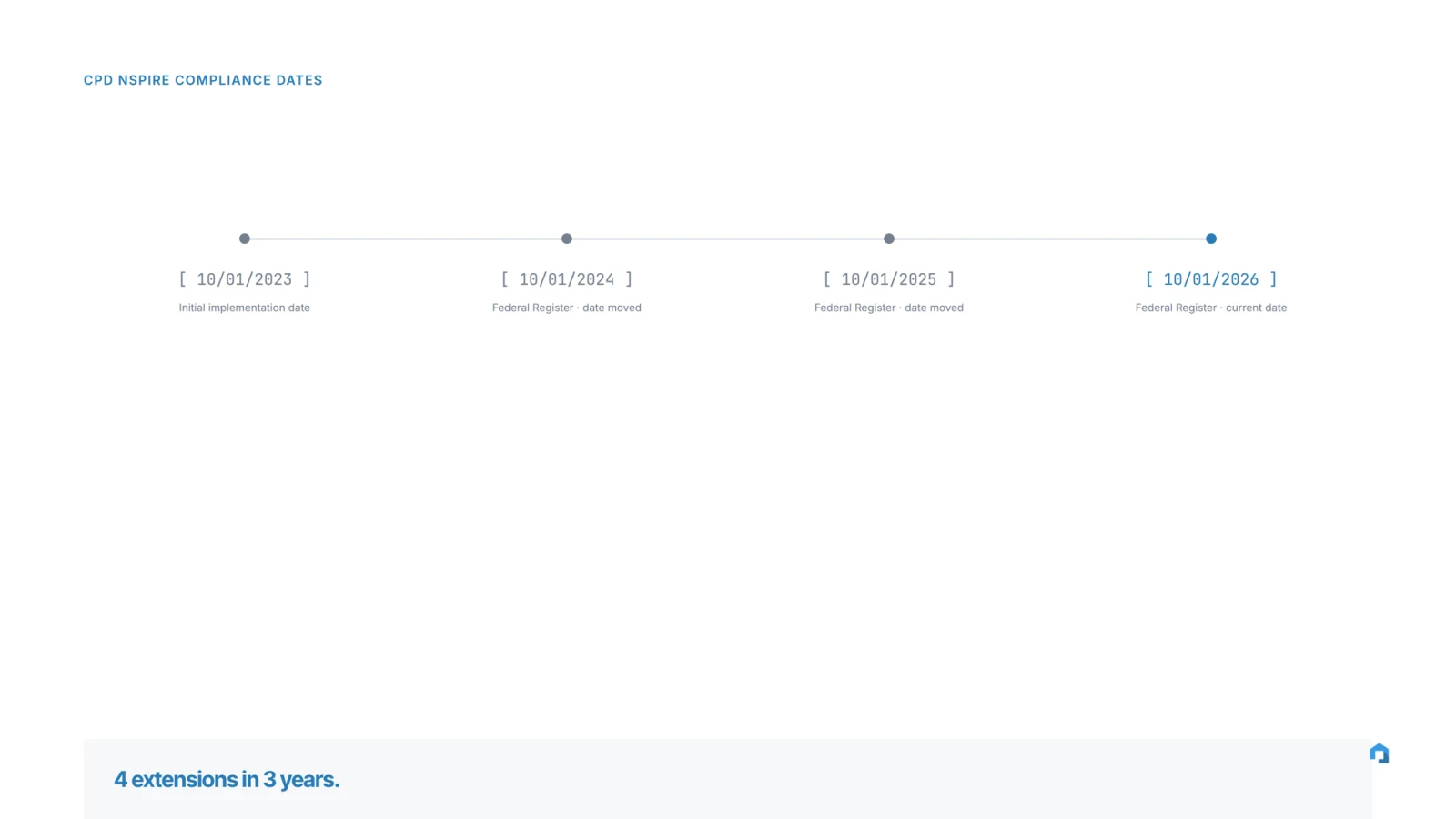
Two consecutive extensions are a delay. Four is a pattern, and pattern is what a program executive is actually forecasting against. But a pattern is not a commitment, and there is a version of this where the standards notice lands in September and the date holds.
Both bets have a cost. Build against the general standards now and you may spend effort against criteria that shift. Wait for the notice and you may have three weeks to retrain inspectors, notify landlords, and start retrofit conversations across every provider in your network.
The uncertainty isn’t evenly distributed across the work. What a late standards notice would change is which deficiencies get cited and at what severity, which is field-level detail. What it would not change is that your providers need one inspection vocabulary, that your landlords need a retrofit conversation, and that your record needs to show which standard each inspection ran under. Almost everything a CoC has to organize is stable regardless of what the notice says. The instinct to wait treats the whole project as uncertain when only the last mile is.
What you can decide now, whatever HUD publishes
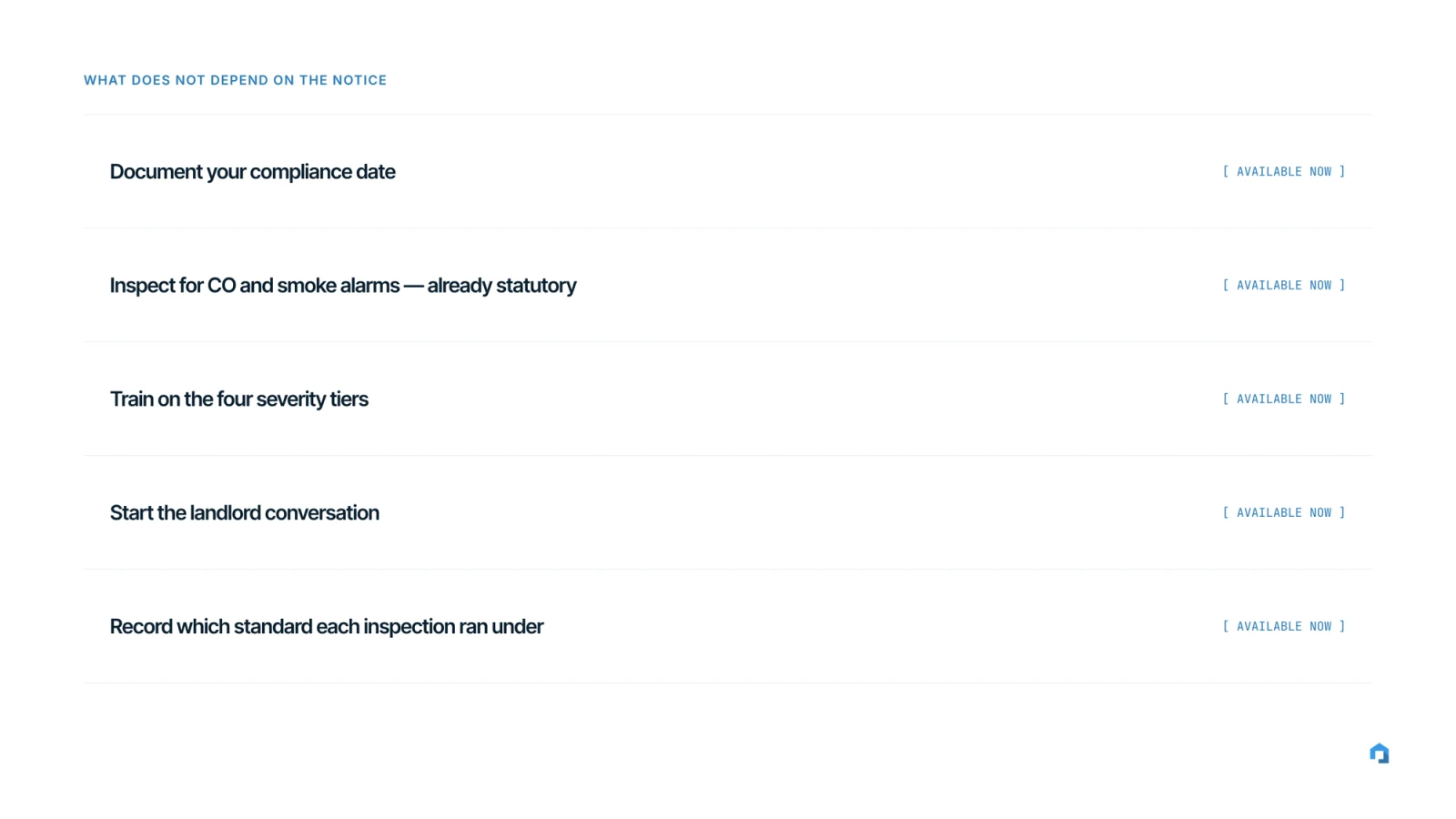
Your compliance date, and the record of it. CPD grantees adopting NSPIRE before the required date must document the chosen compliance date in program records. That obligation exists now and does not depend on the standards notice. If you have not made this decision explicitly, it is being made by default.
The alarm requirements, which are already law. Carbon monoxide alarms have been enforceable since December 27, 2022, and hardwired or sealed 10-year-battery smoke alarms since December 29, 2024. Both come from statute, not from NSPIRE, and both bind your programs today regardless of which inspection standard you are running. The HUD-52580 forms most HQS programs still use do not cover either one. If your checklist predates them, your inspections are already behind the law, and this is the single most common category of NSPIRE failure that PHAs report.
One inspection vocabulary across your providers. Whatever the CoC standards say, they will use the four severity tiers and the correction clocks defined in part 5. Your provider agencies can be trained on that structure now.
The landlord conversation. The retrofit list is stable: sealed-battery or hardwired alarms in the right locations, CO alarms, GFCI protection near water, water-heater discharge piping. These are the highest-volume failures wherever NSPIRE has already landed. Owners need lead time, which is exactly what a late notice takes away from you.
Which standard each inspection ran under. In the Housing Choice Voucher program, HUD codified the transition rule: a unit stays subject to the standard in effect when it was inspected until that inspection fully resolves. A unit failed under HQS in May is reinspected under HQS in June. Your records need to carry that distinction, and mixed-portfolio CoCs will be running two standards side by side for months.
In practice: the mixed-portfolio problem most CoCs are about to have
Assume the dates hold. A community running the full range of funding is looking at this:
- HOPWA units: already under NSPIRE since February 2026
- CoC and ESG: October 1, 2026
- Housing Choice Vouchers: February 1, 2027
- HOME and HTF: approximately April 2027
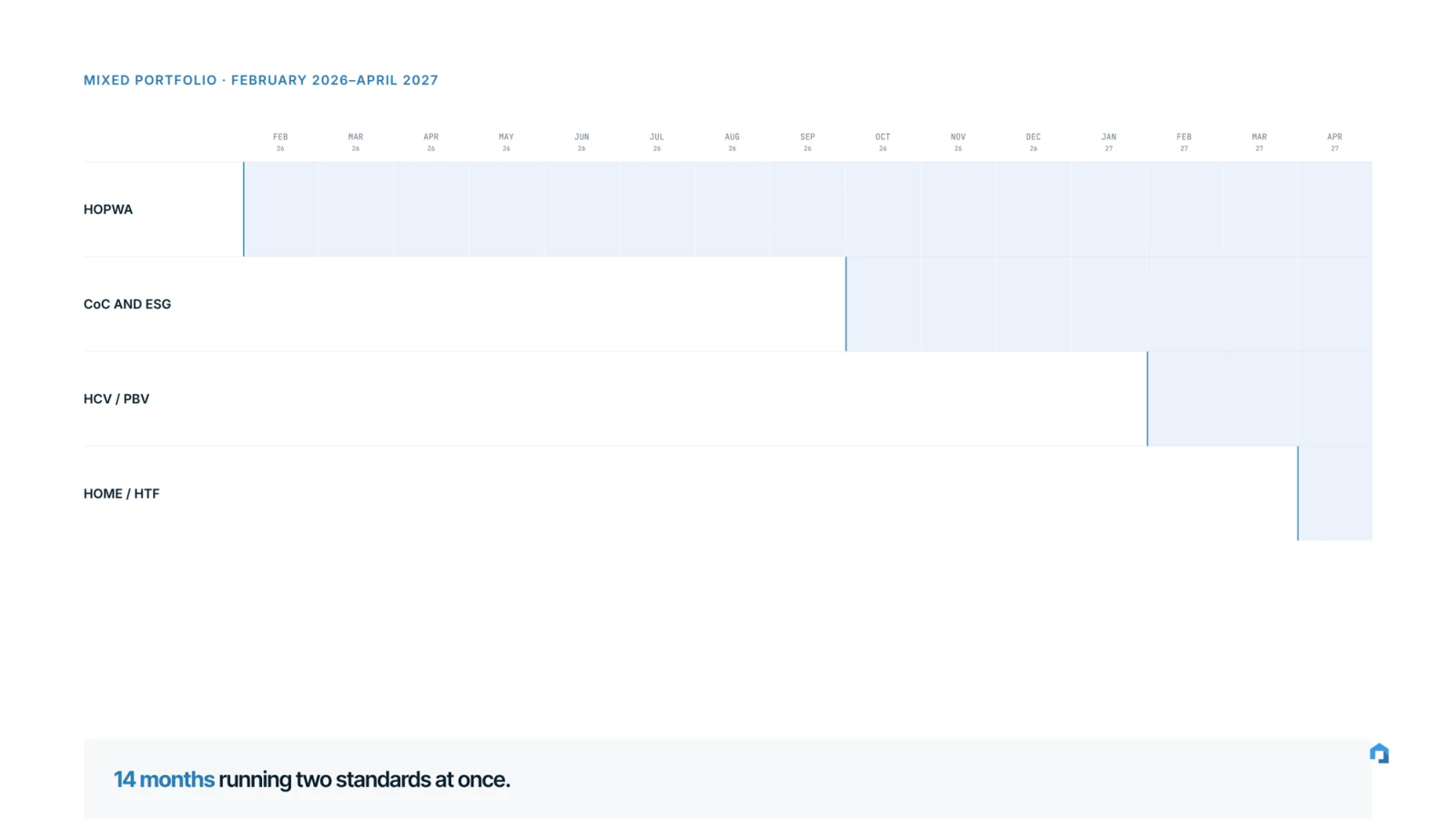
That is roughly fourteen months during which adjacent units in the same building, inspected by the same person, are legitimately governed by different standards with different fail criteria. Your inspection records, correction clocks, and landlord communications all must state which standard applied. Reporting that cannot separate them will not survive a monitoring review.
HUD is not building the software
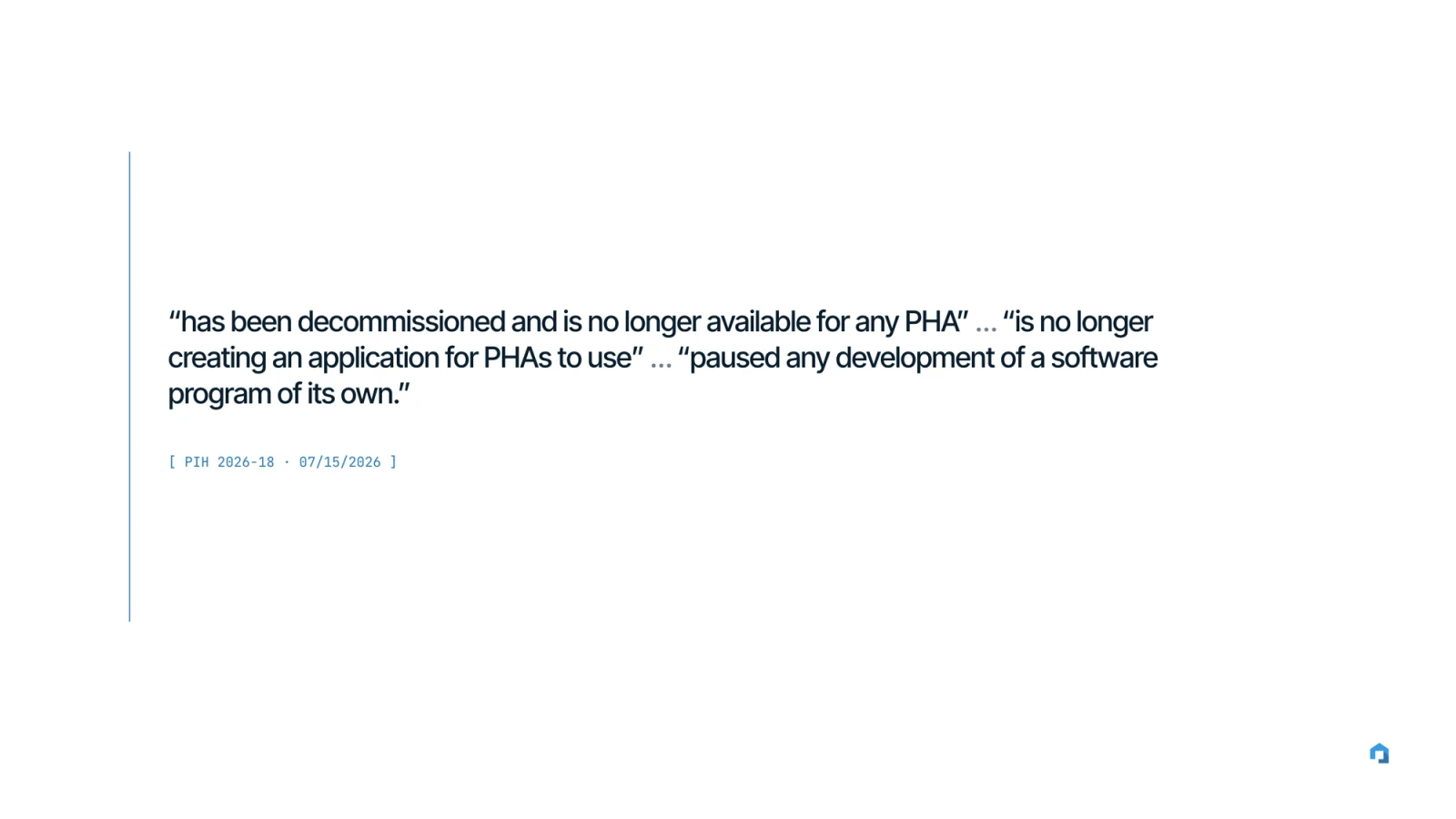
This is still widely assumed to be otherwise. PIH Notice 2026-18, issued July 15, 2026, says the NSPIRE-V demonstration application “has been decommissioned and is no longer available for any PHA,” that HUD “is no longer creating an application for PHAs to use,” and that it has “paused any development of a software program of its own.”
The operating model HUD describes is its fillable inspection checklist or commercial tooling, with the explicit caveat that third-party tools do not themselves ensure compliance. That responsibility stays with the agency. For a CoC executive, that removes a wait-and-see option some programs have been holding open.
What a CoC executive should be tracking
Two things, and both will show up in the Federal Register.
The first is a CoC and ESG standards notice in the Federal Register. If it appears without an accompanying extension, October 1 is real, and your window is whatever remains.
The second is any further extension notice. Given the HOME and HTF precedent, the likeliest shape is both together: standards and a new date in one document.
Neither one changes the list above.
“Journey enabled us to respond with confidence because it provides a proven, repeatable framework for centralized rental assistance administration. We were able to commit to an aggressive timeline because Journey already embeds standardized, compliant workflows.”
— Brian Petersen, COO and President, HOM, Inc. (referencing the LAHSA implementation: 2,500+ households at launch, a 90-day implementation from contract to go-live, and a multi-provider network migrating from independent workflows to a centralized operational model.)
Where this applies
This is written for CoC directors, program executives, and the people who sign compliance certifications, particularly in communities administering rental assistance administration across multiple provider agencies, where a compressed timeline has to move through several organizations rather than one. Single-agency programs face the same uncertainty with fewer parties to coordinate.
For what actually changes at the unit, including what fails now, what passes now, and where inspectors disagree, see NSPIRE vs. HQS.
What to do next
NSPIRE is arriving either way. The open question is whether your providers are standardized before it does or after.
The work that survives either outcome is one vocabulary, one severity structure, and one record showing which standard applied and when the clock started. All of that can start against a date that has not been confirmed. Padmission Inspections runs the four severity tiers and correction windows as the structure of the form, on its own or alongside Padmission Journey, so the records built now carry forward whichever way the notice lands.
Book a conversation with Padmission to walk through what a CoC-wide NSPIRE transition looks like across a provider network, including running two standards at once.
Read next: Administering housing assistance programs — why compliance layers land unevenly across multi-provider systems. For the housing-supply side of the retrofit conversation, centralized landlord engagement.
Frequently asked questions
When do CoC and ESG programs have to comply with NSPIRE?
October 1, 2026, per the Federal Register notice published September 30, 2025 (Doc. 2025-18988). Until that date, recipients may continue using the standards as they existed prior to October 1, 2023 — pre-2023 HQS for CoC via 24 CFR 578.75(b), and the ESG habitability standards at 24 CFR 576.403. Early adoption is permitted, and grantees who adopt early must document their chosen compliance date in program records.
Has HUD published NSPIRE standards specific to CoC and ESG?
Not as of early August 2026. HUD stated in the September 2025 extension notice that it intended to publish CoC- and ESG-specific standards before the compliance date. A review of NSPIRE documents published in the Federal Register during 2026 returns the HOME and HTF standards notice and a HOME streamlining rule, with nothing addressing CoC or ESG. Programs preparing now are working from the general standards at 24 CFR part 5 subpart G and the voucher inspection checklist.
Could the October 1, 2026 date be extended again?
It is possible and there is precedent, though no notice has been published. CPD programs have received four compliance dates to date, moving from October 2023 to October 2024 to October 2025 to October 2026. When HUD published HOME and HTF standards in April 2026, it extended that compliance date by twelve months in the same notice. No extension should be assumed, and programs remain responsible for the October 1, 2026 date unless HUD publishes otherwise.
What should a CoC do while waiting for the standards?
The work that does not depend on the notice: confirm and document a compliance date; verify that carbon monoxide and smoke alarm requirements are being inspected, since both are statutory and already binding; train provider staff on the four severity tiers and correction clocks defined in part 5; begin landlord conversations about the common retrofit items; and ensure inspection records identify which standard each inspection was conducted under.
Is HUD providing inspection software for NSPIRE?
No. PIH Notice 2026-18, issued July 15, 2026, states that the NSPIRE-V demonstration application has been decommissioned and is no longer available, that HUD is no longer creating an application for PHAs, and that development of its own software program is paused. HUD points agencies to its fillable NSPIRE inspection checklist or commercial tools, noting that third-party tooling does not by itself ensure compliance.
Do the smoke alarm and carbon monoxide requirements apply before October 1, 2026?
Yes. Both are statutory rather than NSPIRE-derived. Carbon monoxide alarm requirements have been enforceable since December 27, 2022 under the Consolidated Appropriations Act, 2021, and the hardwired or sealed 10-year-battery smoke alarm requirement took effect December 29, 2024 under the Public and Federally Assisted Housing Fire Safety Act of 2022. They apply regardless of which inspection standard a program is currently using.
Sources
- 90 FR 46912 / Doc. 2025-18988 — CPD compliance date extended to October 1, 2026 (September 30, 2025)
- 90 FR 46911 / Doc. 2025-19070 — HCV, PBV, and Mod Rehab extended to February 1, 2027
- 91 FR 19145 / Doc. 2026-07176 — HOME and HTF standards published with a twelve-month extension (April 14, 2026)
- 90 FR 37546 — HOPWA NSPIRE standards (August 5, 2025), compliance February 2, 2026
- 88 FR 30442 — NSPIRE final rule
- PIH Notice 2026-18 (July 15, 2026) — NSPIRE-V administrative procedures, including HUD’s software position
- 24 CFR 578.75(b) (CoC) and 24 CFR 576.403 (ESG) — pre-2023 standards currently in effect
- Consolidated Appropriations Act, 2021 (P.L. 116-260) § 101 and Public and Federally Assisted Housing Fire Safety Act of 2022 (P.L. 117-328, Division AA, Title VI, § 601) — statutory alarm requirements