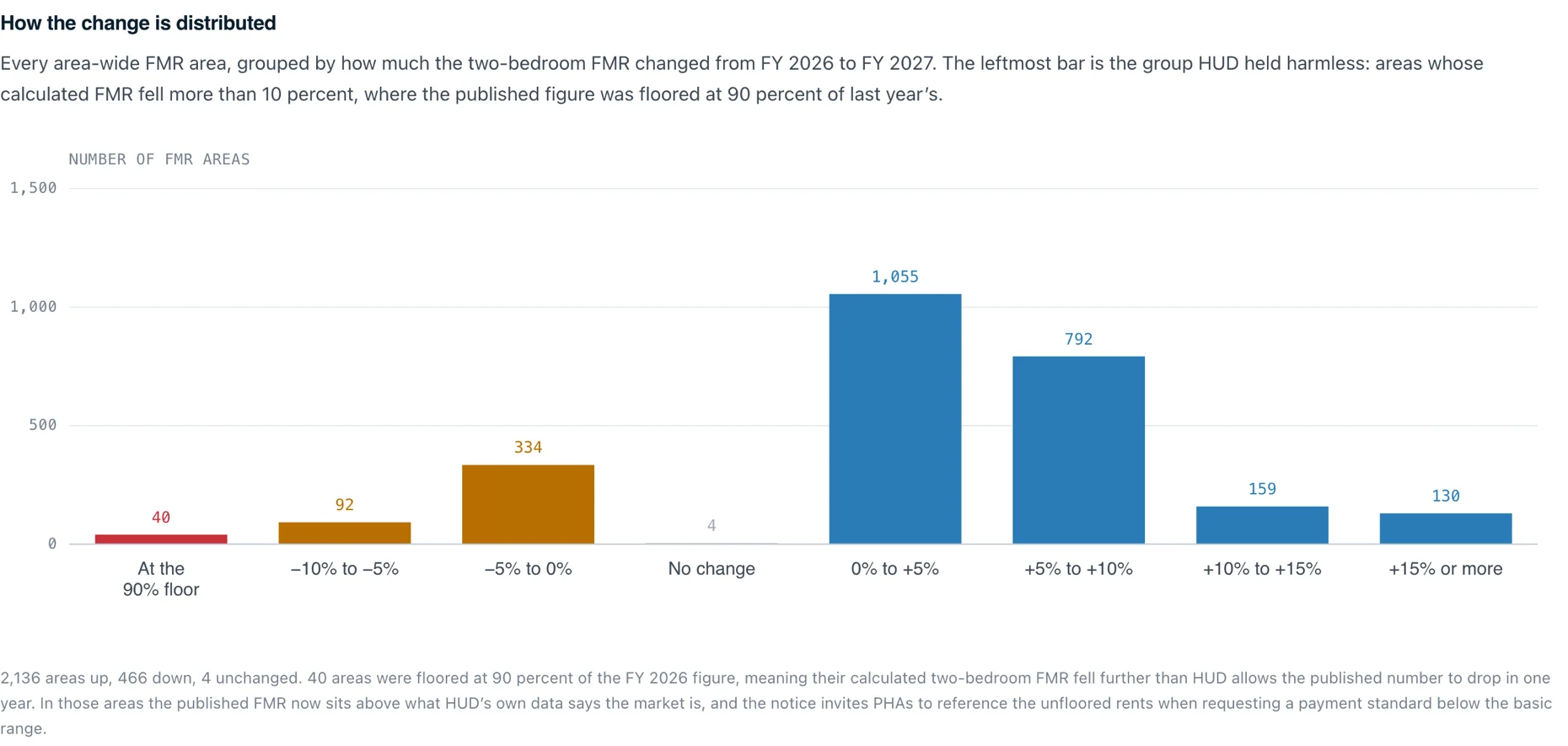
HUD published the FY 2027 Fair Market Rents this morning, effective October 1, 2026 (91 FR 56156, doc. 2026-17891). Across all 2,606 area-wide FMR areas, the typical area’s two-bedroom FMR rose 4.2 percent. Weighted by the people who live there, the national increase is 2.4 percent, and 466 areas came down.
Those two numbers diverged because the increases landed in small and rural areas and the declines landed in large metros — Dallas, Houston, Phoenix, San Diego, Atlanta, Riverside — where most assisted households live. About a third of the country lives in an area where the two-bedroom FMR is lower on October 1 than it was on September 30.
If you run one HUD-funded rental assistance program, you have one number to absorb. Most of the organizations we work with run four or five, and the FMR does a different job in each of them.
What the FMR is
The FMR is HUD’s estimate of the 40th-percentile gross rent for standard-quality units in a market area, calculated under 24 CFR 888.113. For FY 2027 it is built from five-year American Community Survey data collected between 2020 and 2024, then trended forward with a gross rent inflation factor and forecast trend factors.
Two details in this year’s notice will show up in your work.
The first is the floor. A published FMR “may be no less than 90 percent of the prior year’s FMRs for units with the same number of bedrooms.” Forty areas hit that floor at the two-bedroom size this year, and 74 did at the four-bedroom size. In those places the published FMR is not HUD’s estimate of the market. It is last year’s number minus ten percent, because HUD’s actual estimate fell further than the rule lets the published figure drop in one year.
The second is that the notice tells PHAs they can use the gap. A PHA in a floored area “may request payment standards below the basic range (24 CFR 982.503(e))” and “reference the ‘unfloored’ rents” in the FY 2027 FMR Documentation System. § 982.503(e) still requires HUD approval for a standard below 90 percent of the FMR, so this is a way to ask, not permission to act. HUD does not say the published number is wrong in those areas. It did publish the unfloored figures and name that use for them.
That route exists only for voucher agencies. An ESG recipient in a floored area gets the published number as a hard ceiling, with no equivalent process.
Phoenix, one of six large metros that went down
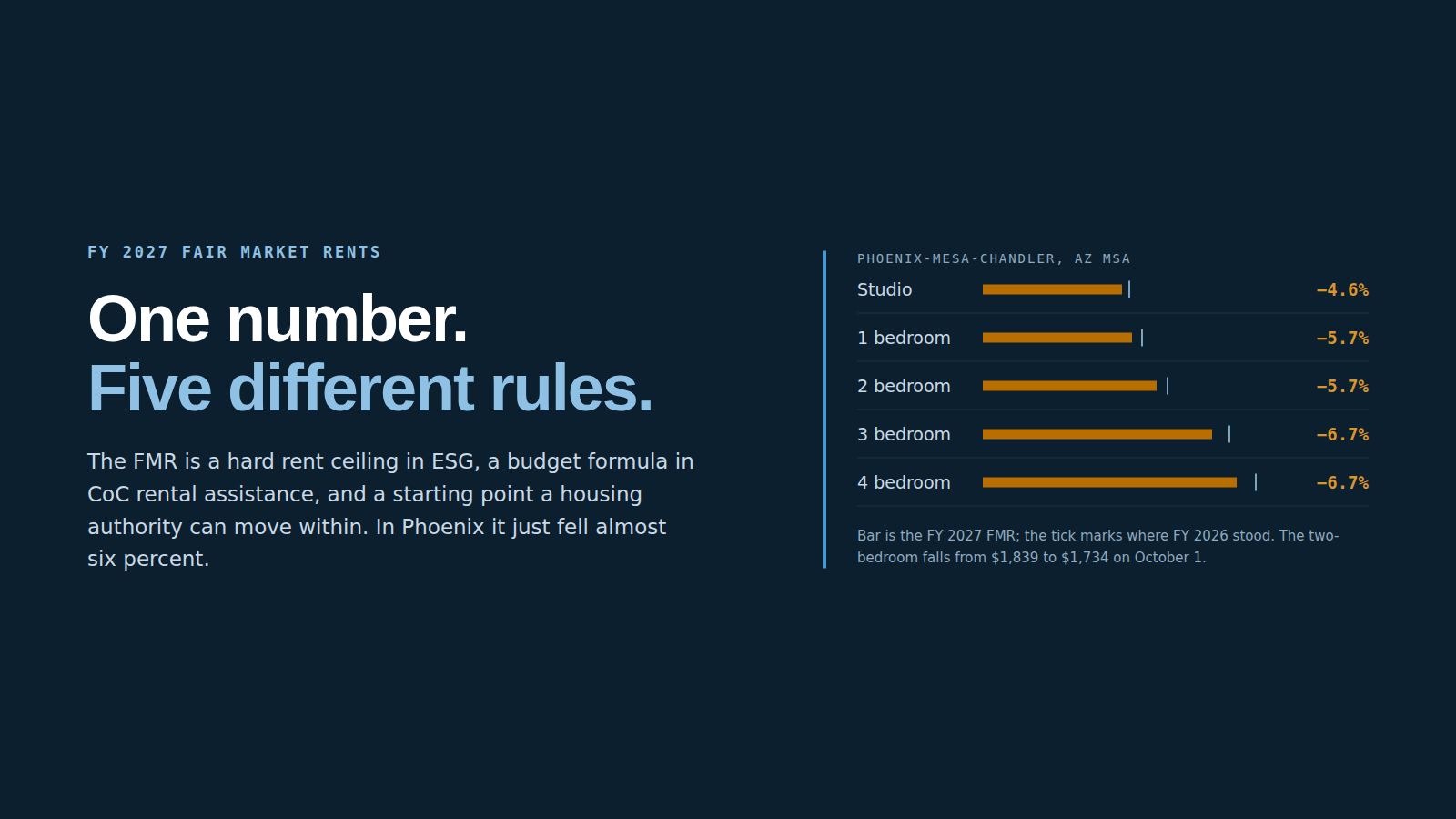
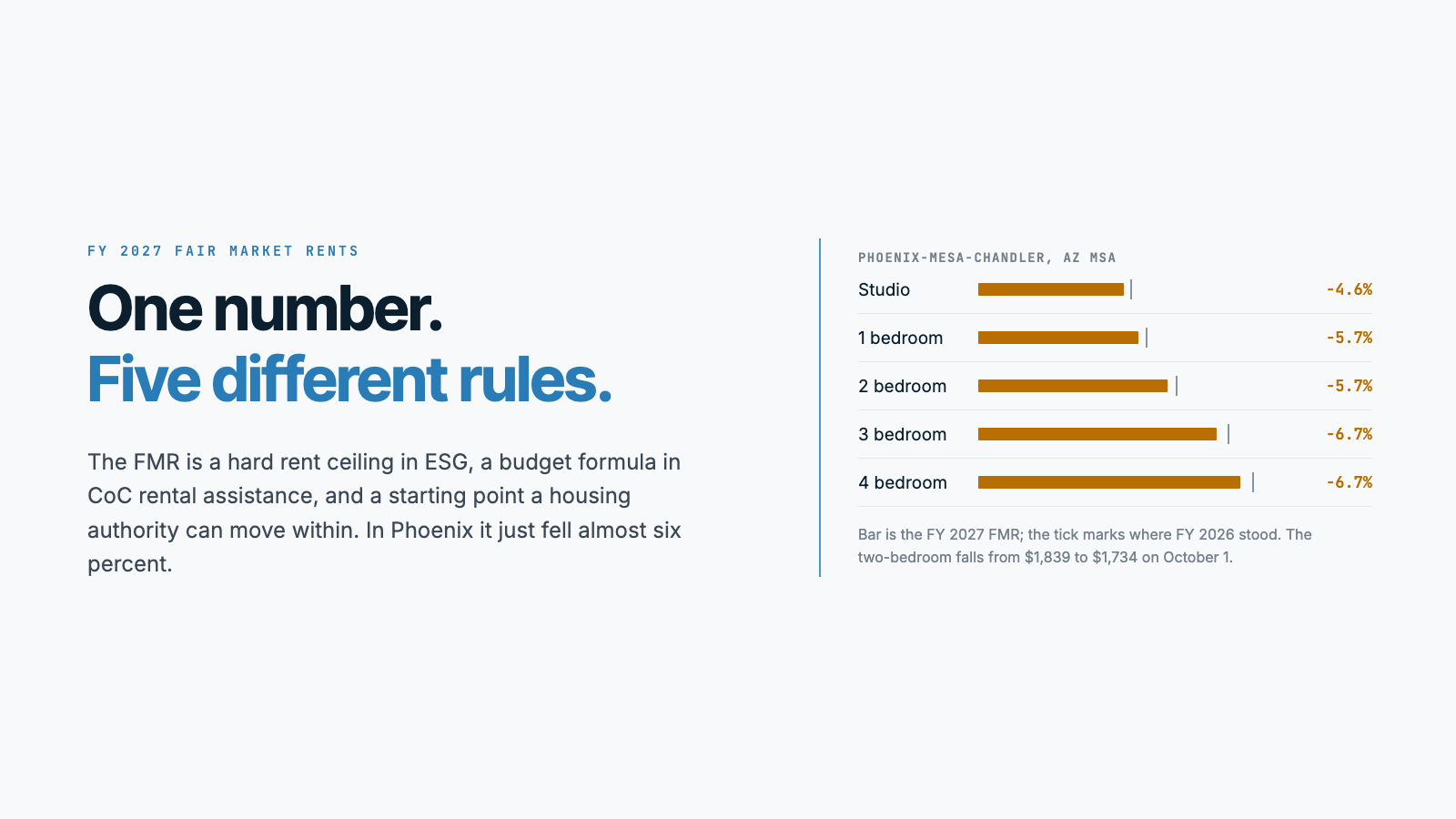
Take the Phoenix-Mesa-Chandler, AZ MSA. Its FY 2027 FMRs:
| Unit size | FY 2026 | FY 2027 | Change |
|---|---|---|---|
| Studio | $1,457 | $1,390 | −$67 (−4.6%) |
| 1 bedroom | $1,583 | $1,493 | −$90 (−5.7%) |
| 2 bedroom | $1,839 | $1,734 | −$105 (−5.7%) |
| 3 bedroom | $2,452 | $2,287 | −$165 (−6.7%) |
| 4 bedroom | $2,720 | $2,537 | −$183 (−6.7%) |
Arizona has the steepest statewide decline in the country this year, and Phoenix is about three-quarters of it. Tucson is essentially flat at +0.2 percent for a two-bedroom. Several smaller Arizona areas, Flagstaff and Yuma among them, fell all the way to the 90 percent floor. Five million people live in the Phoenix FMR area. The larger the unit, the deeper the cut, which hits the family-sized units that rapid rehousing and permanent supportive housing programs are already struggling to find.
Now follow that $105 through each program.
ESG: the FMR is a hard ceiling on gross rent
Under 24 CFR 576.106(d)(1), “Rental assistance cannot be provided unless the rent does not exceed the Fair Market Rent established by HUD, as provided under 24 CFR part 888, and complies with HUD’s standard of rent reasonableness, as established under 24 CFR 982.507.”
Those are two tests, and both have to pass. A unit can be perfectly reasonable next to comparable unassisted units and still fail, because the FMR test is a hard cap.
The rent being tested is gross rent, though the regulation never uses that phrase. Paragraph (d)(2) builds it: the total monthly rent for the unit, plus any fees required for occupancy under the lease other than late fees and pet fees, plus — if the tenant pays utilities separately — the monthly allowance for utilities excluding telephone established by the public housing authority for that area.
Three parts of that definition get missed in the field. Mandatory occupancy fees count, so a $45 monthly “amenity fee” required by the lease is part of the rent for this test. Whether a landlord-required renter’s insurance premium is a fee “required for occupancy under the lease” is a fair reading of the text, but not one HUD has confirmed in guidance we can point to, so treat it as a question for your field office rather than a settled answer. The utility allowance is the PHA’s published schedule for the area, not the landlord’s estimate and not the household’s actual bills. And it is the PHA’s schedule even though ESG is not a PHA program.
In Phoenix on October 1, a two-bedroom unit at $1,650 contract rent with a $95 utility allowance has a gross rent of $1,745. Last year that cleared the $1,839 FMR with room to spare. This year it exceeds $1,734 and fails.
§ 576.106 says nothing about what happens to a household already in that unit. There is no grandfathering clause, no transition period, and nothing that keys the change to lease renewal or annual recertification. The section is a condition on providing assistance. It is silent on a rent that complied when assistance began and stops complying when the FMR drops. Guidance outside the regulation may address it. If your HUD field office has given you a written position, that position is worth more than anything in this article. The rule text itself does not answer the question. In a year when a metro drops six percent, a lot of recipients are about to ask it.
CoC: the FMR sizes your grant, not your rent
This is the misunderstanding that costs people units.
For CoC rental assistance, 24 CFR 578.51(f) provides that “The amount of rental assistance in each project will be calculated by multiplying the number and size of units proposed by the FMR of each unit on the date the application is submitted to HUD, by the term of the grant.”
That is a budget formula. It sizes the award. It is not a cap on the rent you may pay for any particular unit.
What governs the rent is paragraph (g): “HUD will only provide rental assistance for a unit if the rent is reasonable.” Reasonableness is measured against comparable unassisted units in the market, not against the FMR.
Nothing in § 578.51 caps the rent for a CoC rental assistance unit at the FMR. Reasonableness under (g) governs the rent, and the grant total, the approved application budget, and your grant agreement still bind. That is not the same as “you may pay above FMR,” and it is the statement the regulation supports. Many recipients never test it, because they absorbed “the FMR is the cap” from the ESG side of the house and applied it program-wide.
The exception is CoC leasing, which is a different activity with a different rule — and the rule is stricter than the FMR alone. 24 CFR 578.49(b)(2) sets three limits on leasing an individual unit: the rent paid “must be reasonable in relation to rents being charged for comparable units,” it “may not exceed rents currently being charged for comparable units,” and it “may not exceed HUD-determined fair market rents.” The ceiling is whichever is lower: the FMR or the reasonable rent. If the FMR rose, that does not raise what leasing funds may pay. If the FMR fell, that lowers it whether or not the market moved with it.
The thing being capped is the rent paid with grant funds, not the rent the unit commands. A unit renting above the FMR is not off-limits to a leasing project. The recipient holds the lease, so it may take the unit and pay the balance — but only from a non-CoC source, because CoC leasing funds stop at the lower of the two limits. A $1,500 unit that is rent-reasonable at $1,500, in an area with a $1,350 FMR, is a unit a leasing project can hold for $1,350 of CoC funds and $150 of something else.
HUD’s own FY 2027 notice keeps the two uses apart. It lists the FMR’s uses as including “calculation of maximum award amounts for Continuum of Care recipients and the maximum amount of rent a recipient may pay for property leased with Continuum of Care funds.” Two uses. Only the second is a rent cap.
For Phoenix, the grant-amount effect is arithmetic. A CoC rental assistance project applying for 100 two-bedroom units for a one-year term is sized at $2,206,800 using the FY 2026 FMR and $2,080,800 using FY 2027 — $126,000 less for the same 100 units. The rents those units actually command have not fallen by six percent. ACS data and trend factors describe a market as it was, not as it is on the day you sign a lease. The gap lands on the recipient.
HCV: the same metro, priced by ZIP code
Phoenix is one of the metropolitan areas where HUD requires PHAs to use Small Area FMRs in the Housing Choice Voucher program, designated in HUD’s October 25, 2023 notice and effective for HCV since October 1, 2024. That notice uses the older area name, Phoenix-Mesa-Scottsdale, AZ MSA — same CBSA, 38060. Sixty-five metro areas are currently on the list.
For FY 2027, HUD publishes a two-bedroom SAFMR for each of 225 ZIP codes in the Phoenix metro. They run from $1,380 to $2,600, and the high end is not where you would guess: the six ZIP codes at $2,600 include north Scottsdale and Cave Creek, but also Ahwatukee in south Phoenix, south Gilbert, and Waddell out west. The metro-wide figure — $1,734 — is a 40th-percentile estimate for the whole metro. It does not describe any particular neighborhood.
A Phoenix-area PHA sets tenant-based voucher payment standards from those ZIP-level numbers, within the basic range of 90 to 110 percent, which means a two-bedroom payment standard as high as $2,860 in the highest-cost ZIP codes. Project-based vouchers are a separate question: § 888.113(h) lets a PHA extend SAFMRs to PBV, but does not require it.
An ESG project in those same ZIP codes is held to $1,734. A CoC leasing project is held to whichever is lower: $1,734 or the reasonable rent.
That is the rule, not a gap in it. 24 CFR 888.113(c) states that “Small Area FMRs only apply to tenant-based assistance under the HCV program.” The preamble to the 2016 SAFMR final rule says the same thing in plainer English: “Other programs that use FMRs would continue to use area-wide FMRs” (81 FR 80567, Nov. 16, 2016).
What that means on the ground: the two main CPD sources of homeless-dedicated rental assistance cannot follow rents into high-opportunity neighborhoods, in the very metros where HUD has decided that following rents by ZIP code is the right approach for vouchers. A voucher holder in Phoenix can lease in Scottsdale at a payment standard built from Scottsdale rents. A rapid rehousing participant in the same city, served by the same CoC, is priced off a number that averages Scottsdale with south Phoenix.
Where PHAs get room that CPD programs don’t
When the FMR falls, the HCV program has tools for it. The CPD programs mostly do not.
PHAs set payment standards, not rents. Under 24 CFR 982.503(c), a payment standard anywhere from 90 to 110 percent of the applicable published FMR is the “basic range,” and the PHA “may establish a payment standard amount within the basic range without HUD approval or prior notification to HUD.” Revision is required within three months of the FMR’s effective date only where it is needed to stay inside that range.
That range is what CPD programs do not have, and it absorbs a lot of a decrease. The most common two-bedroom SAFMR in the Phoenix metro is $1,740, covering 53 ZIP codes — close enough to the $1,734 metro-wide figure to make the comparison clean. In those ZIP codes HUD publishes a basic range of $1,566 to $1,914, and the PHA may sit anywhere in it without asking HUD anything. A payment standard set at $1,839 last year still falls inside that range, so nothing compels the PHA to reduce it at all.
An ESG recipient looking at $1,734 in the same ZIP codes has no range. A unit is either under the line or ineligible.
Exception standards go further. Above the basic range, § 982.503(d) allows a PHA to establish an exception payment standard between 110 and 120 percent of the applicable FMR on notification to HUD without prior approval when it meets specified criteria (paragraph (d)(3)); to go above 110 percent otherwise with HUD approval (paragraph (d)(4)); and to set a standard up to 120 percent for an individual family as a reasonable accommodation for a person with a disability, without HUD approval or prior notification (paragraph (d)(5)).
A couple of notes, because this section gets repeated loosely. The reasonable accommodation exception is not something the Housing Opportunity Through Modernization Act created. HUD’s 2024 HOTMA implementation rule, which codified it at paragraph (d)(5), described the change as clarifying “existing policy.” What HOTMA newly authorized on payment standards is the 110-to-120 percent range on notification rather than prior approval.
Phoenix also cannot use paragraph (d)(2). That paragraph lets a PHA set ZIP-code exception standards off the SAFMR, but only where the PHA is not in a designated SAFMR area. A Phoenix PHA is already working from SAFMRs, so (d)(2) is not on its menu. Its routes above the basic range are (d)(3), (d)(4), and (d)(5).
Existing voucher households get a long runway. This is the provision with no analogue anywhere in CPD, and it is where the difference becomes a difference in someone’s rent burden. Under 24 CFR 982.505(c)(3), “the initial reduction to the family’s payment standard amount may not be applied any earlier than two years following the effective date of the decrease in the payment standard,” and the PHA “must provide the family with at least 12 months’ written notice of any reduction in the payment standard amount that will affect the family if the family remains in place.” The 12 months can run inside the two years, so the floor is two years, not three. Paragraph (c)(3)(iv) requires the PHA to administer decreases in accordance with its Administrative Plan, which is where a PHA that wants to be more generous than the minimum writes that down.
Put an ESG household next to that. A voucher household in Phoenix whose payment standard falls has at least two years before the reduction can be applied, and cannot be reduced without 12 months’ written notice. Their PHA writes the policy into a document it controls. An ESG household in the same building, in a unit whose gross rent now exceeds $1,734, has a regulation that is silent on their situation and a recipient with no discretion, because the FMR test in § 576.106(d)(1) has no range, no exception standard, and no waiver at the recipient’s level.
If your organization runs both, this is the year that shows up in the same portfolio, in the same ZIP codes, sometimes on the same street.
HOPWA and HOME
HOPWA and HOME sit in different places on this map. They do not behave like ESG or CoC.
HOPWA constrains the grantee’s rent standard rather than the unit rent. Under 24 CFR 574.320(a)(2), “The rent standard shall be established by the grantee and shall be no more than the published section 8 fair market rent (FMR) or the HUD-approved community-wide exception rent for the unit size.” Then it adds flexibility that ESG lacks entirely: “on a unit by unit basis, the grantee may increase that amount by up to 10 percent for up to 20 percent of the units assisted.” Rent reasonableness applies separately under (a)(3). That section has not been amended since 1996.
HOME works off published HOME rent limits rather than the FMR directly, though the High HOME limit under 24 CFR 92.252(a) is still computed as the lesser of the FMR under 24 CFR 888.111 or 30 percent of the adjusted income of a family at 65 percent of area median. HOME tenant-based rental assistance is looser still: under 24 CFR 92.209(h)(3) the participating jurisdiction sets its own rent standard based on either local market conditions or the HCV payment standard determined under 982.503(a) through (c) — with no FMR ceiling of its own. The cross-reference stops at paragraph (c), so a PJ taking the payment standard route cannot import the exception standards in (d).
What to do before October 1
Do this in the order the work actually happens.
- Pull the new FMRs for every area you operate in, at every bedroom size. Not just two-bedroom, and not just your headquarters metro. The bedroom-size gradient this year is real: nationally, studios rose about a point more than four-bedrooms, and in declining markets the largest units fell hardest. Our FY 2027 FMR resource has every area at every size if you want to check yours quickly.
- Re-run every ESG-assisted unit against the new gross rent ceiling. Contract rent plus mandatory occupancy fees plus the current PHA utility allowance. Flag anything within about five percent of the new FMR, not just the units already over — utility allowance updates move that number too.
- Separate your CoC leasing units from your CoC rental assistance units in whatever system you use, if they are not already separated. Only the first group takes an FMR cap, and there it is the lower of the FMR and the reasonable rent. Confirm how your renewal budget was sized before assuming a rent has to come down.
- In SAFMR metros, stop using the metro-wide number for tenant-based voucher payment standards and stop using ZIP-level numbers for the CPD programs. Both errors happen, and they are easy to make when one spreadsheet feeds several programs.
- Check whether any of your areas are at the 90 percent floor. If they are, the published FMR is above HUD’s own estimate of the market, and the FY 2027 FMR Documentation System will show you the unfloored figure. That is directly useful to a PHA under 982.503(e) and useful to everyone else as a market signal.
- If an area FMR looks wrong for your market, the reevaluation door is open. Comments on the notice were due October 1, 2026; survey data supporting a reevaluation request is due January 8, 2027, with revised FMRs published in April 2027. That process exists and is underused.
How Journey handles it
Padmission Journey stores FMRs by area, by bedroom size, and by effective date, and runs the rent test that belongs to the program funding each unit: the gross rent ceiling for ESG, rent reasonableness for CoC rental assistance, the lower of the FMR and the reasonable rent for CoC leasing, the grantee rent standard for HOPWA. Utility allowance schedules are versioned with them, so a gross rent calculation run today and the same calculation run in March both use the allowance that was in effect on the date of the determination.
Because the tables carry effective dates, October 1 does not require a coordinated update across programs on a single afternoon. Units approved under FY 2026 figures keep their determination record. New determinations pick up FY 2027. When an area’s FMR falls, Journey can surface the affected units ahead of the effective date rather than at the next annual recertification. That is the difference between calling a landlord in September and surprising a household in October.
If you want to see how your programs would handle October 1, get in touch.
Frequently asked questions
Do FY 2027 FMRs cap ESG rent?
Yes. Under 24 CFR 576.106(d), ESG rental assistance cannot be provided unless the rent does not exceed the FMR and is also reasonable under 24 CFR 982.507. The rent tested is gross rent: contract rent, plus fees required for occupancy under the lease other than late and pet fees, plus the PHA utility allowance when the tenant pays utilities.
What happens to CoC rental assistance when the FMR goes down?
The grant is sized smaller, but the rent for a unit is not capped at the FMR. 24 CFR 578.51(f) sizes the award by multiplying the number and size of units by the FMR on the date the application is submitted, and paragraph (g) governs the rent itself through rent reasonableness. CoC leasing is the exception: under 24 CFR 578.49(b)(2) the rent paid with grant funds may not exceed the lower of the FMR and the reasonable rent, so a lower FMR lowers it directly.
When do FY 2027 FMRs take effect?
October 1, 2026. HUD published them on September 1, 2026 (91 FR 56156). Comments on the notice were due October 1, 2026, and survey data supporting a reevaluation request is due January 8, 2027.
How many FMR areas went down for FY 2027?
466 of the 2,606 area-wide FMR areas have a lower two-bedroom FMR for FY 2027. About a third of the country lives in one of them, because the declines landed in large metros such as Dallas, Houston, Phoenix, San Diego, Atlanta and Riverside. The FY 2027 FMR resource lists every area at every bedroom size.
Regulatory citations in this article were verified against the eCFR and the Federal Register as of September 1, 2026. Nothing here is legal advice, and where your HUD field office has issued written guidance on a point, that guidance governs.