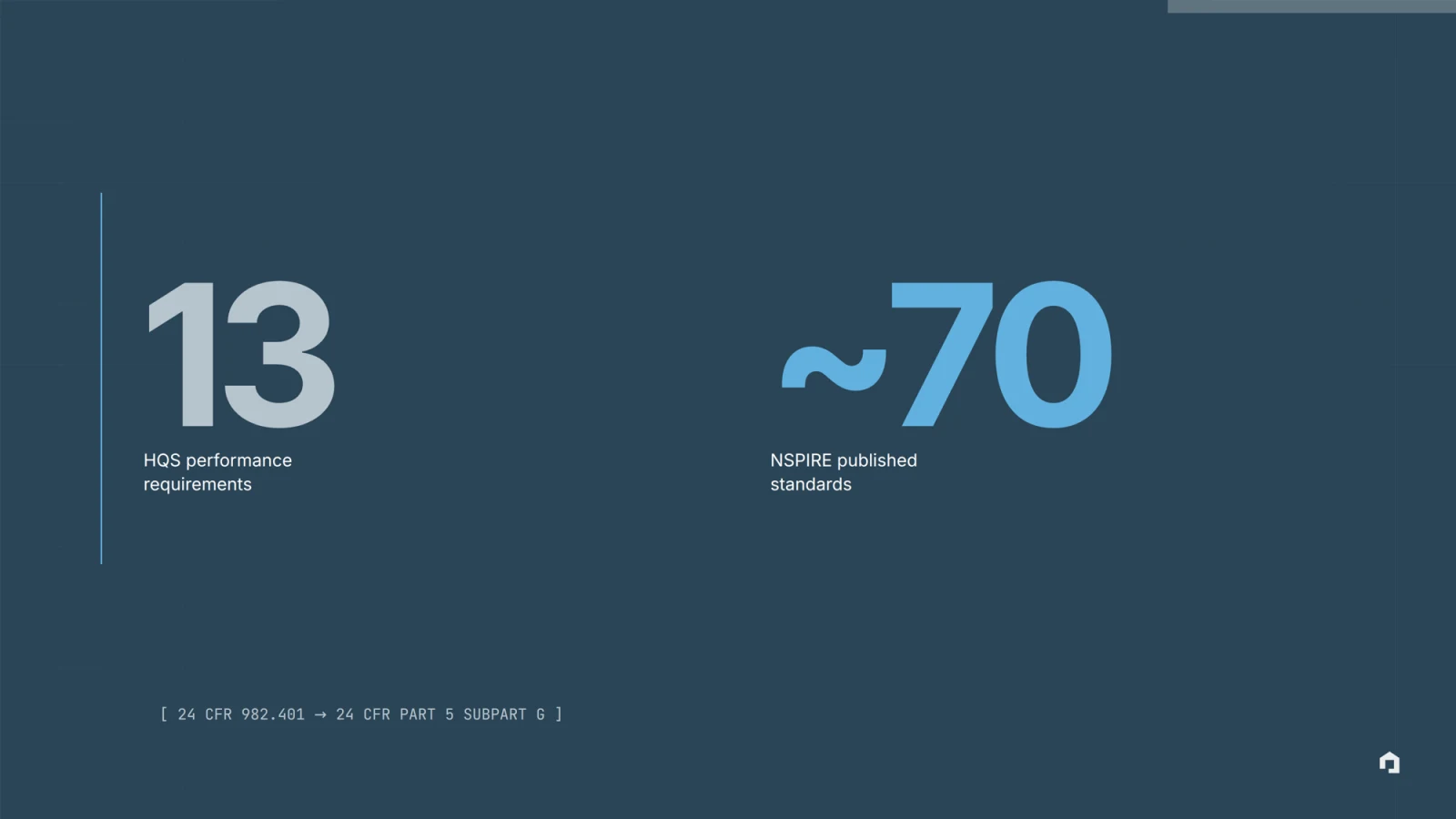
If your team inspects housing units for a HUD-funded housing program, you are moving from a standard written in the 1970s to one written in 2023. Housing program administration under HQS ran on 13 performance requirements at 24 CFR 982.401, a two-page checklist with eight areas to inspect, and inspector guidance last modernized in 2001. NSPIRE, the National Standards for the Physical Inspection of Real Estate, sits at 24 CFR part 5 subpart G and replaces that with roughly 70 published standards. Each one defines a specific deficiency, its severity, and how long the owner has to fix it.
This post covers what changes at the unit for NSPIRE inspection housing programs, in both directions. A criterion-by-criterion table is appended at the end. For where the compliance dates currently stand and what HUD CoC and ESG programs are still waiting on, see the deadline that arrived without the standards.
How the two standards work, side by side
Before the individual criteria, the structural differences — these are what change how your team inspects, independent of any single deficiency.
| HQS | NSPIRE-V | |
|---|---|---|
| Structure | 13 performance requirements with acceptability criteria underneath | Roughly 70 published standards |
| Who determines the outcome | The inspector interprets terms like “adequate heat” and “free of hazards” | The published standard defines the deficiency |
| Classification | Pass, Fail, or Inconclusive | Location (Unit / Inside / Outside) by severity (life-threatening, severe, moderate, low) |
| Correction clocks | 24 hours for life-threatening, otherwise no later than 30 days or a PHA-approved extension | Fixed by severity tier |
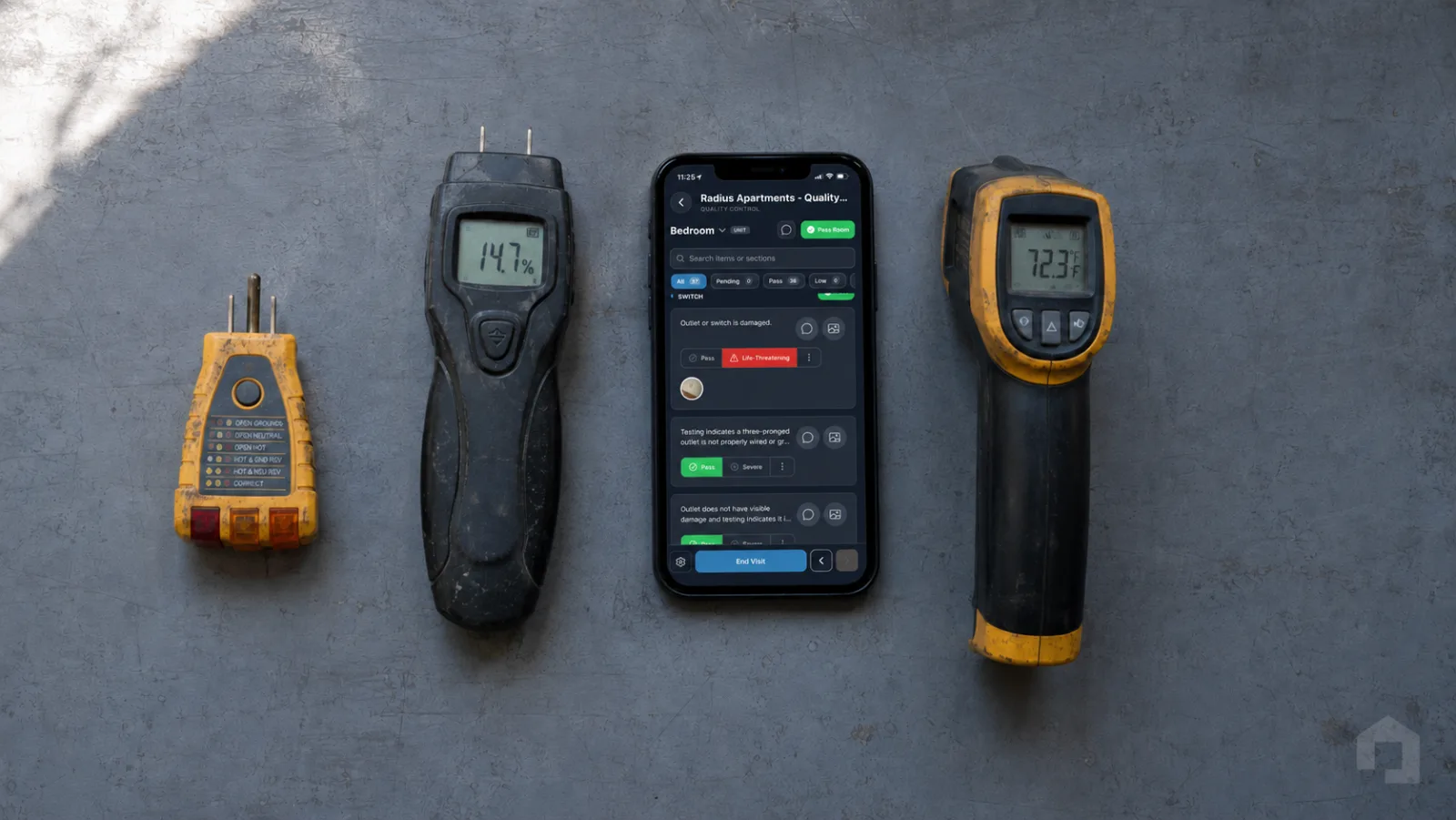
| How conditions are assessed | Visual | Instrumented: outlet tester, moisture meter, thermometer |
| Presence requirements | Does what is installed work? | Some items must be present and functional whether or not they were ever installed |
| Scope | Includes site and neighborhood conditions | Unit-focused; site and neighborhood removed from unit inspections |
| Field instrument | Form HUD-52580 / 52580-A, inspector guidance last updated 2001 | NSPIRE standards v3.0, published deficiency criteria |
| Outcome model (voucher and CPD) | Pass/fail | Pass/fail — no score |
The core change: your inspector stops deciding what “adequate” means
HQS told your inspector the unit needed “adequate heat” and had to be “free of hazards,” then left the call to them. Two reasonable inspectors could look at the same unit and file different results, and both could defend it.
NSPIRE-V writes the numbers down. Interior temperature below 64°F. GFCI protection within six feet of a water source. Guardrails at drops of 30 inches or more. Handrails at four risers. Smoke alarms within 21 feet of a bedroom door. Mold measured in square inches.
Your inspectors now carry instruments (outlet testers, moisture meters, thermometers) because several of these can no longer be assessed by looking. Results get more consistent, and disputes get easier to settle, and conditions that quietly passed for years now fail on the first visit.
Four deficiency tiers, and three of them fail
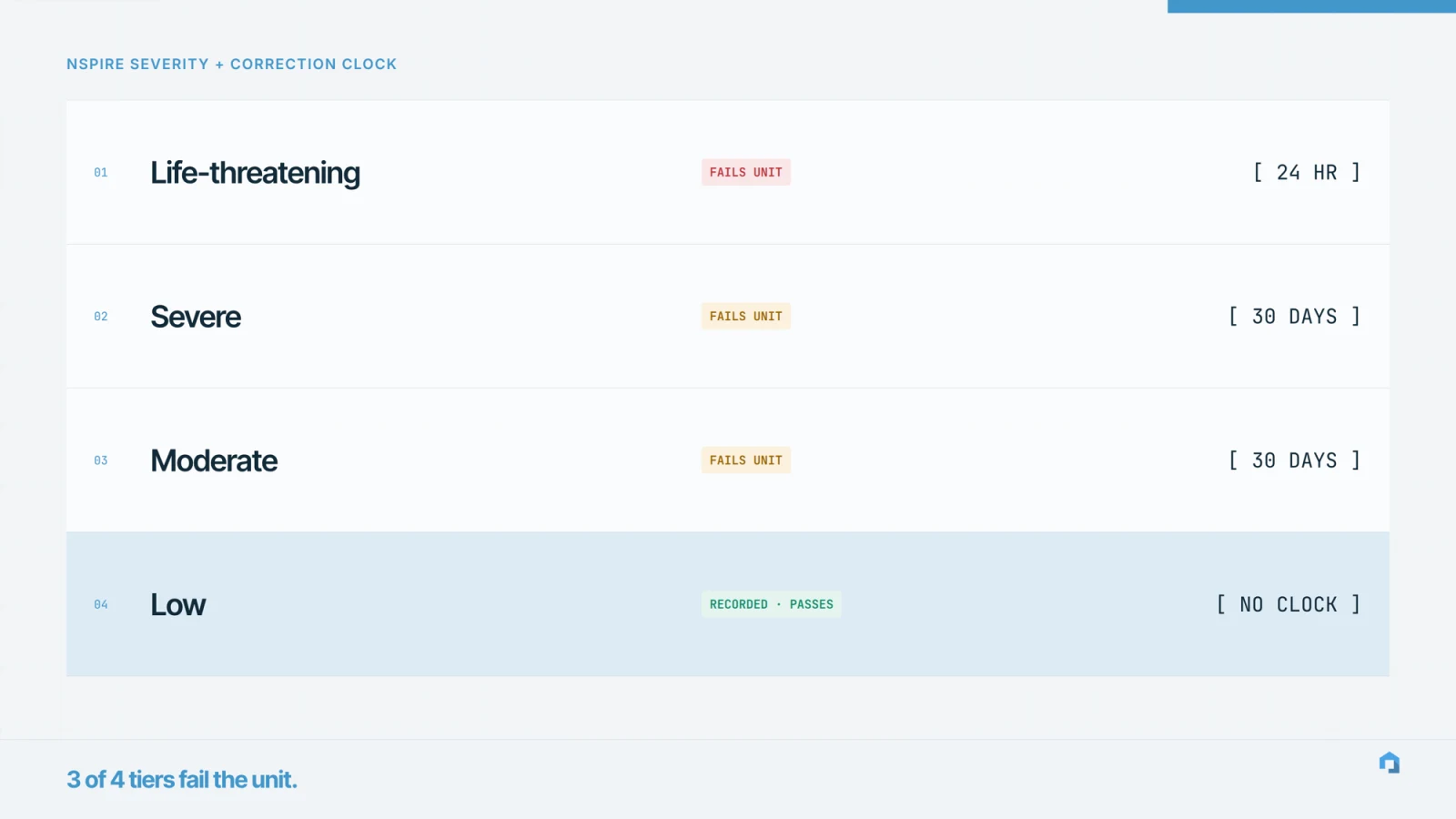
Every NSPIRE-V deficiency carries a severity. For voucher and CPD programs (Housing Choice Voucher, Project-Based Voucher, Continuum of Care, ESG, HOME, HOPWA) there is no score. The unit passes or fails the same as it did under HQS, and severity determines whether it fails and how fast the fix is due.
| Severity | Outcome | Correction clock |
|---|---|---|
| Life-threatening | Fail | 24 hours from notification |
| Severe | Fail | 30 days, or a PHA-approved extension |
| Moderate | Fail | 30 days, or a PHA-approved extension |
| Low | Pass — recorded only | None |
The 0–100 score you may have read about only applies to Public Housing and HUD Multifamily REAC inspections. It has never applied to vouchers or CPD programs.
Low is the closest thing NSPIRE-V has to the HQS “pass with comments.” The difference is that HUD publishes what counts as low. Your inspector no longer decides which borderline conditions get written up and waved through.
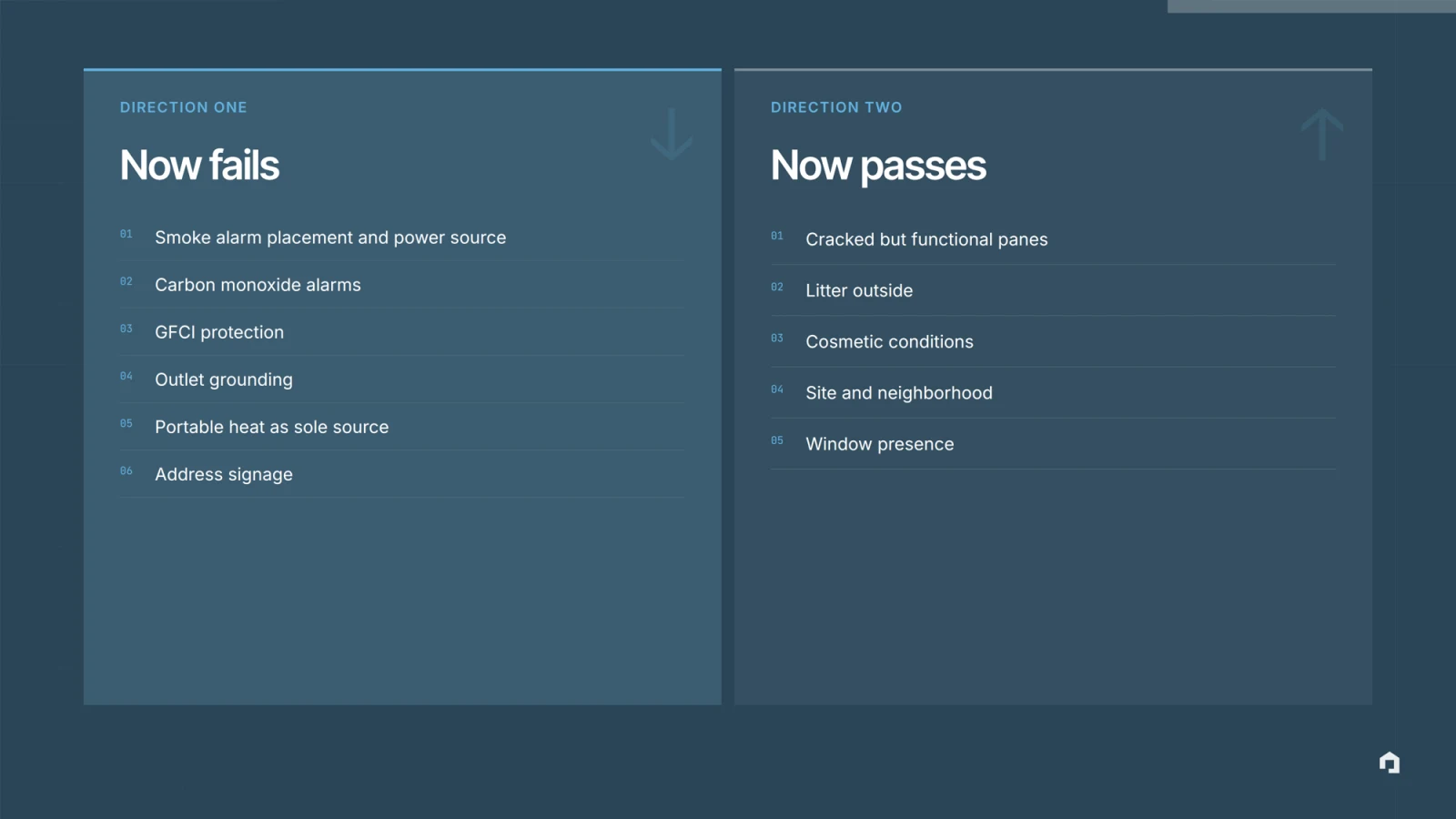
What now fails that used to pass
These are the items PHAs consistently report as their highest-volume failures in the transition.
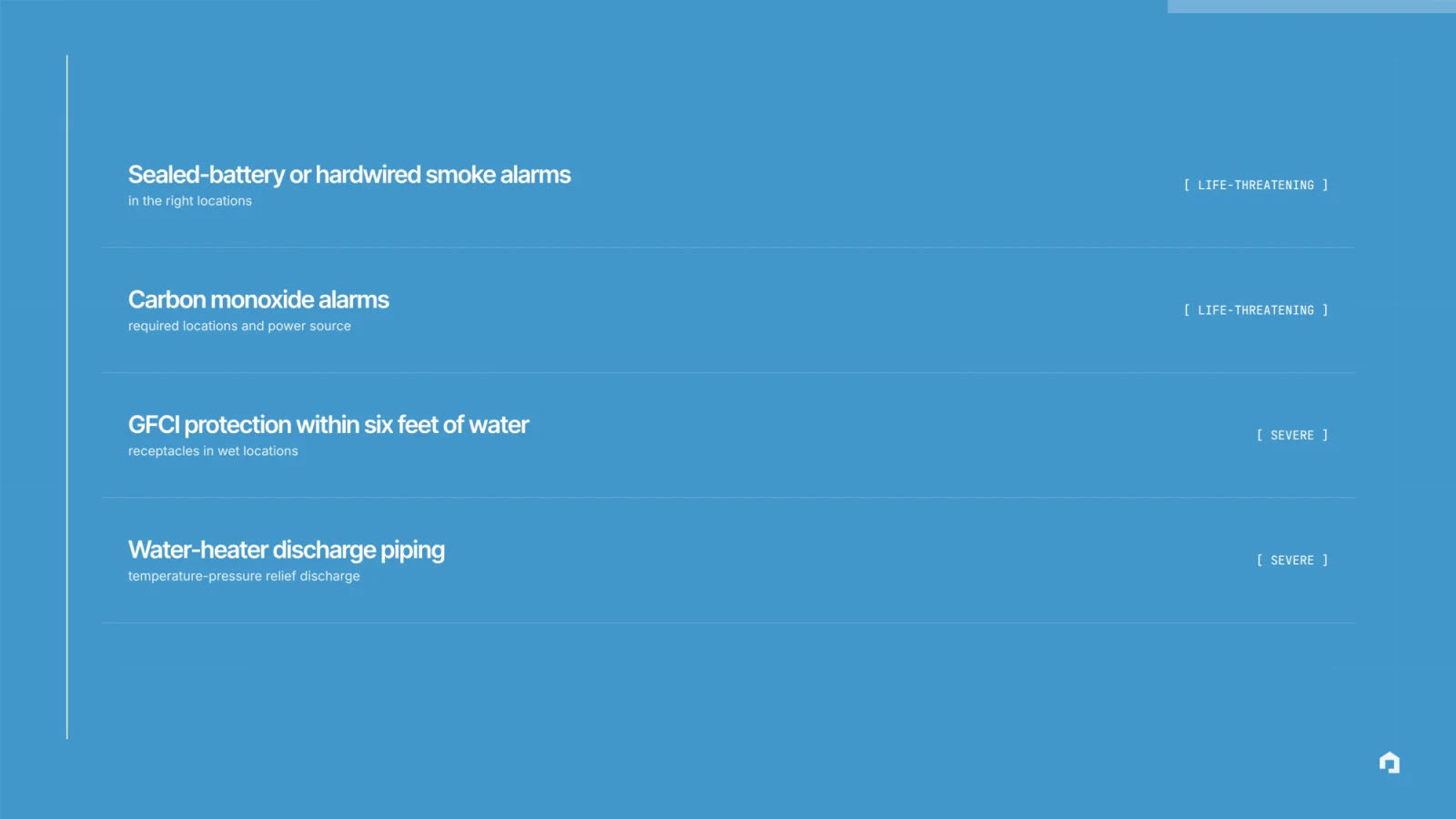
Smoke alarms. HQS wanted one per level and did not care about the power source. NSPIRE-V requires an alarm on each level, inside each bedroom, and within 21 feet of a bedroom door — hardwired or sealed with a 10-year battery. A loose 9-volt alarm on the hallway ceiling was a passing condition for decades, and it now fails twice over: wrong power source and wrong placement. Life-threatening, 24 hours.
Units built or substantially rehabilitated after December 29, 2022, must be hardwired; the sealed-battery option is for existing units. Interconnection between alarms is not an inspectable deficiency; the standard says so explicitly, so don’t cite owners for it.
Carbon monoxide alarms. HQS had no CO requirement at all. NSPIRE-V requires them, life-threatening, 24 hours. The trigger is broader than most people assume: not just a fuel-burning appliance in the unit, but a unit within one story of an attached garage, a unit served by a remote forced-air furnace, or a unit in a building that contains a fuel-burning appliance anywhere, so a shared gas boiler in the basement counts. A fully detached all-electric property with no attached garage is the exemption.
GFCI protection. Not an HQS concept. NSPIRE-V requires it within six feet of a sink, tub, shower, faucet, or toilet, at the outlet or the breaker. Severe, 30 days. An inoperable test or reset button is cited too.
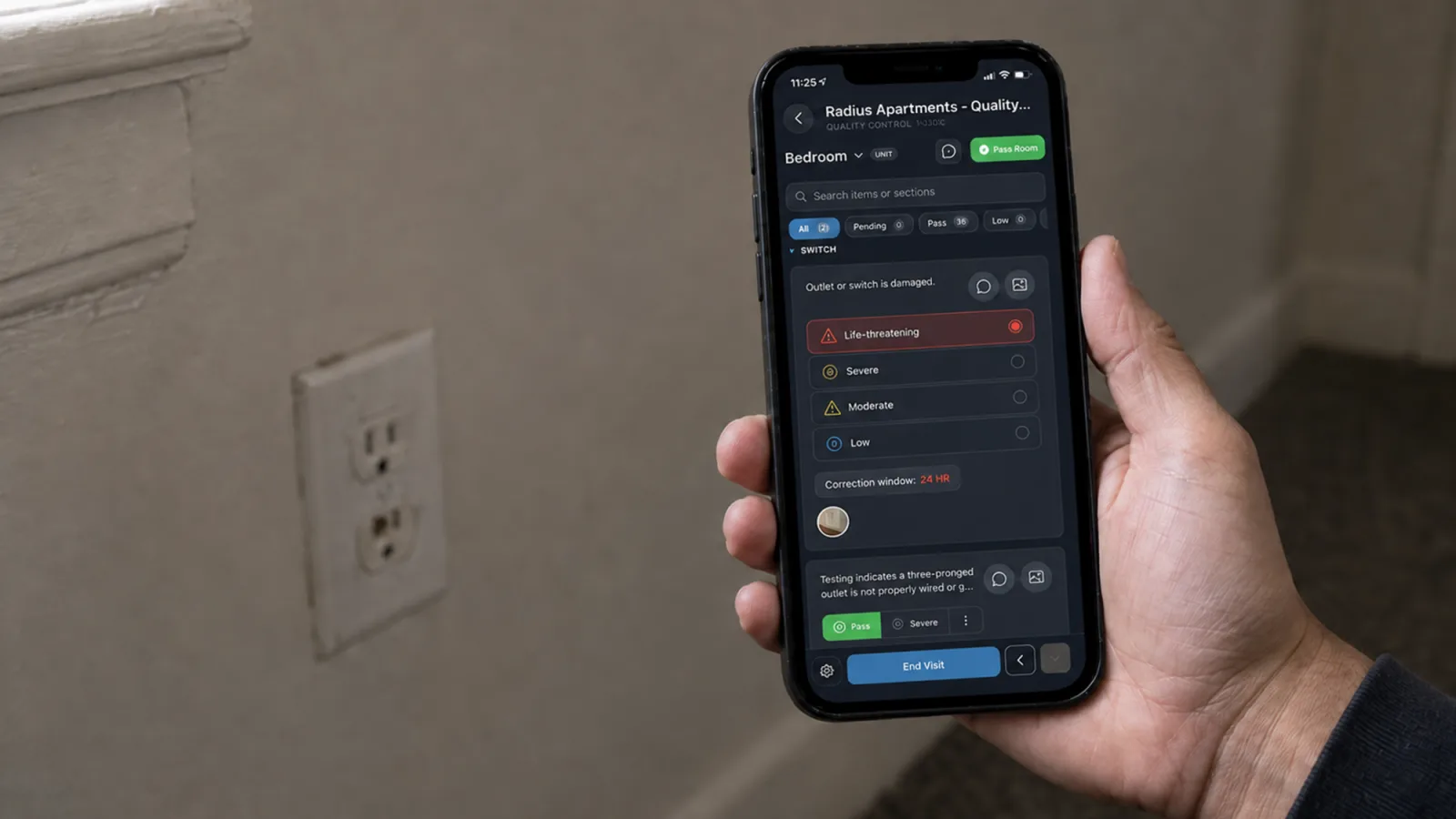
Outlet grounding. A three-prong outlet with no ground rarely got caught under HQS because nothing required a tester. Your inspectors now test, and an improperly wired three-prong outlet or a dead outlet is severe, 30 days.
Permanently installed heat. HQS asked whether the unit could maintain a healthy thermal environment. NSPIRE-V names what does not count: cooking appliances, portable space heaters, fireplaces, and wood stoves cannot be the heating source. During heating season, October 1 through March 31, inoperable heat or an interior below 64°F is life-threatening. Between 64° and 67.9°F is severe, which is still a fail.
Mold. HQS had no mold standard. NSPIRE-V has thresholds based on surface area.
Address and signage. Broken, illegible, or not visible from the street is a moderate fail. There is no HQS equivalent, and it catches people.
What now passes that used to fail
This half of the transition gets almost no coverage, and it is real relief for your landlord conversations.
Cracked windowpanes. There is no cracked-pane criterion in the NSPIRE-V window standard. If the window still closes, latches, and functions, a cracked pane is not a recordable deficiency. Under HQS these failed units routinely.
Litter outside. Ten or more small items in a ten-by-ten-foot area, or any large, discarded item, is a defined deficiency, but outside it is low and passes. The same litter inside a building is a moderate fail.
Cosmetics. Surface cracks, stains, and worn finishes are low, so they pass.
Site and neighborhood. HQS had a performance requirement covering noise, air pollution, traffic, and drainage. NSPIRE-V removed it from unit inspections entirely. (It still applies to Project-Based Voucher site selection, which is a different process.)
Window presence. HQS required at least one window in the living room and each sleeping room. NSPIRE-V regulates the operability, security, and egress function of windows that exist; there is no affirmative requirement that a room has one. Experienced inspectors get this one wrong, so cover it in training.
The net effect on owners is a shift in what you ask them for: less painting and grounds work, more one-time electrical, alarm, and plumbing-detail retrofits.
Where two good inspectors will still disagree
NSPIRE-V narrowed the judgment without eliminating it. Three places your team will still disagree:
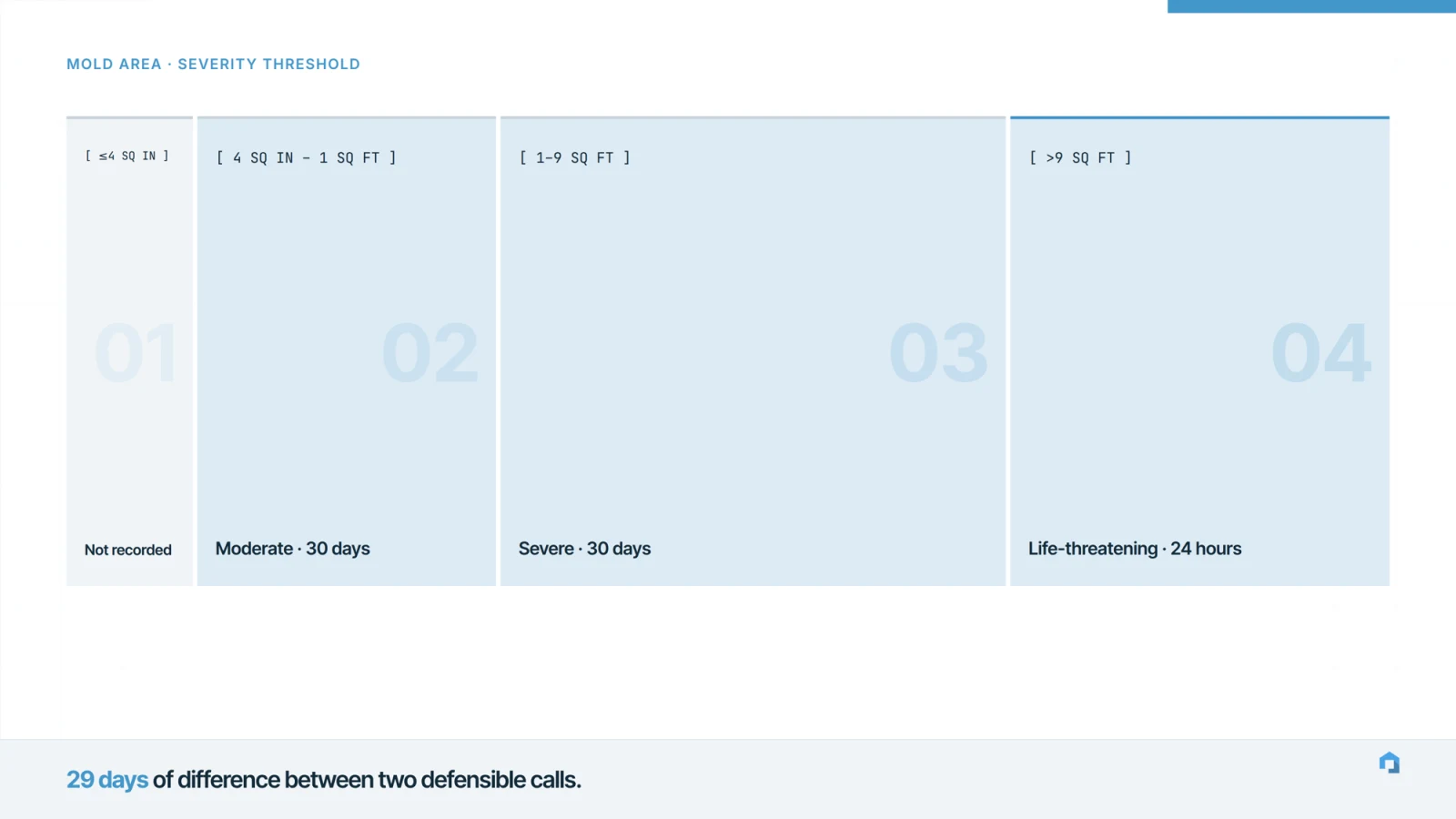
Mold, by area. Four square inches or less is not a recordable deficiency, so your inspector writes nothing. Above four square inches and below one square foot is moderate; a 30-day fail. One to nine square feet is severe. Above nine square feet is life-threatening, 24 hours.
Which means your inspector is standing in a bathroom estimating an irregular patch by eye, and that estimate decides whether the condition goes unwritten, becomes a 30-day fail, or becomes a 24-hour emergency. Two inspectors can look at the same wall and file it differently, and both are following the standard.
Handrails, missing versus never installed. A handrail that is missing, meaning one was there, is a moderate fail at 30 days. A stairway that never had a handrail where the standard requires one is low, which passes. Same empty wall, and the outcome turns on whether your inspector concludes something was removed.
Egress obstruction. Everything under the egress standard is life-threatening: blocked exit paths, double-key deadbolts, fixed security bars on rescue openings at or below the third floor, and a permanently installed window air conditioner blocking a rescue opening in a sleeping room. You will need a shared answer for the unit with a heavy window unit and no other cooling, because “permanently installed” is not defined tightly enough to settle that in the field.
In practice: what your team should iron out before the first NSPIRE cycle
- A shared method for estimating mold area, whether that is a reference card, a tape measure, or a photo protocol, so the four-square-inch and one-square-foot lines get measured rather than eyeballed.
- A written position on handrails: what evidence of prior installation your inspectors treat as sufficient.
- A written position on window air conditioners in sleeping room rescue openings.
- Two reinspection lanes, not one. Life-threatening items generate a 24-hour clock and a near-immediate verification visit. Severe and moderate items queue at 30 days. Under HQS most programs ran a single lane.
- A landlord notice covering the four retrofit items (sealed-battery or hardwired alarms, CO alarms, GFCI, and water-heater discharge piping), sent before the first inspection cycle rather than after the first failure.
The enforcement endgame tightened, separately from NSPIRE-V
Under the HQS text, an owner who missed the cure deadline triggered abatement, and when the tenancy actually ended was administrative-plan policy.
Under the HOTMA-amended enforcement rules at 24 CFR 982.404, abatement is required when the owner misses the deadline, and the housing agency must terminate the HAP contract if the unit still does not comply within 60 days of the noncompliance determination. The household gets at least 90 days to lease somewhere else. This applies to HAP contracts executed or renewed on or after June 6, 2024.
That change came from HOTMA rather than NSPIRE, but the practical effect is that the NSPIRE-V correction clocks now have a mandatory consequence at the end of them.
Inspection frequency does not change
NSPIRE governs what is inspected, not how often. Your cadence still comes from program rules: CoC annual, ESG annual, HOME TBRA annual, HCV at least biennial, Mod Rehab annual. If someone tells you NSPIRE changes your inspection schedule, they are conflating it with HOTMA.
Where the standards apply, as of August 2026
| Program | Standard now | NSPIRE required |
|---|---|---|
| Public Housing | NSPIRE (scored) | In effect since July 2023 |
| Multifamily | NSPIRE (scored) | In effect since October 2023 |
| HOPWA | NSPIRE | In effect since February 2, 2026 |
| CoC and ESG | Pre-2023 standards unless early-adopted | October 1, 2026 |
| HCV, PBV, Mod Rehab | Pre-2023 HQS unless early-adopted | February 1, 2027 |
| HOME and HTF | Pre-2023 standards | Approximately April 14, 2027 |
Two requirements bind right now regardless of which standard your program still inspects under, because they come from statute rather than from NSPIRE: carbon monoxide alarms, enforceable since December 27, 2022, and hardwired or sealed 10-year-battery smoke alarms, effective December 29, 2024. If your HQS checklist does not cover them, your checklist is behind the law — the HUD-52580 forms predate both.
What this means for how you run inspections
Every observed condition now maps to a published deficiency with a severity and a clock, or it does not get recorded. That is a better inspection than HQS produced. It also means your record has to carry more than an outcome: which standard the inspection was conducted under, what severity was assigned, when the clock started, and what closed it.
Padmission Journey’s inspections administration is built around that structure — the four tiers are the shape of the form rather than a reference your inspector consults, the correction window attaches to the classification, photos attach to the room and element they document, and the result syncs to the tenancy record when the device is back in cellular or WiFi coverage. Padmission Inspections also runs on its own for teams doing HQS and NSPIRE-V work without full rental assistance administration.
What to do next
If your program has not set its NSPIRE-V date, that is the first decision, and CPD grantees must document the chosen date in program records either way.
Book a conversation with Padmission to walk through how severity classification, correction clocks, and reinspection run from one record across a provider network.
Read next: The deadline that arrived without the standards — what CoC and ESG programs are still waiting on, eight weeks out. For the wider system view, centralized landlord engagement covers what NSPIRE-V retrofit conversations do to landlord retention.
Frequently asked questions
What is the difference between HQS and NSPIRE-V?
HQS is a 13-requirement, room-by-room checklist at 24 CFR 982.401, dating to the 1970s Section 8 program, where the inspector interpreted terms like “adequate heat” and “free of hazards.” NSPIRE-V, at 24 CFR part 5 subpart G, replaces it with roughly 70 published standards. Each defines a specific deficiency, classifies it by location and by severity — life-threatening, severe, moderate, or low — and attaches a fixed correction timeframe. NSPIRE-V also adds affirmative requirements: things that must be present and working, such as smoke alarms in bedrooms and GFCI protection near water, rather than merely undamaged if they happen to exist.
Does NSPIRE-V score units for CoC, ESG, and voucher programs?
No. The 0–100 scoring model applies only to Public Housing and HUD Multifamily REAC inspections. For Housing Choice Voucher, Project-Based Voucher, and CPD programs including CoC and ESG, inspections remain pass/fail at the unit level. Severity determines whether a deficiency fails the unit and how long the owner has to correct it, not a score.
What are the NSPIRE-V correction timeframes?
Life-threatening deficiencies must be corrected within 24 hours of notification. Severe and moderate deficiencies carry 30 days, or a longer period the housing agency approves. Low deficiencies are recorded but do not fail the unit and carry no required correction timeframe in voucher and CPD programs.
What fails under NSPIRE-V that passed under HQS?
The highest-volume items are smoke alarms in the wrong location or with the wrong power source, missing carbon monoxide alarms, missing GFCI protection within six feet of a water source, ungrounded three-prong outlets, water-heater discharge-piping defects, and units heated only by portable space heaters. Address and signage that is broken or illegible is also a new moderate fail with no HQS equivalent.
What passes under NSPIRE-V that failed under HQS?
A cracked windowpane that still functions is not a recordable deficiency. Litter outside a building is classified low and passes. Cosmetic conditions — surface cracks, stains, worn finishes — are low. The HQS site-and-neighborhood performance requirement was removed from unit inspections entirely. And NSPIRE-V contains no affirmative requirement that a living room or bedroom have a window, which HQS did require.
Do carbon monoxide and smoke alarm rules apply before my program adopts NSPIRE-V?
Yes. Both come from statute rather than from NSPIRE. Carbon monoxide alarm requirements have been enforceable since December 27, 2022, and the hardwired or sealed 10-year-battery smoke alarm requirement took effect December 29, 2024. They apply regardless of which inspection standard your program is currently using, and the HUD-52580 and 52580-A forms do not cover them.
Does NSPIRE-V change how often units are inspected?
No. Inspection frequency comes from program regulations and from HOTMA, not from NSPIRE. CoC and ESG remain annual, HOME TBRA annual, HCV at least biennial with a triennial option for qualifying small rural PHAs, and Mod Rehab annual. NSPIRE-V changes what is inspected and how deficiencies are classified, not the cadence.
Sources
- 24 CFR part 5 subpart G — NSPIRE standards, inspections, and corrections
- 88 FR 30442 — NSPIRE final rule (May 11, 2023)
- 88 FR 40832 — NSPIRE Standards Notice (June 22, 2023), revised August 11, 2023
- HUD — NSPIRE standards and notices
- PIH Notice 2026-18 (July 15, 2026) — NSPIRE-V administrative procedures; supersedes PIH 2023-28 and PIH 2024-26 REV-1
- 24 CFR 982.404 as amended by the HOTMA HCV/PBV final rule, 89 FR 38224 — enforcement and termination
- Consolidated Appropriations Act, 2021 (P.L. 116-260) § 101 — carbon monoxide alarms; implemented via PIH 2022-01
- Public and Federally Assisted Housing Fire Safety Act of 2022 (P.L. 117-328, Division AA, Title VI, § 601) — smoke alarms
Appendix: Criterion by criterion, as of August 4, 2026
What this table is, and what it isn’t. HUD has not published NSPIRE standards specific to CPD programs — Continuum of Care and ESG. Until it does, the determinations below are drawn from the general standards at 24 CFR part 5 subpart G and the voucher-program (NSPIRE-V) checklist, which is the closest published guidance to how CoC and ESG inspections are likely to run. Severity assignments and correction clocks are current as of August 4, 2026, against NSPIRE standards version 3.0. Where CPD-specific guidance differs once it publishes, that guidance governs and this table does not. On why that guidance is missing eight weeks out, see the deadline that arrived without the standards.
Severity determinations shown are the voucher and CPD determinations. Public Housing and HUD Multifamily inspections are scored and some timeframes differ.
| Criterion | Under HQS | Under NSPIRE | Severity | Outcome |
|---|---|---|---|---|
| Smoke alarms | One per level, any battery type, no bedroom placement rule | Each level, inside each bedroom, within 21 ft of a bedroom door; hardwired or sealed 10-yr battery | Life-threatening | Fail — 24 hr |
| Carbon monoxide alarms | No requirement | Required where a fuel-burning appliance or fireplace exists, within one story of an attached garage, served by a remote forced-air furnace, or in a building containing a fuel-burning appliance | Life-threatening | Fail — 24 hr |
| GFCI protection | No requirement | Required within 6 ft of sink, tub, shower, faucet, toilet; inoperable test/reset also cited | Severe | Fail — 30 days |
| Exposed conductors | General “free from electrical hazards” | Exposed conductor; water contacting conductor | Life-threatening | Fail — 24 hr |
| Ungrounded or dead outlets | Rarely caught, no tester required | Instrument-tested; improperly wired 3-prong or dead outlet | Severe | Fail — 30 days |
| Damaged outlet or switch | Inspector judgment | Visibly damaged with function impacted | Life-threatening | Fail — 24 hr |
| Mold-like substance | No standard | Defined by cumulative area per room: ≤4 sq in not recordable; >4 sq in to <1 sq ft; 1–9 sq ft; >9 sq ft | Moderate / Severe / Life-threatening by area | Fail above 4 sq in — 30 days or 24 hr |
| Elevated moisture | No standard | Moisture-meter verified | Moderate | Fail — 30 days |
| Infestation | “Free of vermin and rodent infestation” | Evidence of pests; extensive roach, bedbug, mouse, or rat activity | Moderate / Severe | Fail — 30 days |
| Lead-based paint | Defers to 24 CFR part 35 | Same, with two-tier severity by de minimis threshold; visual assessment scope differs HCV vs PBV | Severe / Moderate | Fail — 30 days |
| Heating, in season (Oct 1–Mar 31) | “Capable of maintaining a healthy thermal environment” | Inoperable or below 64°F; 64–67.9°F is a separate tier | Life-threatening / Severe | Fail — 24 hr / 30 days |
| Heating source | Not specified | Permanently installed source required; cooking appliances, portable heaters, fireplaces, and wood stoves do not count | Life-threatening / Severe | Fail |
| Unvented fuel-burning space heaters | Prohibited | Prohibited; prior HQS variations rescinded effective Jan 1, 2024 | Life-threatening | Fail — 24 hr |
| Water heater TPR valve and discharge | “Pressure relief valve and discharge line” | Enumerated: valve function, pipe material, slope, termination height 2–6 in from receptor | Severe / Moderate by defect | Fail — 30 days |
| No hot water | Fail | Defined | Severe | Fail — 30 days |
| Blocked flue or chimney; damaged gas shutoff | Inspector judgment | Defined | Life-threatening | Fail — 24 hr |
| Egress | “Alternate means of exit in case of fire” | Obstructed egress; double-key deadbolts; fixed security bars on rescue openings at or below 3rd floor; keyed or tool-operated locks on movable bars | Life-threatening | Fail — 24 hr |
| Guardrails | Field convention, roughly 30 in | Required at drops ≥30 in; missing or not functionally adequate | Life-threatening | Fail — 24 hr |
| Handrails — missing | Field convention, 4 risers | Required at ≥4 risers; 28–42 in height; 200-lb load. “Missing” means one was previously installed | Moderate | Fail — 30 days |
| Handrails — never installed | Same convention | “Not installed where required,” never previously present | Low | Pass |
| Entry door security | Lockable required | Cannot be secured; will not open or close | Severe / Moderate | Fail — 30 days |
| Windows — operation and security | Lockable if accessible; presence required in living room and bedrooms | Operability, security, and egress function of windows that exist | Moderate / Severe | Fail — 30 days |
| Windows — presence | At least one required in living room and each sleeping room | No affirmative presence requirement in 5.703 | — | No longer inspected |
| Cracked but intact pane | Often failed | No cracked-pane criterion; not recordable if the window remains functionally adequate | — | Pass |
| Cooking appliance | Required, with microwave substitution rules | Missing, or will not ignite or heat | Severe | Fail — 30 days |
| Refrigerator | Required, appropriate size | Missing or inoperable | Moderate | Fail — 30 days |
| Food preparation surface | Not evaluated | Absent prep area, ≥10% exposed substrate, or unsanitizable surface | Moderate | Fail — 30 days |
| Sole toilet — damaged | Private flush toilet required | Damaged or inoperable | Severe | Fail — 30 days |
| Sole toilet — missing | Same | Missing entirely | Life-threatening | Fail — 24 hr |
| Sole tub or shower | Required | Inoperable | Severe | Fail — 30 days |
| Bathroom ventilation | Openable window or vent | Same; missing | Moderate | Fail — 30 days |
| Structural failure | “Structurally sound,” judgment | Signs of serious structural failure | Life-threatening | Fail — 24 hr |
| Roof hole or ponding | Judgment | Unintentional roof hole of any size; ponding roughly ≥25 sq ft | Moderate | Fail — 30 days |
| Trip hazards | Undefined judgment | Unintended vertical difference ≥¾ in, or horizontal separation ≥2 in, perpendicular to path of travel | Moderate | Fail — 30 days |
| Sharp edges | Judgment | Separate defined standard | Severe | Fail — 30 days |
| Site and neighborhood | Performance requirement covering noise, pollution, traffic, drainage | Removed from unit inspections entirely (still applies to PBV site selection) | — | No longer inspected |
| Litter — outside | Could fail | 10+ small items in a 10×10-ft area, or any large discarded item | Low | Pass |
| Litter — inside | Could fail | Same definition, inside the building | Moderate | Fail — 30 days |
| Address and unit signage | Not required | Broken, illegible, or not visible | Moderate | Fail — 30 days |
| Outlets per room | 2 outlets, or 1 plus a fixture, in living room and bedrooms | Same rule generalized to all habitable rooms | Moderate | Fail — 30 days |
| Kitchen and bathroom light fixture | Permanent fixture required | Same | Moderate | Fail — 30 days |
| Occupancy | Two persons per sleeping room | Carried over at 5.703(d)(5) | — | — |
Not established as of this date
Three determinations could not be confirmed against a published HUD standard and are marked here rather than guessed:
- Microwave as the sole cooking appliance. HQS explicitly allowed substitution in defined cases. The NSPIRE Cooking Appliance and Food Preparation Area standards do not address it, and PIH 2026-18 is silent. Treat as PHA-policy territory until HUD says otherwise.
- Missing outlet cover or panel knockout. Life-threatening where conductors are exposed. Where they are not, the severity follows the Service Panel standard, which was not directly available for verification.
- Environmental water intrusion and minor surface damage. Sometimes cited as moderate and low respectively. Neither appears in the Structural System, Roof Assembly, or Ceiling standards. If the classifications exist, they sit in another component standard.
Compiled from 24 CFR part 5 subpart G, the NSPIRE Standards Notice (88 FR 40832, as revised August 11, 2023), the individual HUD NSPIRE standard PDFs, the NSPIRE-V inspection checklist, PIH Notice 2026-18, and the pre-2023 text of 24 CFR 982.401. Verified August 4, 2026 against standards version 3.0.