The short version
- Many housing-search delays are readiness failures that systems misdiagnose as search failures. Starting the unit search before the household understands its assistance, has its documents, and knows its screening barriers turns predictable problems into application-stage surprises.
- Federal housing programs already treat housing search as more than finding a listing. Eligible services include credit work, application support, landlord communication, lease education, and other work that occurs before and after the actual unit search.
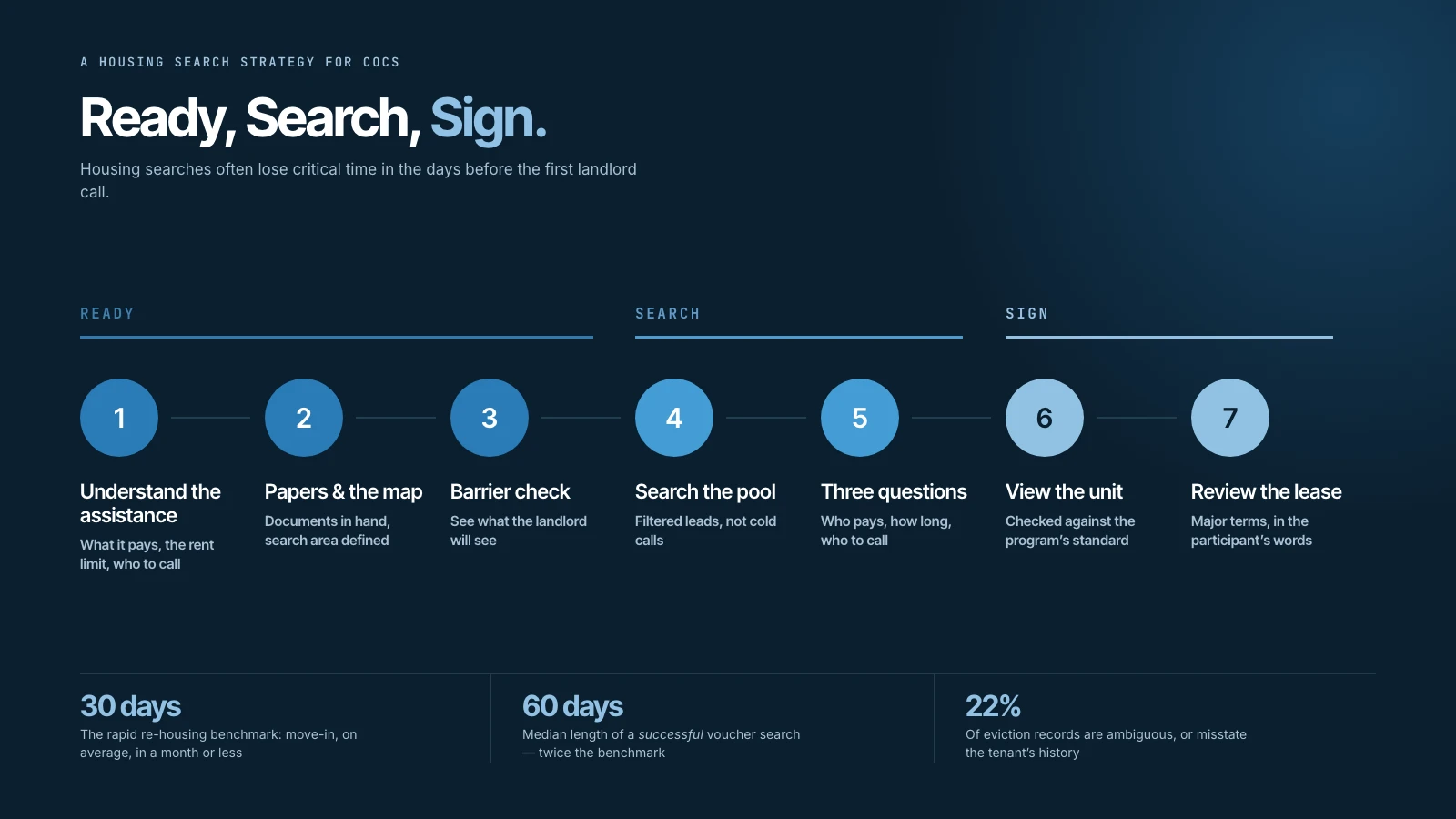
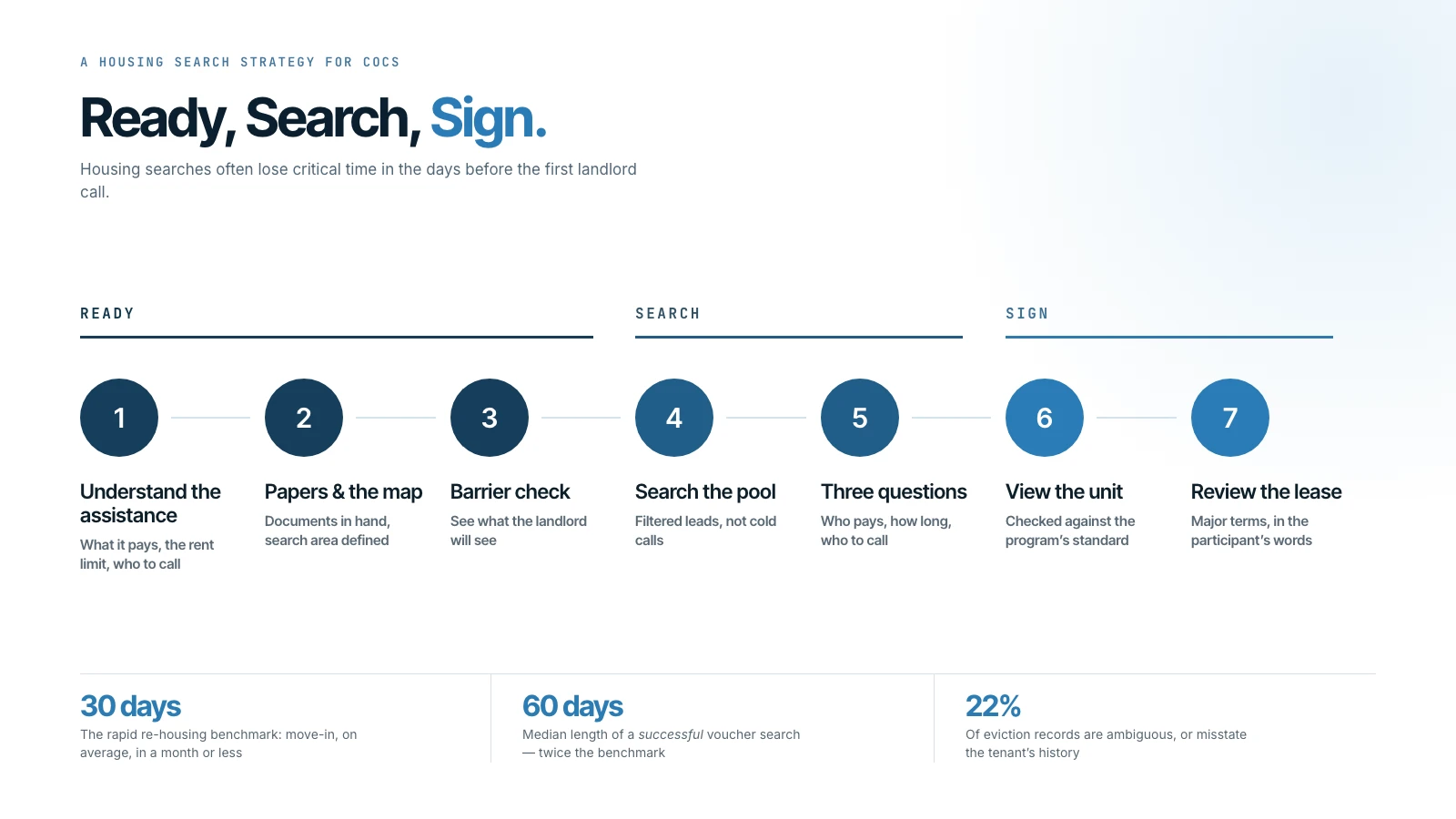
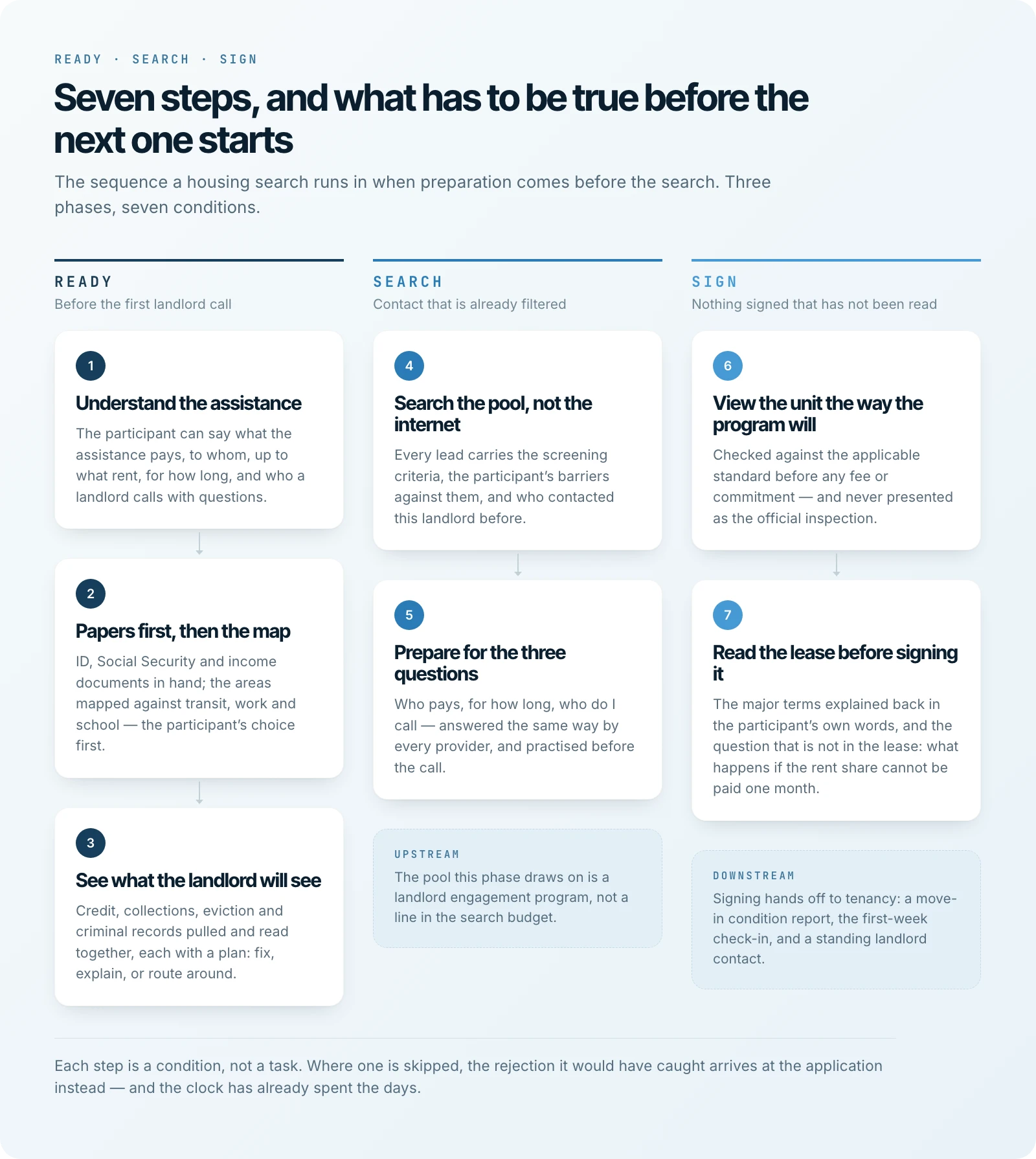
- The sequence matters. Ready, Search, Sign organizes the work into seven steps, with a condition that should be true before the next one begins.
- A good housing search does not eliminate barriers or guarantee approval. It moves knowable barriers forward, where the participant and navigator still have time to respond.
- For system leaders, the key measures are not only lease-ups. They are where time is being lost, when barriers are discovered, why applications fail, and whether providers are working from the same housing information.
Putting the cart before the horse
This happens every day across urban, rural and suburban systems — sophisticated and rudimentary, well-funded and sparsely resourced alike. I’ve seen it. I’ve been guilty of it. A case manager or housing navigator spends their remaining emotional capacity intentionally applying trauma-informed motivational interviewing to help someone in crisis identify their motivation and goals. The unhoused neighbor they serve takes their advice, finds a unit, and applies, just to be shut down for their credit score, denied for their lack of earned income, or put off until they have their IDs and proof of income.
None of this is new information, but the housing search is extended because it was addressed reactively instead of proactively.
The photo ID is expired. The rent is outside the program’s allowable range. A prior-landlord balance appears on the screening report. An eviction filing the participant thought had been dismissed appears as unresolved. The property requires something that could have been identified before the viewing.
None of those problems began at the application. They became visible there.
That distinction matters because housing search is the part of the process everyone can see. When placements stall, programs naturally respond by looking for more listings, making more landlord calls, or asking navigators to search harder. Sometimes housing supply really is the constraint. But many searches begin before the household is ready to use the supply the system already has.
That is premature search: opening the unit search before the conditions necessary to complete it are in place.
The result is a familiar cycle. Staff spend time contacting units that won’t work. Participants experience preventable denials. Landlords answer questions the program should already have resolved. The assistance clock keeps running while documents and screening issues get handled after they become urgent.
Put the steps in order and the same staff time produces viewings that can end in a lease: documents, rent range and screening issues settled first, then the search. It takes no more time than handling them after a denial, and it spends the assistance clock on units the household can actually get.
Housing search is already more than finding a unit
There is no single federal definition of housing search across every housing program, but the programs that define it describe something much larger than a listings function.
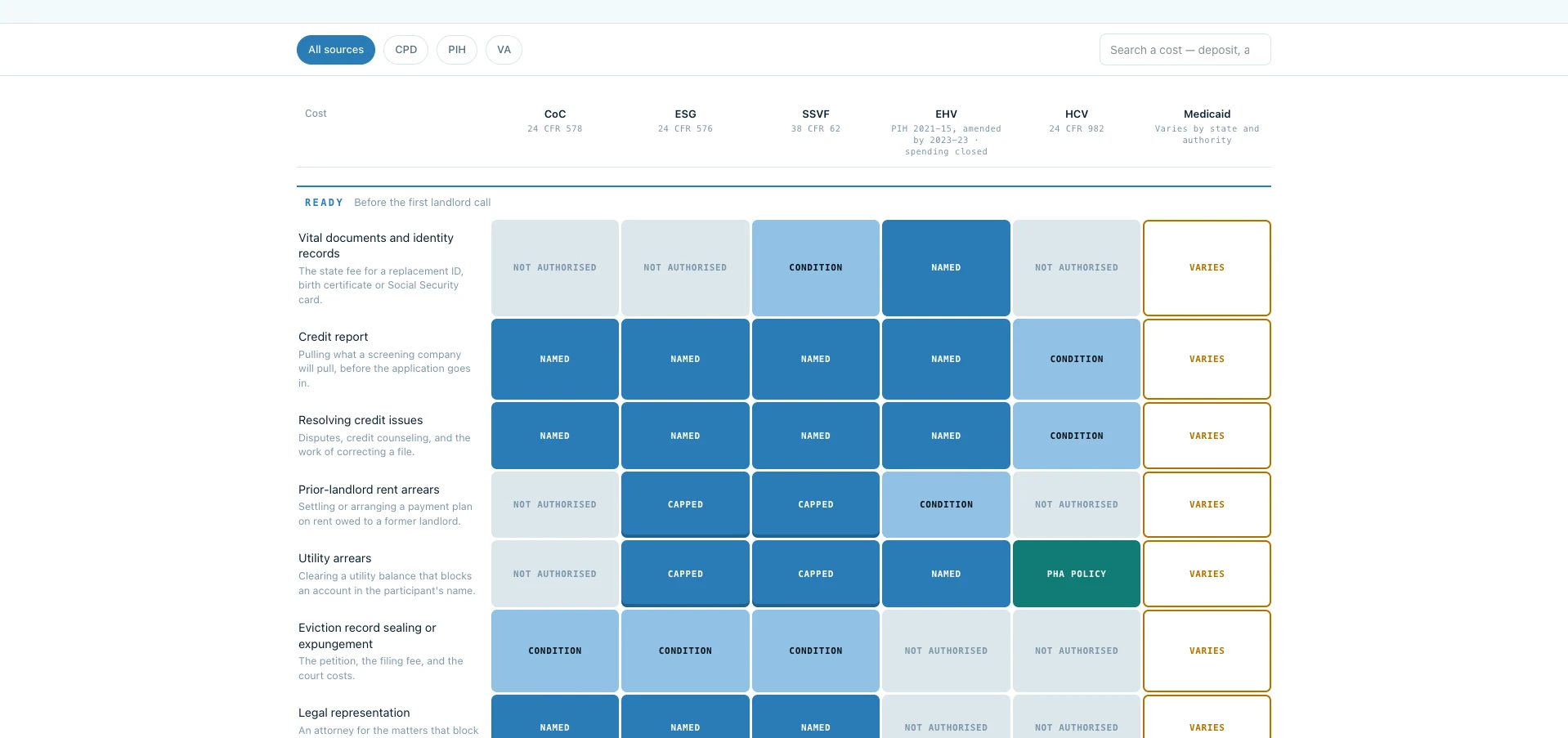
The Continuum of Care regulation defines housing search and counseling services as the cost of helping participants “locate, obtain, and retain suitable housing,” and the list of what that includes is the interesting part: helping households “understand leases,” securing utilities, mediation with landlords, “credit counseling, accessing a free personal credit report, and resolving personal credit issues,” and “the payment of rental application fees,” all under 24 CFR 578.53(e)(8). ESG’s parallel service, housing search and placement, is written the same way at 24 CFR 576.105(b)(1).
HUD’s newest funding models the exact gaps programs serving people experiencing homelessness have learned. The Emergency Housing Voucher program paid PHAs a $3,500 service fee per voucher and required housing search assistance be offered to every participant — covering application and holding fees, security and utility deposits, moving costs, household goods, and tenant-readiness work on barriers like thin or damaged credit, per HUD’s EHV service fee guidance. EHV is winding down, and for this purpose it is already closed: no surrendered voucher could be reissued after September 30, 2023, families have moved onto regular vouchers, and the services fee could not be spent at all after August 19, 2025, per HUD’s EHV page and Notice PIH 2025-19. It stays in the argument as the clearest case of HUD pricing the pre-search work and paying for it. For veterans, SSVF pays for much of this today: its rule names housing search assistance, credit counseling and outreach to landlords, and its funding notice adds a landlord payment and a move-in allowance, per 38 CFR part 62 and VA’s FY 2027 SSVF funding notice. In a growing number of states, Medicaid now pays for housing navigation as a health service; California’s version covers a housing assessment, a support plan, the search, application help, landlord education, and advocacy, with deposits and tenancy support funded separately, per NASHP’s summary of CalAIM housing supports.
The rapid re-housing field has had a standard since 2016. The Rapid Re-Housing Performance Benchmarks and Program Standards, developed with HUD, the VA, and USICH, name housing identification as a core component and set the benchmark that households “move into permanent housing in an average of 30 days or less.”
The common shape is straightforward:
Get ready. Find and secure. Sign and hold.
The problem is that the middle phase, the visible search, is often much more structured than the preparation around it.
We call the full sequence Ready, Search, Sign. It has seven steps. Each step creates a condition the next step depends on.
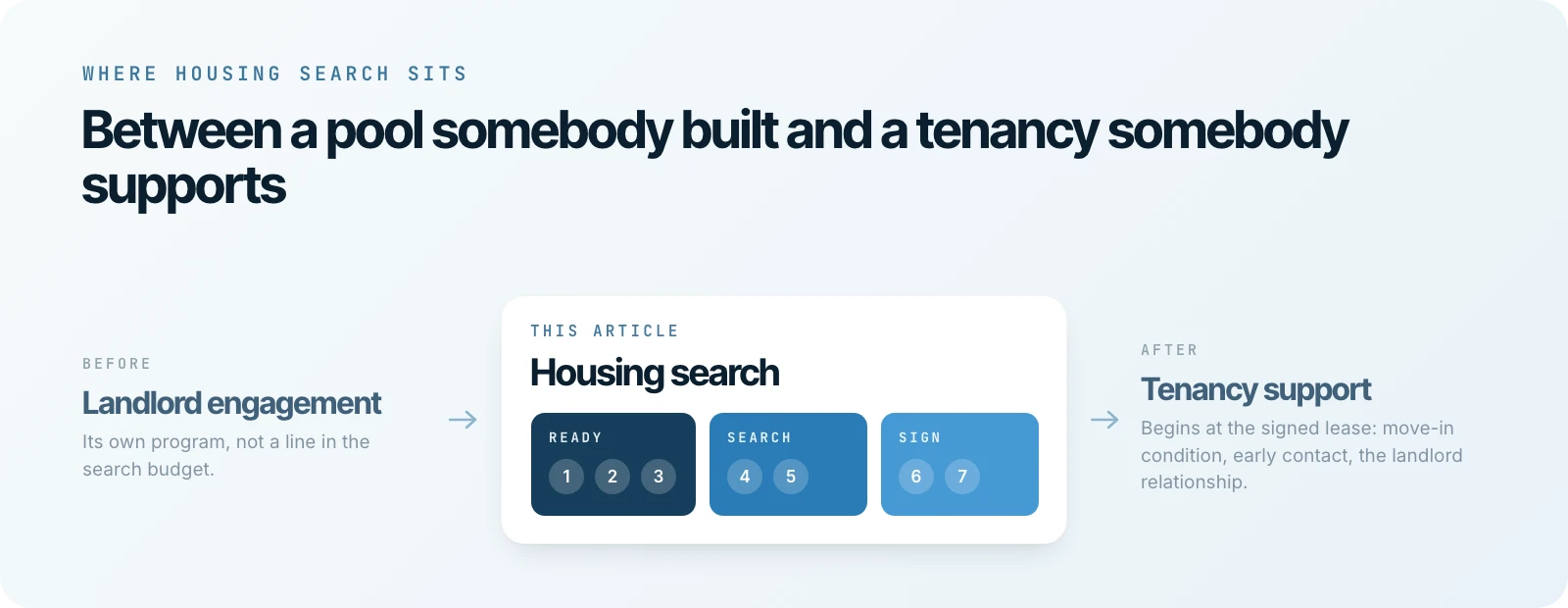
The landlord pool itself is built upstream, and it is its own discipline. Our guide to landlord engagement strategies for CoCs works through how communities staff that function centrally and what they ask of the agencies sharing it. This article begins where a household is preparing to use the supply that work produces.
What has to be true before the next step
The value of the sequence is not whether staff can say all seven activities occurred eventually. The question is whether the necessary condition was in place before the next stage started.
| Step | Ready to proceed when… | Early failure signal | Useful system measure |
|---|---|---|---|
| 1. Understand the assistance | The participant can explain what the assistance pays, the rent range, the timeframe, and who the landlord contacts | Staff or landlords have to explain the subsidy after a unit is identified | Days from program enrollment to search-ready status |
| 2. Build the packet and define the search area | Required application documents are available and the participant has identified practical areas where they want to live | Applications pause for documents or searches begin without geographic priorities | Share of searches opened with a complete packet |
| 3. Check known barriers | Credit, landlord debt, eviction history, and other relevant screening issues have a plan | The first meaningful discussion of a barrier happens after a rejection | Barriers found before application versus at rejection |
| 4. Search the housing pool | Listings have current criteria and can be filtered against participant needs and known barriers | Staff cold-call listings before knowing whether the household can qualify | Qualified leads contacted per search |
| 5. Prepare the landlord conversation | The participant or navigator can explain payment, duration, and program contact consistently | Different providers describe the same assistance differently | Landlord contacts requiring program clarification |
| 6. View against program requirements | The unit appears likely to meet the applicable housing standard before fees or commitments are made | Obvious deficiencies are first discovered during the formal inspection | Units screened out before formal inspection |
| 7. Review the lease | The participant understands the major lease obligations and knows who to call when something goes wrong | Lease terms become a surprise after move-in | Documented lease reviews before signing |
A system does not need every search to move through those gates at the same speed. Households are different. Markets are different. Barriers are different.
What should remain consistent is the order.
READY
Step 1: The ticket is a countdown, not a coupon
A housing voucher or program slot creates an opportunity, but it usually also creates a clock.
The Housing Choice Voucher program sets the clearest version of that clock: the initial voucher term “must be at least 60 calendar days,” suspended while a tenancy approval request is pending, under 24 CFR 982.303. It is a useful yardstick, because HUD’s own analysis puts the median successful voucher search at about 60 days — twice the 30-day rapid re-housing benchmark — per HUD’s analysis of voucher success rates.
The important operational point is not whether every CoC program follows an HCV clock. They do not.
It is that every search has a limited window in which staff attention, participant attention, housing availability and program resources have to line up — and that window should not open with the participant still working out what their assistance means. Before listings, they should be able to explain what the program pays, who receives the payment, the rent limit governing the search, how long the assistance lasts, and who a landlord calls with questions. Pin the rent limit down first: which FMR applies, and how differs across ESG, CoC, HCV, HOPWA and HOME, and a navigator working from the wrong figure searches the wrong end of the market.
▸ System design. Write the explanation once for each program type, in the language a landlord will hear it in, and issue it with the ticket. A landlord should not receive five materially different explanations of the same assistance because five agencies happen to administer it.
Step 2: Papers first, then the map
Nothing stalls an otherwise viable application as predictably as discovering that a required document is missing after a landlord is ready to proceed.
Photo identification, income or benefit verification, program documentation, Social Security documentation where required, references, and a working contact method should be assembled before the first serious landlord contact.
For people experiencing homelessness, that isn’t clerical busywork. The Government Accountability Office, the nonpartisan agency that audits federal programs for Congress, has documented that people experiencing homelessness “often lack a reliably safe place to store IDs,” may be unable to give a residential address to obtain one, may not be able to pay the fee or reach the office, and lose documents when encampments are cleared, per GAO-24-105435. The same report found that seven of the ten states it reviewed accept a wider range of identity documents, including school or military records and expired IDs, and some let shelter staff verify residence by affidavit. Knowing which your state allows pays for itself, because the money is awkward here: staff time to assemble documents sits comfortably inside housing search and placement services, but the fee for the document itself is named by none of the funding sources. The cheapest route is usually procedural — an affidavit or alternative document the state already accepts — rather than financial.
That makes document recovery part of the housing-search strategy, not something to send the participant away to solve.
Then comes the map, because “Where do you want to live?” should not be answered by whichever unit appears first.
The evidence for choice is the evidence that underpins Housing First. In the original randomized study, participants who chose their own apartments and neighborhoods “obtained housing earlier, remained stably housed, and reported higher perceived choice” than the comparison group, per Tsemberis, Gulcur, and Nakae’s 2004 study. The rapid re-housing standards make it a program standard: “multiple housing choices within practical constraints.”
Those constraints are real. A unit may meet the rent limit and still be wrong for the household because it is three bus transfers from work, separates children from their school, makes medical care impractical, or removes the household from the people who help them stay stable.
The navigator’s role is to convert the participant’s preferences into a usable search area before listings begin: neighborhoods, transportation, work, school, family, accessibility, and other requirements that would make an otherwise available unit unworkable. Real client choice depends on the household seeing enough of the pool to compare one option against another — three listings is a referral, not a choice.
Cincinnati has been running that argument since 2023, when Strategies to End Homelessness launched RentConnect across 30 partner agencies. Its manager frames centralization as a choice problem before it is a speed one: without a shared pool, households were essentially made to take what they could get. Tiffany Gehrlich, RentConnect Manager at Strategies to End Homelessness, puts the stakes plainly:
“What we know about housing stability is that it increases dramatically when people get to make their own decisions about where they live.”
▸ Case manager and navigator. Build the document packet as a physical and digital set before the search opens: ID, Social Security documentation, income and benefit letters, the subsidy paperwork, a reference list with phone numbers, and a phone number a landlord can actually reach. Then draw the map with the participant, not for them.
Step 3: See what the landlord will see
Many of the conditions that lead to a denial can be identified before the application. Not every denial is predictable, but credit files, prior-landlord debt, eviction records, criminal records where relevant, source-of-income protections and documented screening criteria should not stay unknown until a screening company returns its result.
The barrier check has a simple purpose: see what the landlord is likely to see while there is still time to do something with the information.
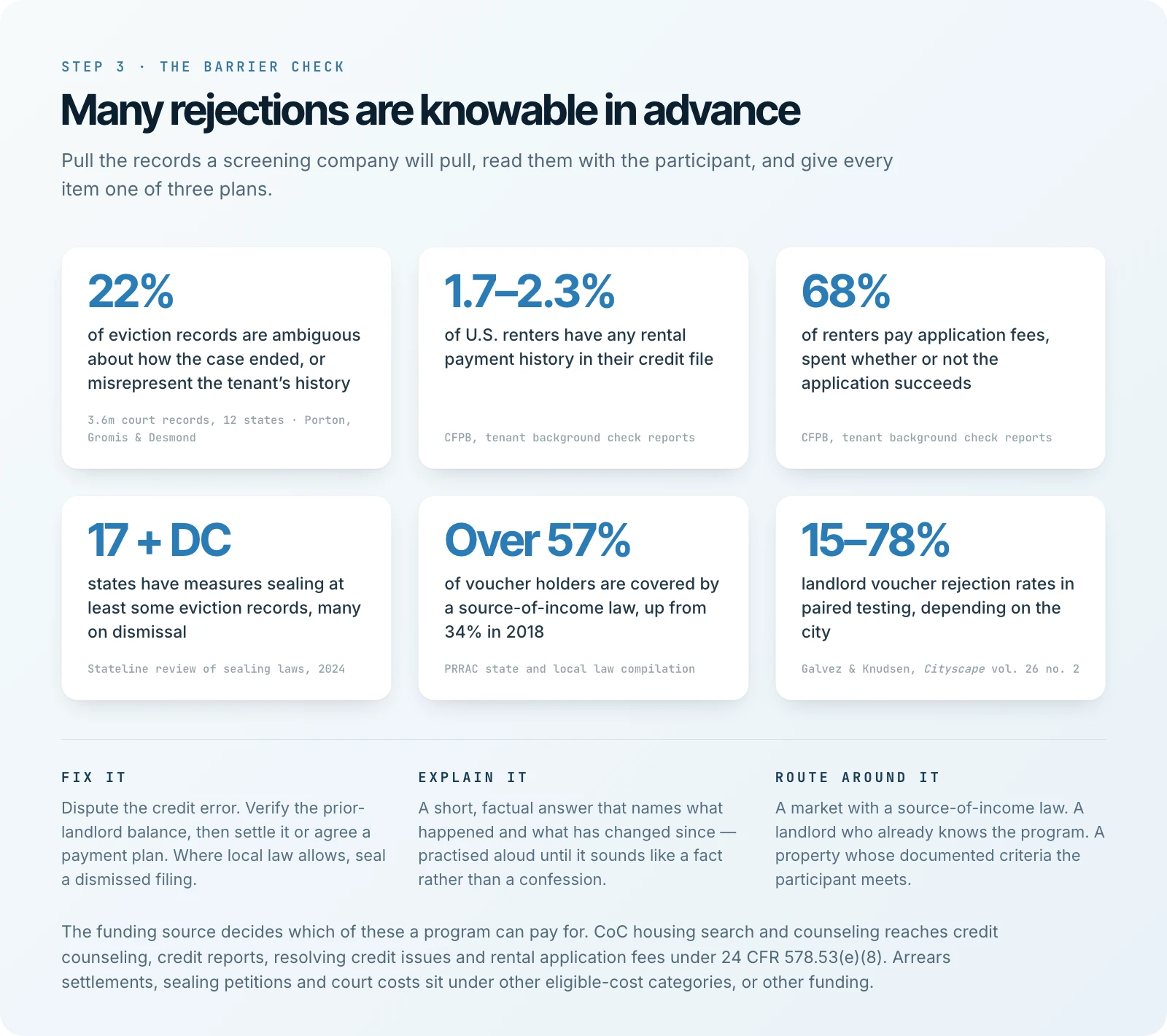
Each material issue gets one of three plans:
Fix it. Explain it. Route around it.
An incorrect record gets disputed or corrected. An accurate prior-landlord balance may need verification, settlement, or a payment plan. A dismissed eviction filing may need documentation or, where local law permits, sealing. A legitimate barrier that can’t be changed becomes part of the property-matching strategy rather than a surprise after an application fee has been paid.
Credit is a good example, and the useful starting point is the report rather than the score — AnnualCreditReport.com is the federally authorized source for the free ones. The reason to pull them early is structural: rental payment history appears in the files of “between 1.7% to 2.3% of U.S. renters,” so a household can pay rent on time for years and still show a thin or empty file. The same reports found 68 percent of renters pay application fees, and that of more than 24,000 renter complaints reviewed, over 16,000 concerned incorrect information on a screening report, per CFPB’s tenant background check reports.
Eviction records require the same care. A filing is not the same thing as an eviction judgment. Research on 3.6 million court records across 12 states found that roughly 22 percent were ambiguous about how the case ended or misrepresented the tenant’s eviction history, per Porton, Gromis and Desmond in Housing Policy Debate. Several jurisdictions also seal some eviction records automatically or through a petition process.
Criminal-record screening requires local knowledge as well. HUD has withdrawn or rescinded several previous federal guidance documents in this area, while program requirements and state and local fair-chance rules continue to vary. The appropriate question for a navigator is therefore not “What is the national rule?” but “What may this landlord lawfully consider in this market, under this program, today?”
Source-of-income protection is similarly local, and now covers “over 57%” of voucher holders nationally, up from 34 percent in 2018, per PRRAC’s state and local law compilation. Paired testing found landlord rejection rates ranging from 15 percent in one large city to 78 percent in another, and jurisdictions adopting protections saw voucher use rise 7 to 12 points against their neighbors, per Galvez and Knudsen in Cityscape. Where those laws apply, a navigator should know the difference between a property unlikely to suit a household and one whose refusal of lawful rental assistance may itself be illegal.
The barrier check should not become an interrogation about someone’s worst year. Ask only for information that changes the housing plan, explain why the question matters, verify records rather than assuming they are right, and let the participant decide how anything personal is disclosed when disclosure is actually necessary.
By the time the search opens, the participant and navigator should know which barriers have been resolved, which need a short factual explanation, and which types of property are unlikely to be viable.
That is search readiness.
▸ System design. The barrier check costs money, and the funding source decides which costs. CoC supportive services expressly reach credit counseling, access to a free personal credit report, resolving personal credit issues, and rental application fees under 578.53(e)(8). Other remediation — arrears settlements, record-sealing petitions, court costs — sits under different eligible-cost categories or different funding entirely. Build the barrier-check budget from the rules of the source paying for it, and confirm each line before you commit to it.
SEARCH
Step 4: Search the pool, not the internet
Once the household is ready, the quality of the search depends on the quality of the housing pool.
A navigator working from current properties — owners who understand the programs, units visible across agencies, screening criteria documented — is doing different work from one opening public listing sites and cold-calling, and the difference is counted in days on the participant’s clock.
Albuquerque is close to a controlled test of that, because it started from nothing. Before August 2024 the city had no landlord engagement function at all, and agencies worked from Zillow and personal contact lists; the New Mexico Coalition to End Homelessness then built a closed, vetted network shared by 15 agencies and more than 100 case managers. Two years in, Tenisha Erni, its Lead Landlord Liaison, reports what moved:
“According to HMIS data, the time it takes for clients to locate housing has decreased from 90 days to 46 days on average.”
Getting there meant vetting every landlord before a case manager saw them — the Albuquerque story covers what that asked of the 15 agencies sharing the pool.
Three functions meet here and should stay distinct even when one person performs all of them: landlord engagement creates and maintains the housing opportunities, housing search matches them to a particular household, and housing navigation supports the person moving through it. They need different work and different records.
The operational rule at this stage is simple: filter before contact. Bedrooms, rent, neighborhood, accessibility, pet rules, screening criteria and availability should narrow the pool before a participant spends time on a viewing or an application. That removes the obvious non-matches; the household still chooses among what is left.
The shared record matters because the work also has to survive handoffs. A landlord conversation should not disappear because one staff member is out. A property already contacted by another provider should not look like a new lead. A case manager should be able to see whether a unit is still available and whether someone else is already holding it.
Partnership Home built for that in Tarrant County by moving landlord relationships out of individual caseloads and into a shared record — far enough that frontline staff began bringing the central team landlords they had found themselves. Kimberly Doty, its Director of Housing, describes what that buys on an ordinary day:
“Padmission has given our team a way to centralize our knowledge. We can pick up where someone else has left off in connecting with a property.”
▸ Case manager and navigator. Before the first call, write down the household’s non-negotiables and its known screening constraints, then filter the pool against both. A contact list that hasn’t been filtered is a to-do list, not a search.
Step 5: Prepare for the three questions
Most landlord conversations about rental assistance eventually come down to three questions:
Who pays? For how long? Who do I call?
The participant or navigator should be able to answer each consistently.
The first explains the payment arrangement: what share the program pays, what share the tenant pays, and how the property gets paid. The second explains duration honestly — temporary assistance described as a permanent guarantee, or long-term assistance described as though it vanishes in a few months, both cost the program its credibility. The third is the relationship behind the program: if a property owner has a problem during tenancy, who responds? That answer is a promise, so a program should not advertise landlord support it isn’t structured to provide.
Preparing for the landlord conversation is less about scripting someone’s life story than removing unnecessary uncertainty. The participant doesn’t need to narrate their homelessness, diagnosis, family history, or every event that led to the current search. They need to answer legitimate tenancy questions accurately and understand when a question crosses into information a housing provider is not entitled to demand.
This is where the barrier check earns its place: if an eviction filing is likely to appear the participant has already seen the record, and if there is prior-landlord debt the amount is already verified, so nobody is inventing an explanation for the first time under pressure.
Practice the conversation before the call. The point is not to make every participant sound the same — it is to make sure the program does. When the same subsidy is described differently depending on which provider answers the phone, landlords hear that as uncertainty about the whole system.
▸ System design. Publish the three answers per program type and hold every provider to the same version. Landlord confusion is usually a system inconsistency wearing a customer-service costume.
SIGN
Step 6: View the unit the way the program will
The viewing is the last inexpensive place to discover an obvious physical problem.
The participant is asking, “Do I want to live here?” The navigator should also be asking, “Is there anything here that will stop this unit being approved?”
The applicable inspection standard ultimately governs whether the program can assist the unit. A navigator is not replacing the inspector and should not represent a walkthrough as an official inspection. But staff can carry the current program checklist and recognize obvious conditions before application fees, holding fees, inspections, and move-in plans begin accumulating around a unit that has little chance of approval.
That means checking the basics the formal process will eventually care about: functioning locks, windows, alarms, heating, hot water, electrical conditions, appliances where required, visible hazards, and other conditions covered by the applicable standard.
For buildings constructed before 1978, federal lead-disclosure requirements also apply. The landlord must provide the required lead information and disclosures before the tenant becomes obligated under the lease, under 24 CFR 35.88.
The standard is changing, and the date is close. CoC and ESG programs move from HQS-based requirements to NSPIRE on October 1, 2026, a date HUD set in a Federal Register notice published September 30, 2025. Staff need to know which standard governs the unit in front of them and carry the matching checklist — which is harder than it sounds, because HUD has not published CoC- and ESG-specific NSPIRE standards, leaving programs to prepare against the general standards at 24 CFR part 5 subpart G and the voucher checklist. That gap is its own problem, covered in what CoCs are supposed to inspect against before the deadline arrives. For the walkthrough, the practical change is scale: HQS set 13 performance requirements, NSPIRE publishes roughly 70, so the conditions a checklist has to cover are broader than what staff have been carrying.
A preventable problem found during a walkthrough may cost an afternoon; the same problem found after the participant has committed to the unit can restart a large part of the search.
▸ Case manager and navigator. Carry the checklist that matches the standard governing that unit, and say plainly to the participant and the landlord that a walkthrough is not the official inspection.
Step 7: Read the lease before signing it
Lease signing is often treated as the ceremonial end of housing search. Operationally it is one of the highest-consequence parts of it.
The lease determines rent obligations, late fees, utilities, guest policies, pets, maintenance responsibilities, landlord entry, renewal, termination, and the notice the household must provide when leaving.
It is also not safe to assume that every clause in a lease accurately describes what the law permits. One hand-collected study of 70 residential leases in a single metro area found unenforceable or misleading provisions were common, per Furth-Matzkin in the Journal of Legal Analysis. It is one sample in one jurisdiction, not a national prevalence estimate, but the practical lesson travels: the document deserves review.
The CoC regulation recognizes that directly by including assistance understanding leases within housing search and counseling services.
Before signing, the participant should be able to explain the major terms of the lease in their own words: the term and renewal, rent and due date, late fees, utilities, guest policy, pet policy, repair and entry rules, and notice requirements.
Then ask one question that is usually more important than another paragraph of lease language:
What happens if I cannot pay my share of the rent one month?
The participant should know whom to call before that happens.
A community doesn’t need to turn every navigator into an attorney. It does need a consistent lease-review practice, so understanding the lease isn’t dependent on which agency happens to be supporting the household.
Signing ends the housing search. It doesn’t end housing support.
A move-in condition record, early tenancy contact, housing-stability work and planning for the end of time-limited assistance belong to the next phase, and shouldn’t be squeezed into housing search because the same staff are involved. A good handoff leaves that phase a signed lease, a documented unit condition, clear assistance terms, a known landlord contact, and a participant who understands both the lease and the support behind it.
▸ System design. Adopt one lease-review guide across providers and fund the time it takes. Lease literacy is a funded service under the CoC regulation, not a courtesy.
What this looks like on Monday morning
A mother with two children enters a rapid re-housing program on Monday.
The first conversation isn’t about apartments. It’s about the assistance: what the program pays, what the household owes, how long it lasts, and who a landlord will call.
Her ID expired during a shelter move, so the navigator starts the replacement that day. She wants to stay near her older child’s school and a bus route to work, so they settle on a few neighborhoods rather than the whole metro.
The barrier check finds two issues. A utility balance from years earlier is in collections — verified, and on a plan, before any application goes in. An old eviction filing looks unresolved in a screening record, but the court record shows it was dismissed; they gather the documentation and prepare a short factual explanation in case it surfaces anyway.
Only then does the unit search begin, filtered to two-bedroom units in her areas, inside the rent limit, against documented property criteria. Several viable options remain.
She makes the landlord call with the navigator beside her, knowing how the assistance works, what screening will show, and who the landlord can call. At the viewing, the navigator uses the applicable checklist without calling it an inspection; a bedroom window doesn’t lock, and the landlord agrees to repair it. Before signing, they review the major lease provisions and the contact plan for problems during tenancy.
None of those activities is exceptional. A structured search only makes ordinary work happen in the order the next step requires.
What system leaders should fund and measure
Housing search funding should reflect the work required to complete the sequence, not only the staff hours spent looking for units.
A community that expects barriers to be addressed needs a way to pay for addressing them. One that expects complete packets needs a process for replacing documents. If lease literacy is part of the service, staff need a review guide and training. If navigators are expected to search a coordinated pool, somebody has to maintain the relationships and information that make it useful. Eligible costs differ by source, so program design starts with the grant requirements rather than assuming every housing-search budget buys the same things.
Measurement should follow the sequence too. Lease-ups and days-to-lease still matter, but those figures only say that time was lost, not where. A more useful record shows when the household became search-ready, whether the packet was complete, which barriers surfaced before applying, why applications were denied, which units were rejected before formal inspection, and how long each phase took. Each of those points at a different fix:
- Delay concentrated before Step 4 will not be solved by adding listings.
- Search-ready participants who can’t find viable units point at the housing pool.
- Viable units that repeatedly fail on unknown screening criteria point at the information attached to the inventory.
- Landlords repeatedly asking for clarification point at an inconsistent program explanation.
None of that is visible when every provider keeps its own partial record. System leaders can’t separate a supply problem from a readiness problem if the evidence lives in emails, spreadsheets, case notes and individual staff memory. That is the same erosion our guide to administering housing programs traces across the whole operation: the commitment and the expertise held, and the tooling underneath them never caught up with what the work became.
Frequently asked questions
What is housing search assistance?
Under the CoC Program, housing search and counseling services help participants locate, obtain, and retain suitable housing. Eligible activities include lease education, help securing utilities, landlord mediation, credit counseling and credit-report access, resolution of personal credit issues, and rental application fees under 24 CFR 578.53(e)(8). Other housing programs structure the service differently, so programs should always apply the rules of the funding source supporting the household.
What should be checked before applying for an apartment?
The household should understand its assistance and rent limit; have the documents the application is likely to require; know what appears in relevant credit, landlord-debt, eviction, or other screening records; understand applicable local protections; and compare those conditions with the property’s documented criteria.
The purpose is not to eliminate every possible reason for denial. It is to move knowable issues earlier in the process.
What should a tenant review before signing a lease?
At minimum: the lease term and renewal provisions, rent and due date, late fees, utilities, guest and pet policies, maintenance and repair obligations, landlord-entry provisions, and notice requirements.
The participant should also know whom to contact if a tenancy problem begins.
What Connect does, and what it does not
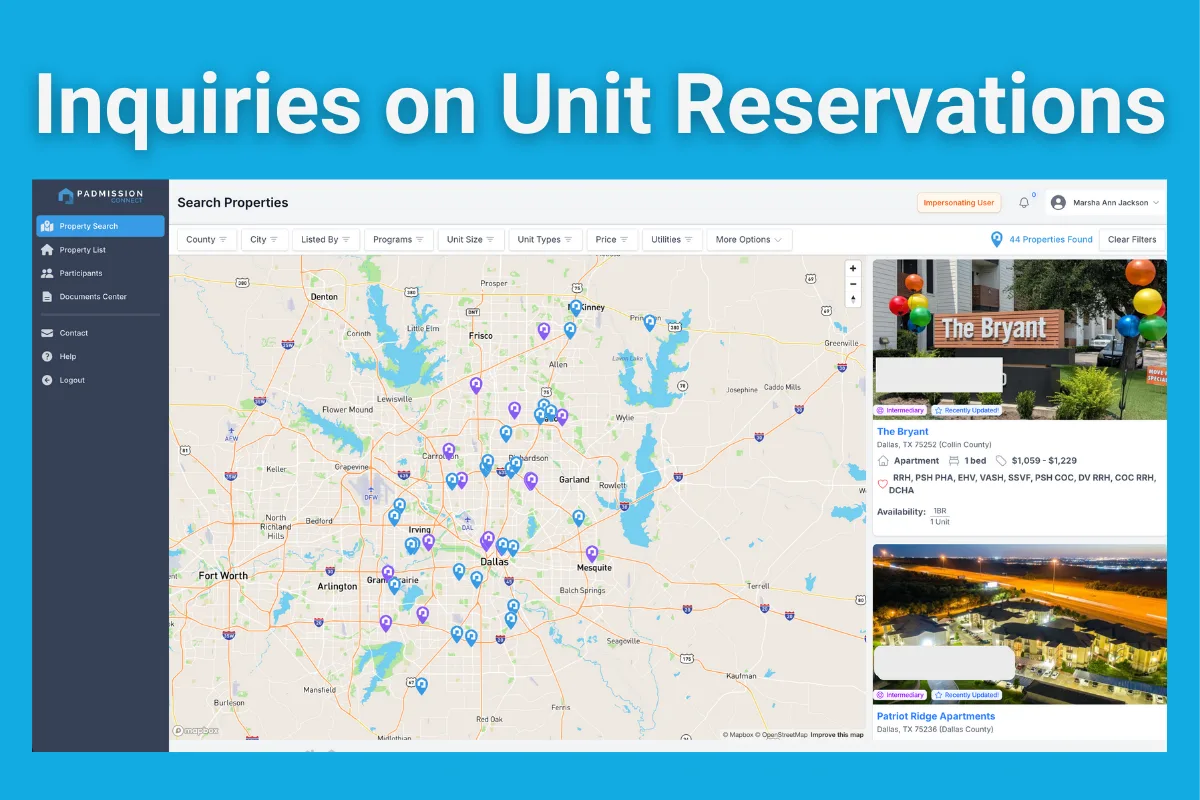
Padmission Connect supports the shared search record inside this sequence: the coordinated property pool, documented property and unit information, screening criteria, map-based housing search, inquiry history, reservation status, and lease-up record that allow staff across agencies to work from the same current information.
It does not conduct the participant’s barrier assessment. It does not decide where someone should live. It does not interpret a lease for the participant.
Those remain human responsibilities.
The role of the software is to keep the housing side of the search from being rebuilt in separate spreadsheets, personal landlord lists, emails, and staff memory every time another household begins.
That allows the seven steps to operate as a community process rather than seven activities each provider has to reconstruct independently.
Next steps
If you are evaluating housing search in your community, start with one question:
At what step do unsuccessful searches usually stop?
If the answer is unknown, begin by making the sequence visible. Define what “ready” means before a search opens. Record the reasons applications and units fall out. Measure the time between the gates rather than only the total time to lease.
If the search reaches Step 4 and the housing pool itself is the constraint, the next question moves upstream: whether the community has a sustained way to recruit, organize, and retain property relationships. Cincinnati’s experience offers one practical example of building coordinated housing navigation across partner agencies.
If your community wants to compare its current housing-search process against Ready, Search, Sign, book a 30-minute discovery conversation. We can walk through where the process is structured today and where searches are most likely to lose time.