
Editor’s note — November 2026: Written in 2020, shortly after HUD issued guidance encouraging Continuums of Care to build proactive, affirmative landlord engagement systems. The definitions and the case for centralization still hold, and the last section points to our current writing on each half of the work: landlord engagement and housing search.
As homeless services systems scale permanent housing interventions like Permanent Supportive Housing (PSH) and Rapid Rehousing (RRH) in communities, there is a tremendous opportunity and need to strengthen and align efforts in landlord engagement and housing search assistance. On May 15, 2020, HUD issued guidance on the HUD Exchange to Emergency Solutions Grants (ESG) recipients and Continuums of Care (CoCs) on developing a “proactive, affirmative landlord engagement system” in communities.
We were pleased to be highlighted by HUD in this guidance where they encourage CoCs to “develop a system-level tool or database to collect and maintain available units and landlord contact information.” Padmission provides CoCs and homeless services organizations with the tools and technology to do just that.
What landlord engagement and housing search assistance mean
Let’s first look at how we define each of the key concepts.
Landlord engagement is the cumulative efforts of rental market research, outreach and education, recruitment, incentivization, and retention of landlords to expand housing opportunities for people experiencing homelessness.
Housing search assistance includes the support provided to individuals and families to identify and secure safe, affordable, and accessible housing that meets their needs. Elements of support might include transportation, information sharing about available rental opportunities in the community, accompaniment in viewing rental units, assistance with applications for tenancy, advocacy for reducing tenant screening criteria, and ultimately successful lease execution and move-in.
Evolution and The Case for Centralization
What these efforts look like from community to community varies a lot. Some communities have just a few providers operating rental assistance programs. Others have several providers and multiple programs operating in the same rental market, often in competition with each other! Where there are multiple provider agencies recruiting and managing landlord relationships exclusively for their own programs’ benefit, we see disjointed experiences for landlord partners and uneven outcomes among agencies and the individuals and families served.
Like our friends at HUD, we believe every community should work towards a centralized approach to landlord engagement and housing search assistance. The expertise and skill sets required to perform this function is distinctly different from traditional social work that is the foundation of most homeless services organizations. There is also efficiency to be gained through centralization that benefits all stakeholders. Minimally, standardization of core elements like marketing of housing program interventions and maintenance of a common list of participating landlords and available rental units in the community is achievable.
Community and Client Centered Technology
Recognizing that all homeless services systems are unique in their local context and journey towards centralized landlord engagement, we’ve designed Padmission Connect to meet communities where they are at. Padmission Connect is highly configurable for use in a centralized or de-centralized approach to landlord engagement and housing search assistance.
Our Approach to the Solution
Padmission Connect is a web-based CRM and housing search platform built for homeless services systems to coordinate landlord engagement and housing search assistance across every provider in a community. Each group involved works from the same shared inventory:
- Housing locators keep one record of every property owner and manager the community works with, and update listings alongside their landlord partners so availability stays accurate.
- Property owners and managers list their units for free and market them to people in the community’s housing programs.
- Case managers and housing navigators search available units with simple or advanced filters, narrowing to units that accept a household’s program.
- Individuals and families searching for housing use the same search to find a unit that fits their needs.
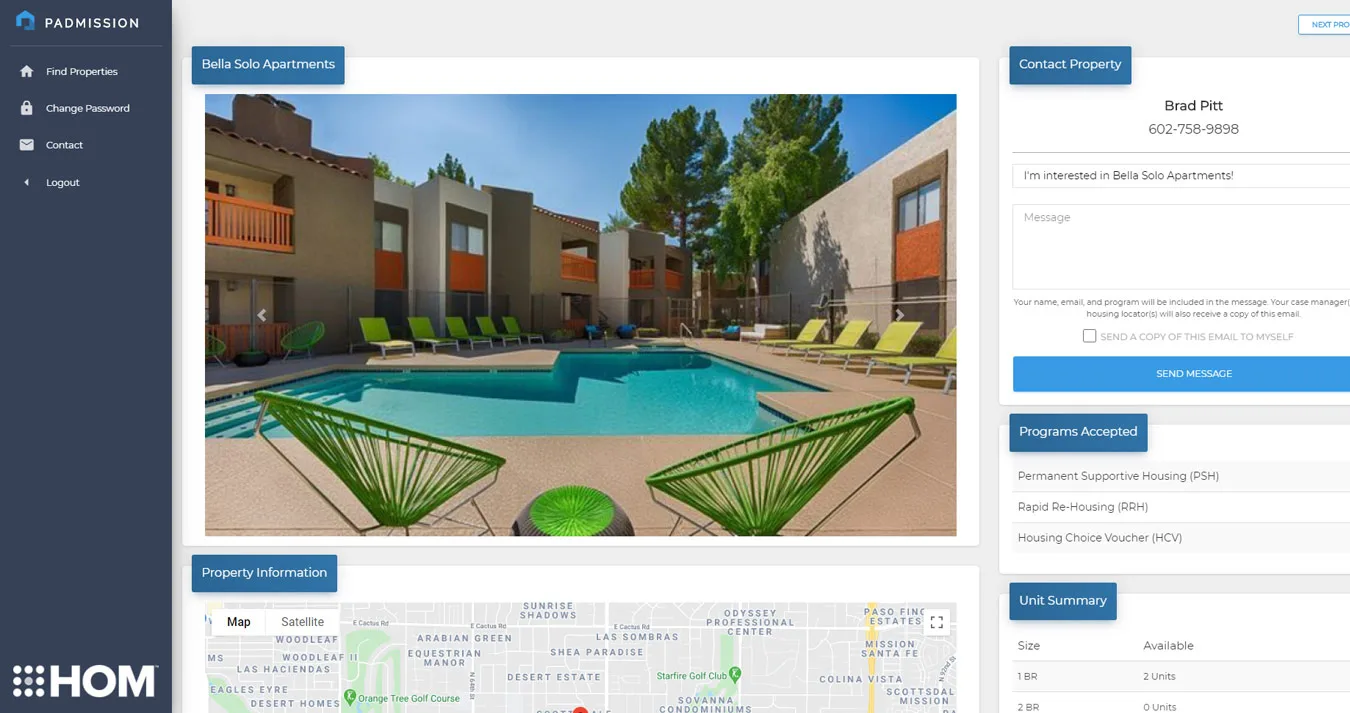
Reports and analytics cover outreach, listings, lease-ups and locator activity, so housing locators can measure landlord engagement, unit availability and lease-up from one place. The Padmission Connect page shows the product as it runs today, including its map search and the network’s current figures.
We would love to learn about your community’s efforts to expedite the housing process and discuss how we can help. Contact us.
Where this work stands now
The two halves of this post have each grown into a subject of their own.
- Landlord engagement follows the landlord lifecycle from positioning the offer through outreach, onboarding and support after move-in to keeping the landlord for their next vacancy, and names the step where most communities lose them. For how Continuums structure the function, build partnerships at scale and measure results, read Centralized Landlord Engagement for Continuums of Care (CoCs).
- Housing search follows a household from a listed unit to a signed lease, with client choice treated as an operating requirement. Ready, Search, Sign: A Housing Search Strategy for CoCs lays out seven steps that put a household’s documents and barriers in order before the unit search starts.
- A centralized program, built. RentSelect in Montgomery County is our fullest account of a community running centralized landlord engagement day to day.
FAQ
What is housing search assistance?
Housing search assistance is the support a household receives to find and secure safe, affordable and accessible housing: information about available units, transportation to and accompaniment at viewings, help with rental applications, advocacy to reduce tenant screening barriers, and support through lease signing and move-in.
How is housing search assistance different from landlord engagement?
Landlord engagement works on the supply of housing: researching the rental market, recruiting property owners and managers, offering incentives and keeping them as partners. Housing search assistance works with the household, helping them find, choose and lease one of those units. A community needs both, and they work best when the landlords one team recruits and the units households search are kept in the same shared record.
What did HUD’s 2020 guidance ask Continuums of Care to build?
HUD’s May 2020 guidance to ESG recipients and Continuums of Care encouraged communities to develop a “proactive, affirmative landlord engagement system” and to “develop a system-level tool or database to collect and maintain available units and landlord contact information.”
Why centralize landlord engagement and housing search?
When several agencies recruit landlords separately for their own programs, landlords hear from many organizations at once and households get uneven results depending on which agency serves them. A centralized approach standardizes how housing programs are presented to landlords and keeps one common list of participating landlords and available units that every provider can use.