Padmission’s Unlocked series documents what changes when a community builds a structured, coordinated approach to housing access — told, wherever possible, in the words of the people who built it. This entry covers Community Shelter Board, the collective impact organization coordinating homelessness response across Franklin County and the Central Ohio region, and what centralized landlord engagement produced there once unit outreach moved out of email threads and into a shared record.
Emails and spreadsheets were the system
Community Shelter Board (CSB) drives strategy, accountability, collaboration, and resources for people facing homelessness in Franklin County and the Central Ohio region. As of November 2026, CSB reports that its system of care served 15,000 people over the previous year, across homelessness prevention, shelter, street outreach, rapid re-housing, and permanent supportive housing.
Before Padmission Connect, CSB got available units in front of partner agencies by email and spreadsheet.
“Before Padmission we were using emails and spreadsheets to get the word out to partner agencies. This process was never deemed efficient, nor did we have the data to show it was useful.”
— Nicholas Brenner, Community Housing Manager, Community Shelter Board
CSB could announce available units by email, but it had no data to show whether those emails were useful.
Landlord engagement became a full-time role
“Since adopting Connect, my position as the Community Housing Manager has evolved and become much more robust. Previously, this position served as a supplementary role within our internal processes. Since we adopted Padmission, my role has more directly focused on landlord engagement and unit outreach. As a result, the responsibilities for my job have expanded considerably, making this a full-time position.”
— Nicholas Brenner, Community Housing Manager, Community Shelter Board
Landlord engagement had been one part of a broader position at CSB. With landlords and available units kept in Connect, it became the center of Nicholas’s job, and the position became full-time.
A listed unit comes with a prepared landlord
“It is much easier to communicate where and why landlords/property managers are located in our county, as well as the housing options they currently have available. Case managers know units in Padmission have been vetted in the sense that the landlord understands where the clients are coming from and potential barriers.”
— Nicholas Brenner, Community Housing Manager, Community Shelter Board
Vetted, as Nicholas uses it, describes the landlord rather than the unit: before a case manager calls, the landlord already knows where clients are coming from and the barriers they may bring. Keeping track of those landlords has also become simpler.
“It has made the role of keeping track of new landlord connections so much easier, as well as communicating with those options.”
— Nicholas Brenner, Community Housing Manager, Community Shelter Board
Shared inventory gave the manager a way to follow up
“Some landlord partners love using it and have consistent communication with our system. Others have had difficulty finding the program useful, as their postings are not being found or their units are out of range for our clients. Part of my role is to connect with landlords who are struggling with engagement of their units and assist with rent setting, criteria negotiation, or other advice to increase their chances of renting the unit to a client in our system.”
— Nicholas Brenner, Community Housing Manager, Community Shelter Board
When a landlord’s postings aren’t being found, or their rents are out of range for CSB’s clients, Nicholas can see it in Connect and contact the landlord about rent setting or screening criteria.
Leadership reviews monthly counts
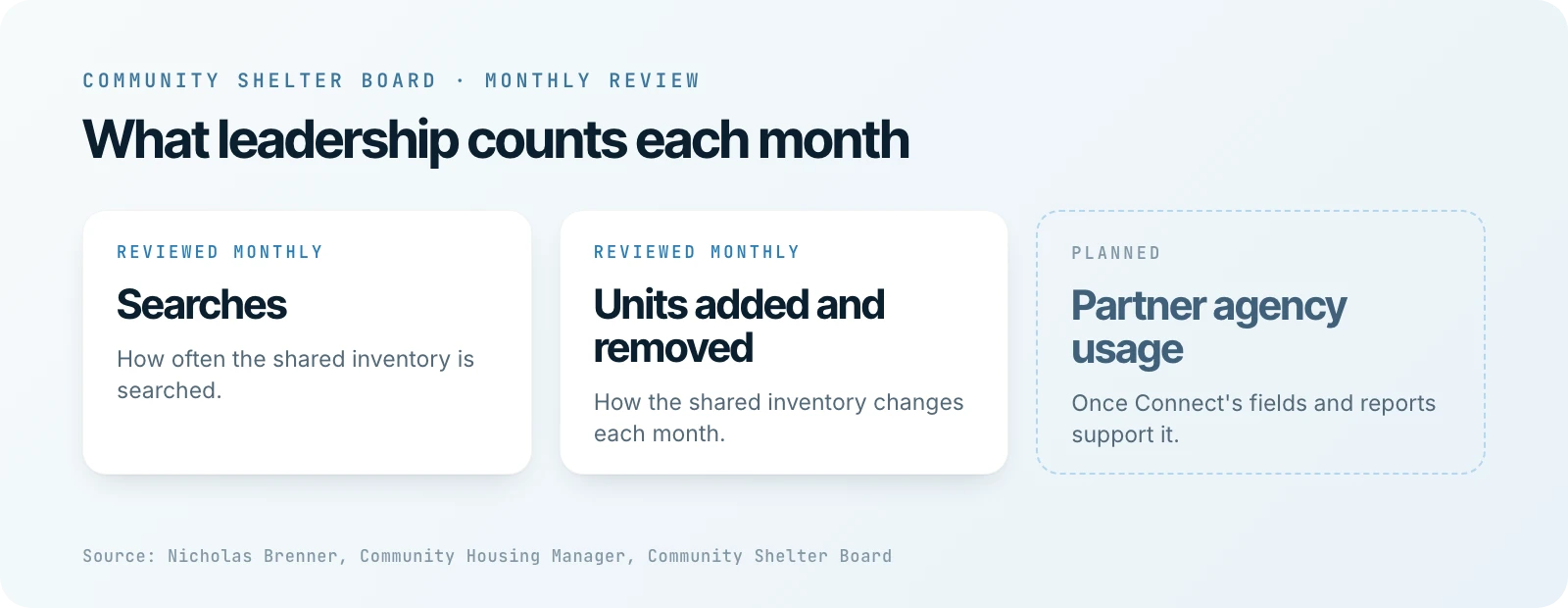
“I use it to see how many potential housing options are in our area for clients, as it’s intended use. Leadership looks at the number of searches and units added/removed per month, and we are planning to monitor partner agency usage when those fields/reports are available.”
— Nicholas Brenner, Community Housing Manager, Community Shelter Board
Today CSB’s leadership reviews two counts each month: searches, and units added and removed. Tracking how much each partner agency uses the shared inventory is planned, for when Connect’s fields and reports support it.
One landlord started the lease-ups herself
One example of a landlord starting the process, rather than a case manager:
“We have had multiple times when the Lease-Ups were initiated by our landlord partner, Marlene*, and it has shown that she went through the whole process and found a client with our YMCA partner. Marlene* also uses our incentives and is a valuable landlord partner to deal with!”
— Nicholas Brenner, Community Housing Manager, Community Shelter Board
Marlene* has started the lease-up process in Connect herself more than once, carried it through, and found a client working with CSB’s YMCA partner. She also takes part in CSB’s landlord incentives.
The advice: one dedicated person, and consistency
“Make sure to have a dedicated member for the program and exhaust all other options when it comes to broadcasting units to your system. Stay consistent and don’t give up.”
— Nicholas Brenner, Community Housing Manager, Community Shelter Board
Adoption at CSB has been uneven: case managers took to searching quickly, other workflow features have taken longer, and the team keeps following up.
Visible, vetted, coached: questions for your own system
CSB’s experience follows three steps. Each comes with a question a community can ask about its own process.
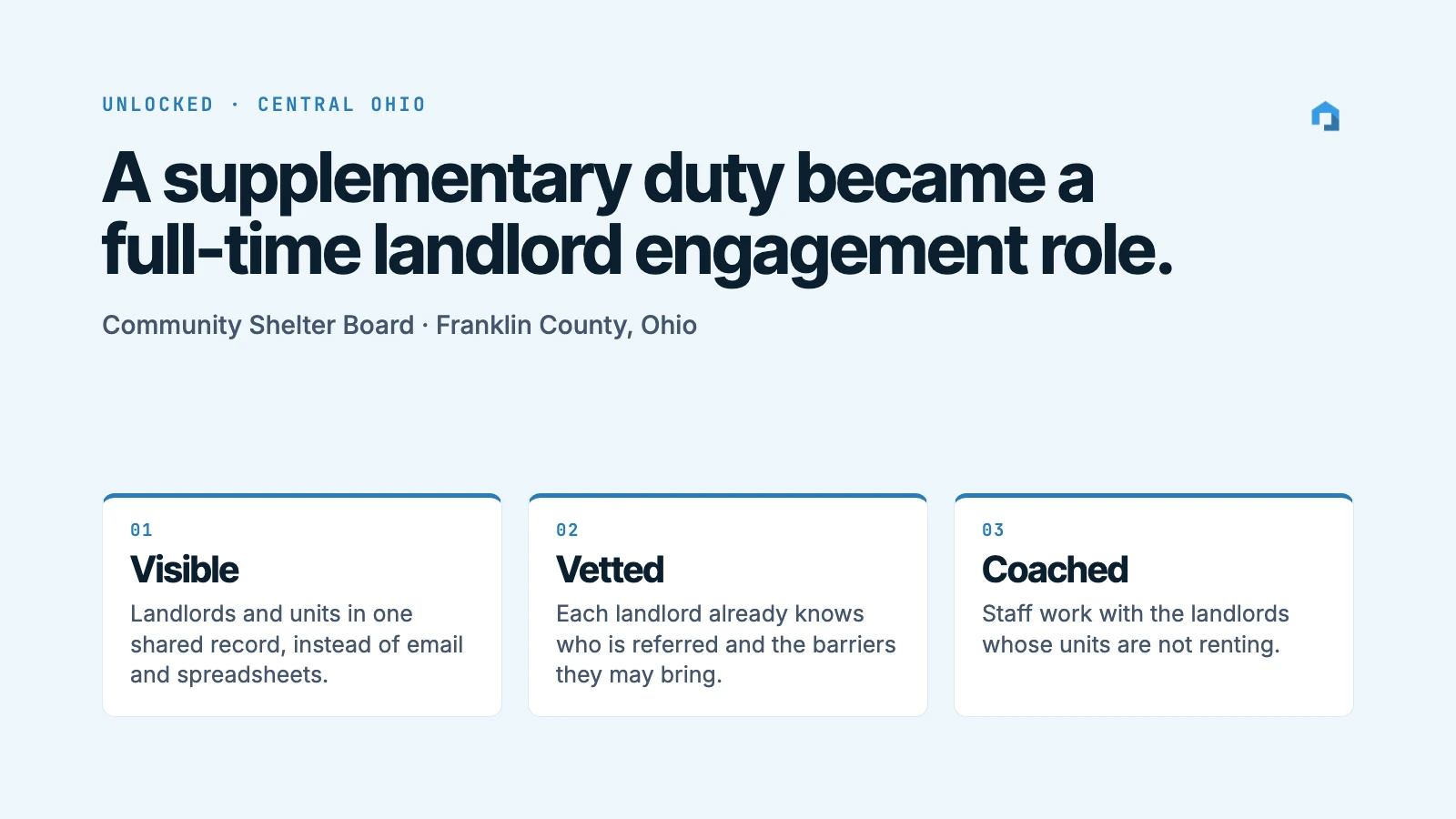
- Visible. At CSB, landlords and available units moved out of emails and spreadsheets into one record that leadership can count. Where are available units announced in your community today, and does anything record who acted on them?
- Vetted. Landlords in that record understand where clients are coming from and the barriers they may bring. What does a landlord know about your programs before a case manager calls?
- Coached. Nicholas follows up with the landlords whose units are not renting. When a landlord’s units sit unrented, who finds out, and who calls them?
FAQ
What is centralized landlord engagement?
Centralized landlord engagement is a coordinated approach in which one team recruits, vets, and maintains landlord relationships on behalf of every agency in a Continuum of Care or regional homelessness response system, and makes that shared inventory available to all case managers through a single record. It replaces fragmented, agency-by-agency outreach in which each program keeps its own informal landlord list.
Does CSB’s approach fit a single-agency program?
CSB’s experience is most relevant to Continuum of Care lead agencies and collective impact organizations coordinating landlord engagement across several provider agencies, especially where units are announced by email or tracked in agency spreadsheets. A single agency with one housing locator gains the shared record, but may not need the dedicated full-time role CSB created.
See how RentSelect built the same model countywide in Montgomery County, read how Continuums structure and staff centralized landlord engagement, follow the landlord lifecycle from first outreach to the next vacancy under landlord engagement, or talk with our team about what a centralized model would look like in your community.
*Names marked with an asterisk have been changed. All quotes are verbatim.