
How Communities Fund Their Padmission Connect Subscription
A practical guide to identifying and approaching CoC, philanthropic, and local government funding sources.
One of the most consistent questions we hear from communities evaluating Padmission Connect is: how are other communities paying for this? This page answers that question directly — organized by funder type, with practical framing guidance for each.
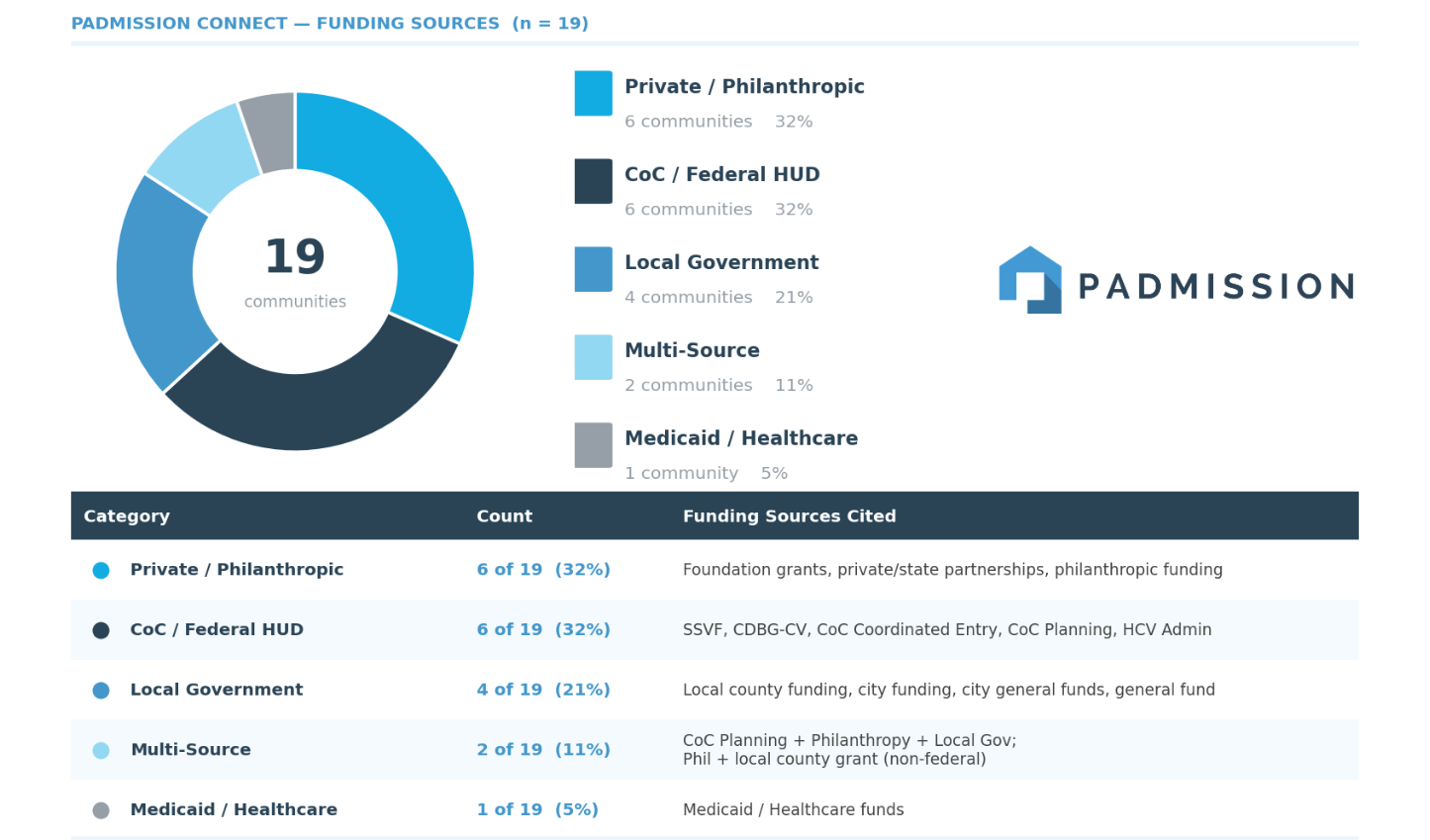
The direct answer: there is no single dominant funding source. Communities fund Connect through CoC and federal budget lines, private and philanthropic grants, and local government appropriations — often in combination. What follows is a breakdown of each path and what the case looks like when you bring it to the right room.
The Short Answer
Three funding tracks have worked for communities adopting Connect:
- CoC and federal funds — Supportive Services activities, CoC Planning grants, HCV Administrative fees, SSVF, CDBG, and Coordinated Entry budget lines have all been used. The case is direct: Connect does what these funds were designed to support.
- Private and philanthropic grants — Foundation grants, capacity investments, and systems change philanthropy. The framing: Connect is a durable operational change, not a service delivery line.
- Local government appropriations — County general fund, city housing budgets, community development. The framing: if you’re funding the work, fund the platform that makes it coordinated.
Many communities blend sources. Some use a cost-share model where participating agencies each contribute to a shared subscription.
CoC and Federal Funding
CoC Planning grants, HCV Administrative fees, SSVF, CDBG, and Coordinated Entry budget lines are all viable sources for a Connect subscription. The operational logic is direct: Connect centralizes landlord engagement and housing search coordination — a function that sits within the mandate of every one of these programs. Communities have funded Connect through each of these mechanisms independently and in combination.
Federal and CoC sources that have been used
- Supportive Services Activities — CoC Program funds allow expenses related to “Housing search and counseling services”, including component services for identifying rental assistance units.
- CoC Planning grant — System-wide coordination and administration activities. Connect makes housing access coordination function at the system level, which is the explicit purpose of Planning funds.
- HCV Administrative fees — PHAs draw admin fees to cover operational costs of voucher administration, including landlord engagement and housing search. Connect’s function maps directly to these activities.
- SSVF — Where SSVF grantees participate in housing search and landlord engagement alongside non-veteran programs, Connect’s subscription may be allocable to SSVF operational costs.
- CDBG — Communities whose CDBG administrator can establish alignment with housing access activities have funded Connect through community development block grants.
- Coordinated Entry operations budget — Many CoCs maintain a dedicated CE operations budget. Connect supports the housing search and unit matching functions that are core to CE.
- CoC Planning + HCV Admin (split model) — At least one community uses a 50/50 split between CoC Planning and HCV Administrative fees.
How to frame it
“Padmission Connect centralizes the landlord engagement and housing search coordination that CoC systems are designed to produce. The operational function maps directly to what Planning funds, HCV administrative fees, and Coordinated Entry budgets were designed to support — and it makes those investments more effective by eliminating fragmentation.”
Private and Philanthropic Funding
Private and philanthropic funding is among the most common paths communities have used for Connect. Foundation grants, private/state partnerships, and community philanthropy have all been used. The strongest philanthropic case frames Connect as a capacity investment — not a technology project, not a service delivery grant, but a durable change in how your community’s housing access work operates at the system level.
Grant types and funders to explore
- Operational capacity grants — Grants that help organizations strengthen operations and reduce fragility. Connect reduces dependence on individual staff relationships and makes housing access a system-level function.
- Systems change or technology grants — Connect isn’t a single-organization tool. When deployed across a CoC, it changes how every participating agency engages landlords and searches for housing.
- Community foundation housing grants — Community foundations actively funding housing or homelessness are natural partners. The ask is modest relative to program grants, and the impact is system-wide.
- United Way impact area investments — Housing access and placement outcomes are core United Way impact areas in many communities.
- Corporate philanthropy / CSR — Local employers with housing or workforce investment interests may see Connect as a community infrastructure investment.
How to frame it
“Connect is a capacity investment in how our community coordinates housing access. Housing search and landlord engagement go from being individual activities distributed across dozens of case managers to a coordinated function with shared visibility and consistent practice. Landlord relationships belong to the community, not to individual staff — so they survive turnover.”
Local Government Funding
Counties and cities that fund homelessness programs have a direct stake in those programs operating consistently. The local government case for Connect is simple: if you’re funding the work, fund the platform that makes the work coordinated. This is not a request for new money — it’s a request to direct existing investment toward an operational tool that makes current programs more effective.
Local government sources to explore
- County general fund — homelessness services — If your county has a general fund line item for homelessness programs, Connect is a direct operational investment in programs already funded by that line.
- City housing initiative or housing stability budget — Cities with explicit housing access or placement goals can fund Connect as an operational tool for achieving those outcomes.
- CDBG entitlement (locally administered) — Where the local government is the CDBG entitlement recipient, a Connect subscription may be eligible where it aligns with housing program activity.
- Local match to federal programs — Connect’s subscription cost may be documentable as a local match contribution to a federally funded coordinated housing program.
How to frame it
“The county is already funding housing search and landlord engagement through the programs it appropriates to our CoC. Connect makes those programs operate consistently, with shared inventory and coordinated outreach across every participating agency. You’re not funding a new program — you’re funding the platform that makes your existing investment go further.”
Multi-Source and Cost-Share Options
Communities don’t need a single source to fund Connect. If no one budget line covers the full subscription, the cost can be split across two or three sources — each funder covering the portion of Connect’s function that aligns with their eligible activities.
A cost-share model — where participating agencies each contribute a portion of the subscription — is also an option. This mirrors how communities fund shared HMIS or other CoC-administered operational systems. Each agency funds its share from its own available budget.
Your Padmission contact can walk through a cost-share model if multiple agencies are involved.
Flyers for Your Funder Conversations
These one-page leave-behinds are designed to be shared with a specific funder type. Each is written from your organization’s perspective — making the case to a funder for why Connect is a fit for their funding priorities. Fill in the bracketed fields before sharing.
Both flyers include placeholder fields (e.g., [Your CoC Name], [$X/year]) to be filled in before sharing with a specific funder.
Go Deeper
Funding Identification Toolkit
The toolkit is a structured workbook that walks your team through each funding track — mapping specific budget lines and fund sources to Connect’s function, with internal discovery questions to help identify where you have the strongest path forward.
It covers:
- Five CoC and federal fund sources with fit logic and framing guidance
- Five philanthropic grant types and how to frame the ask for each
- Four local government mechanisms with specific language for county and city conversations
- Self-assessment checklists for each track
- Multi-source and cost-share models
- Internal discovery questions and guidance on who to involve
Talk to Us About Your Funding Situation
Your Padmission contact can support your funding conversations directly. We can provide:
- A cost and use-case summary formatted for a specific funder conversation
- Peer references from communities that have used a particular funding source
- Support for a funder presentation, proposal narrative, or budget justification
- A cost-share model walkthrough if multiple agencies are involved