
Unlocked: How Syracuse Designed Centralized Landlord Engagement For System-Level Coordination

The Unlocked Series highlights how Continuums of Care are structuring centralized landlord engagement and housing search as coordinated system functions—moving beyond fragmented workflows toward shared infrastructure that supports consistent housing access.
In Central New York, that shift is already producing measurable results. The CNY CHANCE program (Centralized Housing Assistance and Network for Community Engagement), powered by Padmission Connect, has surpassed its first-year housing placement goal in just nine months.
We sat down with Muris Avdic, Housing Services Coordinator at the Housing & Homeless Coalition of Central New York (HHCCNY)—the Collaborative Applicant, HMIS Lead, Coordinated Entry Lead, and Lead Agency for CoC NY-505—to understand how the system was designed, how it operates in practice, and what changes when landlord engagement and housing navigation are structured at the CoC level.
What follows is not a feature story. It is a system-level view into how coordination is built—and what happens when it is.
System Before: Fragmentation Was the Operating System
In Central New York, housing access did not break down because of a lack of effort. It broke down because coordination was not structurally supported.
“The system was heavily siloed.”
This fragmentation was not limited to agency boundaries. It existed within organizations, across programs, and throughout the housing search process.
“Through listening sessions with funded and non-funded partners, it became clear the system was heavily siloed. Even projects within the same organization were operating independently. Case managers relied on small personal lists of somewhat trusted landlords, and once those options were exhausted, they had to start from scratch for every new client with traditional listing platforms.”
Housing access depended on relationships that were informal and difficult to scale. Those relationships functioned as isolated access points rather than shared system resources.
The constraints that followed were consistent across the system:
“The pain points were consistent: limited landlord partners, limited units that could pass inspection, limited stock at or near FMR, and application processes that were often inaccessible to applicants with real or perceived barriers.”
The system was not lacking effort. It was lacking shared structure.
Trigger for Change: Designing Coordination as Infrastructure
The shift toward centralized landlord engagement in Syracuse did not emerge from incremental process improvement. It was a deliberate decision to redesign how the system functions.
After exposure to centralized engagement models, leadership chose not to optimize fragmented workflows. Instead, it introduced a coordinated model at the system level through the creation of the CNY CHANCE program.
This decision established a different starting point.
Rather than asking how individual agencies could improve housing search, the system defined housing access as a shared function. Landlord engagement, inventory visibility, and placement workflows were designed to operate across agencies from the outset.
This reframing matters.
Coordination is often treated as an outcome of better communication. In this case, it was treated as infrastructure—something that must be built, not assumed.
Structural Intervention: Separating Functions and Centralizing Access
Padmission Connect was implemented alongside the CHANCE program, allowing coordination to be embedded directly into system operations.
“Padmission Connect plays a critical role in this effort.”
The most important change was the separation of responsibilities between landlord engagement and housing navigation.
“My team with the CHANCE program within our CoC operates much like a nonprofit broker, helping eligible families experiencing homelessness secure permanent housing. Since many case managers represent households who are not CHANCE-eligible, our role as Housing Locators is to expand access to landlords and available units across the system while also utilizing some of those same vacancies for our program clients.”
This model introduces role clarity that is often absent in housing systems.
Housing Locators focus on landlord relationships as a system-level function—building, maintaining, and prioritizing partnerships over time.
Case managers continue to support households, but they are no longer required to independently source housing opportunities. Instead, they operate within a shared inventory.
This shift is reinforced by how the platform is used:
“The platform allows our team to focus on building and maintaining strong landlord relationships.”
At the same time, shared visibility becomes a central coordination mechanism:
“The Map Search is the most frequently used feature of Padmission… it provides a clean, user friendly interface to gain insight into available vacancies at any given point in time.”
This is not simply a feature preference. It is what allows multiple roles to operate from the same understanding of available housing.
Operational Reality: From Communication to Coordination
As implementation progressed, coordination began to move out of informal channels and into a shared system.
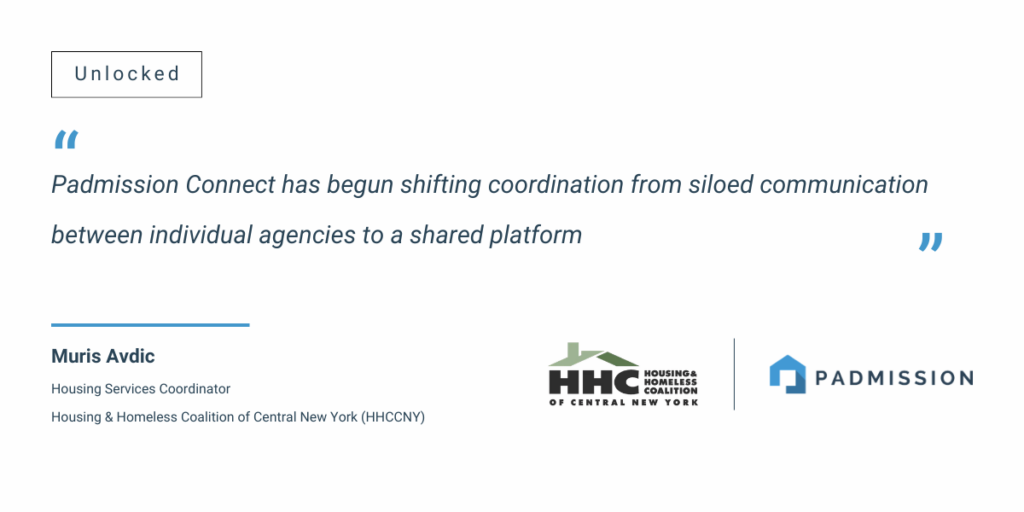
“We launched our Padmission Connect instance just one month before the CHANCE program began… About 40 case managers currently have access to the platform, with a goal over the next year to expand access to all coalition agencies and create a more coordinated, self-sustaining ecosystem. … Padmission Connect has begun shifting coordination from siloed communication between individual agencies to a shared platform where available units and housing opportunities can be seen across the system.”
This shift changes how work happens day to day.
Before, coordination relied on communication:
- Emails
- Phone calls
- Internal referrals
- Individual updates
Now, coordination is anchored in shared visibility:
“Available units and housing opportunities can be seen across the system”
This changes both behavior and decision-making.
Case managers no longer operate in isolation. They can evaluate housing options in the context of system-wide availability, rather than relying on partial information.
To support this, the team applies a structured intake framework:
“Our focus remains on the matchmaking side of the housing search process, which is the more familiar side of the housing coin, with landlord engagement representing the other. I refer to our intake framework as the 4Bs: Background, Barriers, Borders, and Budget. These four factors help determine where clients want to live and where they realistically can live, which are not always mutually exclusive. This helps avoid competition for units as much as possible.”
This framework aligns housing search with both participant preference and program constraints, reducing unnecessary competition for units and improving placement fit.
The key shift is not just access to data. It is alignment around how that data is used.
Outcomes: Early Evidence of System Alignment
Within the first nine months of operation, the CHANCE program reached a significant milestone:
“Over 100 families have been leased into permanent housing.”
This reflects improved throughput, but also reduced friction across the housing placement process.
At the same time, landlord engagement has become more stable and predictable.
“Landlords have noted how surprisingly user-friendly the platform is… there is no fluff, no ads, and no fees”
These characteristics matter because landlord participation depends on ease of use and consistency. When engagement is simple and supported, participation becomes repeatable.
The system is also producing outcomes related to housing choice:
“Every family housed in a home of their choice is the ultimate success story.”
This reflects a shift in how placements are made. When housing options are visible and accessible across the system, participants can make decisions based on both preference and feasibility.
Finally, the broader system impact is articulated directly:
“Invest in Padmission Connect, as it is a powerful catalyst for transforming the housing landscape in your community. The platform provides a seamless software-as-a-service solution that moves landlord engagement and housing searches from siloed approaches to a coordinated system… and the return on investment in the form of improved performance metrics can be tenfold.”
This frames the shift not as a tool adoption, but as a structural change in how housing systems operate.
System-Level Takeaways for CoCs and Funders
The Syracuse implementation offers several replicable insights:
1. Centralization Must Be Intentional
Coordination cannot be layered onto fragmented workflows. It must be designed into the system from the outset.
2. Landlord Engagement Is a Distinct Function
Treating landlord relationships as a dedicated, managed function improves retention and supply stability.
3. Shared Inventory Unlocks Existing Capacity
The system did not create housing units—it made them visible and accessible across agencies.
4. Role Clarity Reduces System Friction
Separating engagement from placement allows both functions to operate consistently.
5. Coordination Requires Shared Decision Logic
Housing search workflows like the “4Bs” align how placement decisions are made across the system.
6. Simplicity Drives Adoption
Low-friction participation is critical for landlord engagement at scale.
7. Early Outcomes Can Indicate Structural Success
Reaching 100 lease-ups in under nine months signals that system alignment is already improving performance.
HHCCNY was kind enough to share a brochure used by housing locators when doing outreach; check it out, below!
About the Author:
Daniel Davis
Related Posts
Unlocked: How Syracuse Designed Centralized Landlord Engagement For System-Level Coordination
The Unlocked Series highlights how Continuums of Care are structuring centralized landlord engagement and housing search as coordinated system functions—moving beyond fragmented workflows toward shared infrastructure that supports consistent housing access.
In Central New York, that shift is already producing measurable results. The CNY CHANCE program (Centralized Housing Assistance and Network for Community Engagement), powered by Padmission Connect, has surpassed its first-year housing placement goal in just nine months.
We sat down with Muris Avdic, Housing Services Coordinator at the Housing & Homeless Coalition of Central New York (HHCCNY)—the Collaborative Applicant, HMIS Lead, Coordinated Entry Lead, and Lead Agency for CoC NY-505—to understand how the system was designed, how it operates in practice, and what changes when landlord engagement and housing navigation are structured at the CoC level.
What follows is not a feature story. It is a system-level view into how coordination is built—and what happens when it is.
System Before: Fragmentation Was the Operating System
In Central New York, housing access did not break down because of a lack of effort. It broke down because coordination was not structurally supported.
“The system was heavily siloed.”
This fragmentation was not limited to agency boundaries. It existed within organizations, across programs, and throughout the housing search process.
“Through listening sessions with funded and non-funded partners, it became clear the system was heavily siloed. Even projects within the same organization were operating independently. Case managers relied on small personal lists of somewhat trusted landlords, and once those options were exhausted, they had to start from scratch for every new client with traditional listing platforms.”
Housing access depended on relationships that were informal and difficult to scale. Those relationships functioned as isolated access points rather than shared system resources.
The constraints that followed were consistent across the system:
“The pain points were consistent: limited landlord partners, limited units that could pass inspection, limited stock at or near FMR, and application processes that were often inaccessible to applicants with real or perceived barriers.”
The system was not lacking effort. It was lacking shared structure.
Trigger for Change: Designing Coordination as Infrastructure
The shift toward centralized landlord engagement in Syracuse did not emerge from incremental process improvement. It was a deliberate decision to redesign how the system functions.
After exposure to centralized engagement models, leadership chose not to optimize fragmented workflows. Instead, it introduced a coordinated model at the system level through the creation of the CNY CHANCE program.
This decision established a different starting point.
Rather than asking how individual agencies could improve housing search, the system defined housing access as a shared function. Landlord engagement, inventory visibility, and placement workflows were designed to operate across agencies from the outset.
This reframing matters.
Coordination is often treated as an outcome of better communication. In this case, it was treated as infrastructure—something that must be built, not assumed.
Structural Intervention: Separating Functions and Centralizing Access
Padmission Connect was implemented alongside the CHANCE program, allowing coordination to be embedded directly into system operations.
“Padmission Connect plays a critical role in this effort.”
The most important change was the separation of responsibilities between landlord engagement and housing navigation.
“My team with the CHANCE program within our CoC operates much like a nonprofit broker, helping eligible families experiencing homelessness secure permanent housing. Since many case managers represent households who are not CHANCE-eligible, our role as Housing Locators is to expand access to landlords and available units across the system while also utilizing some of those same vacancies for our program clients.”
This model introduces role clarity that is often absent in housing systems.
Housing Locators focus on landlord relationships as a system-level function—building, maintaining, and prioritizing partnerships over time.
Case managers continue to support households, but they are no longer required to independently source housing opportunities. Instead, they operate within a shared inventory.
This shift is reinforced by how the platform is used:
“The platform allows our team to focus on building and maintaining strong landlord relationships.”
At the same time, shared visibility becomes a central coordination mechanism:
“The Map Search is the most frequently used feature of Padmission… it provides a clean, user friendly interface to gain insight into available vacancies at any given point in time.”
This is not simply a feature preference. It is what allows multiple roles to operate from the same understanding of available housing.
Operational Reality: From Communication to Coordination
As implementation progressed, coordination began to move out of informal channels and into a shared system.
“We launched our Padmission Connect instance just one month before the CHANCE program began… About 40 case managers currently have access to the platform, with a goal over the next year to expand access to all coalition agencies and create a more coordinated, self-sustaining ecosystem. … Padmission Connect has begun shifting coordination from siloed communication between individual agencies to a shared platform where available units and housing opportunities can be seen across the system.”
This shift changes how work happens day to day.
Before, coordination relied on communication:
- Emails
- Phone calls
- Internal referrals
- Individual updates
Now, coordination is anchored in shared visibility:
“Available units and housing opportunities can be seen across the system”
This changes both behavior and decision-making.
Case managers no longer operate in isolation. They can evaluate housing options in the context of system-wide availability, rather than relying on partial information.
To support this, the team applies a structured intake framework:
“Our focus remains on the matchmaking side of the housing search process, which is the more familiar side of the housing coin, with landlord engagement representing the other. I refer to our intake framework as the 4Bs: Background, Barriers, Borders, and Budget. These four factors help determine where clients want to live and where they realistically can live, which are not always mutually exclusive. This helps avoid competition for units as much as possible.”
This framework aligns housing search with both participant preference and program constraints, reducing unnecessary competition for units and improving placement fit.
The key shift is not just access to data. It is alignment around how that data is used.
Outcomes: Early Evidence of System Alignment
Within the first nine months of operation, the CHANCE program reached a significant milestone:
“Over 100 families have been leased into permanent housing.”
This reflects improved throughput, but also reduced friction across the housing placement process.
At the same time, landlord engagement has become more stable and predictable.
“Landlords have noted how surprisingly user-friendly the platform is… there is no fluff, no ads, and no fees”
These characteristics matter because landlord participation depends on ease of use and consistency. When engagement is simple and supported, participation becomes repeatable.
The system is also producing outcomes related to housing choice:
“Every family housed in a home of their choice is the ultimate success story.”
This reflects a shift in how placements are made. When housing options are visible and accessible across the system, participants can make decisions based on both preference and feasibility.
Finally, the broader system impact is articulated directly:
“Invest in Padmission Connect, as it is a powerful catalyst for transforming the housing landscape in your community. The platform provides a seamless software-as-a-service solution that moves landlord engagement and housing searches from siloed approaches to a coordinated system… and the return on investment in the form of improved performance metrics can be tenfold.”
This frames the shift not as a tool adoption, but as a structural change in how housing systems operate.
System-Level Takeaways for CoCs and Funders
The Syracuse implementation offers several replicable insights:
1. Centralization Must Be Intentional
Coordination cannot be layered onto fragmented workflows. It must be designed into the system from the outset.
2. Landlord Engagement Is a Distinct Function
Treating landlord relationships as a dedicated, managed function improves retention and supply stability.
3. Shared Inventory Unlocks Existing Capacity
The system did not create housing units—it made them visible and accessible across agencies.
4. Role Clarity Reduces System Friction
Separating engagement from placement allows both functions to operate consistently.
5. Coordination Requires Shared Decision Logic
Housing search workflows like the “4Bs” align how placement decisions are made across the system.
6. Simplicity Drives Adoption
Low-friction participation is critical for landlord engagement at scale.
7. Early Outcomes Can Indicate Structural Success
Reaching 100 lease-ups in under nine months signals that system alignment is already improving performance.
HHCCNY was kind enough to share a brochure used by housing locators when doing outreach; check it out, below!
About the Author:
Daniel Davis