
Centralized Landlord Engagement for Continuums of Care (CoCs)

A Structural Guide to Building Scalable Housing Access
Landlord engagement is one of the least discussed but most consequential functions inside a homelessness response system. For Continuums of Care (CoCs)— the regional systems responsible for coordinating federal homelessness funding and housing programs — the ability to recruit, maintain, and coordinate relationships with property owners and operators ultimately determines whether rental assistance programs translate into real housing placements. When landlord engagement is fragmented across agencies, housing opportunities remain limited.
When communities implement centralized landlord engagement, housing supply expands, housing search becomes more effective, and lease-up success — the rate households enrolled in a program successfully convert that assistance into an active lease — improves across the system. This guide explains how centralized landlord engagement for Continuums of Care can transform fragmented outreach into a coordinated housing access system for homelessness response systems. As housing supply grows, systems regain the capacity to move people quickly into housing.
Landlord engagement in homelessness systems refers to the structured work of recruiting, supporting, and coordinating relationships with private rental housing providers so people exiting homelessness can access units in the broader rental market. Since most housing programs rely on private landlords rather than publicly owned housing stock, CoCs must treat landlord engagement as a system function rather than an individual provider activity — a structural shift this guide is designed to support.
Why Centralized Landlord Engagement Determines Whether Continuums of Care Can Actually End Homelessness
Housing assistance programs administered in a Housing First framework are the most effective way of ending homelessness, converting public funding into leases and sustained tenancies. These programs enable people experiencing homelessness, sheltered or unsheltered, to move into their own homes and stabilize through supportive services and rental assistance.
In most CoCs the limiting factor is no longer programmatic expertise or supportive service tools but reliable access to units and the structured relationships required to secure them consistently. When landlord engagement is limited or inconsistent, that gap is not a peripheral problem. It is a housing supply problem, and housing supply is the foundation everything else depends on. Homelessness response systems do not operate outside the rental market — they operate inside it.
When housing supply is unstable, the effects move through the system quickly. Search times lengthen. Participants settle for fewer options. Project utilization declines. Programs designed to move households rapidly into stable housing begin to stall. Shelter beds turn over more slowly, and availability decreases for people living unsheltered who are waiting for an opportunity to come inside. As we examine in our analysis of how rental assistance administration becomes structurally fragile under fragmentation, housing search access, funding utilization, and landlord engagement also succeed or fail together.
Landlord engagement sits as the key enabler of housing search, rental assistance utilization, and system coordination, shaping whether providers can operate consistently under funding and performance expectations.
The inverse is equally true: when systems address these structural constraints, the results compound. As TJ Reed, Human Services Assistant Director at the Community Resilience Division in Maricopa County, described the experience after Maricopa Regional CoC centralized landlord engagement:
“We knew finding housing and using the funding that was already available was difficult. Once… there were more properties and units available for our provider partners to use, we knew we could start to dream bigger and fund with more confidence.”
That confidence translates into more funding deployed into housing programs — rather than into shelter capacity that expands only because housing access remains the bottleneck.
That shift — from constrained and reactive to expansive and confident — is what structural landlord engagement makes possible. The rest of this guide explains how to build it.
What Centralization Actually Means
Centralization is often misunderstood as control.
When landlord engagement is centralized, property owner and operator relationships become shared system assets rather than agency-specific resources. Housing opportunities become visible across participating providers, reducing duplicated outreach and internal competition.
Relationship history persists as part of the system itself, not as a function of who currently holds a role.
Smaller providers gain access to housing opportunities they could not develop independently, while larger providers avoid rebuilding the same relationships across multiple teams.
The system becomes more resilient because housing access no longer depends on any single individual or organization.
Landlord Engagement and Housing Search Solve Different Problems
Centralizing property engagement and coordinated housing search are related but distinct functions.
Both are essential. But they solve different problems and require different solutions.
Landlord engagement focuses on recruiting and maintaining relationships with Property Owners and Operators. Its purpose is to expand the housing supply available to the system.
Housing search determines how participants and providers access that supply once it exists.
Put simply:
Landlord engagement creates housing opportunities.
Housing search connects participants to those opportunities.
Centralizing housing search without strengthening landlord engagement simply redistributes a limited supply of units. Centralizing landlord engagement without coordinated housing search can leave new opportunities unevenly distributed across programs.
When Housing Supply Is Limited, Systems Compete Against Themselves
In many communities, landlord engagement was never designed as a system function. It developed organically within individual programs.
Housing navigators built personal networks.
Case managers tracked properties in spreadsheets.
Programs were often forced to pursue placements with any landlord willing to accept rental assistance, even when the partnership was poorly aligned.
These efforts often produce placements. But over time, fragmented landlord engagement limits program scalability and creates structural dynamics that weaken the system as a whole.
When housing supply is limited and outreach is decentralized, providers also begin competing for the same units.
Information about participating landlords becomes guarded rather than shared. Programs maintain private property lists. Some relationships become informally protected because staff fear that introducing a landlord to the broader system may reduce their own program’s access.
Over time, communities develop what practitioners sometimes describe as “pocket landlords” — property owners known quietly by a few providers who are willing to accept higher-barrier applicants.
This dynamic emerges not from unwillingness to collaborate, but from the absence of a reliable system for growing and managing housing supply collectively.
As competition increases, pressure on individual staff grows. Housing navigators are often expected to produce units in a market they cannot control. Under those conditions, providers may feel forced to pursue opportunities with landlords who are poorly aligned with program expectations simply because housing options are scarce.
Even funders feel the constraints as agencies regularly identify a lack of available units as a program performance cap. Maricopa County’s experience, described earlier in this guide, reflects a pattern that appears consistently across communities that have made this transition — the structural conditions that make centralization difficult are often the same ones that make it necessary.
The result is a system that is working harder, producing fewer sustainable outcomes, and depending on unstable housing supply conditions to perform.
Housing Supply Constraints Shape Where Participants Can Live
Limited landlord recruitment also affects where participants ultimately secure housing.
When the same small group of properties – often because they are properties participants previously lived or independently located on their own – placements tend to concentrate in the same neighborhoods and buildings. Participants often return to the same areas because those are the only locations where units are reliably available to their agency.
Over time, a handful of properties may absorb a disproportionate share of placements.
Scattered-site housing programs can begin to resemble de facto project-based models when placements cluster in the same developments simply because those properties accept housing assistance programs.
This pattern is not ideal, though rarely intentional. It is usually the natural outcome of insufficient housing recruitment.
Without deliberate expansion of the landlord network, systems recycle the same housing supply rather than increasing it.
Participant choice narrows.
Geographic diversity declines.
And the placement stability may weaken as properties become oversaturated.
When participants have meaningful access, they are better able to prioritize the conditions that support long-term stability, greatly increasing client choice in housing search. Access to housing near family, employment, transportation, and community services reduces daily strain and increases the likelihood that households remain successfully housed. When housing supply is limited, those choices disappear and participants often accept the few units available rather than the homes that best support their lives.
Expanding the pool of participating property owners and operators is therefore not simply about increasing placement opportunities. It is also about preserving participant choice, protecting scattered-site housing models, and improving lease-up success across the system.
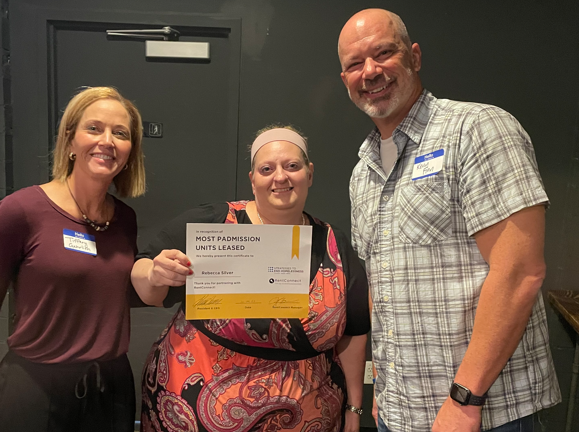
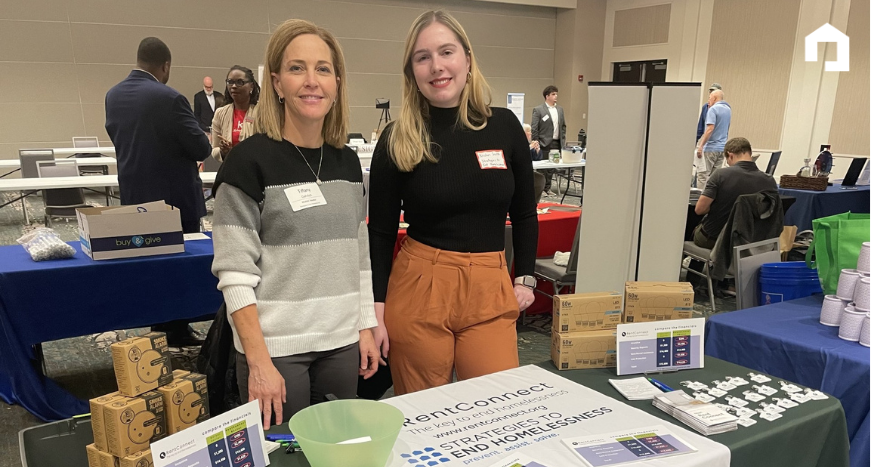
RentConnect Celebrates Key Partners
Celebrating relationship and mutual benefit, RentConnect Manager Tiffany Gerhlich highlights a partner for having the "Most Padmission Units Leased".
Why Landlord Engagement Must Become a System Function
As housing programs expand and expectations around performance increase, landlord engagement inevitably becomes a system-level concern.
Over time, property partners disengage—not because they oppose participation, but because the system becomes difficult to navigate.
As Tiffany Gehrlich, RentConnect Manager at Strategies to End Homelessness, described Cincinnati’s experience before centralization:
“Property providers had some housing program staff contacts and housing program staff had some property provider contacts—but they were trying to find the right fit at the right time with limited connections. If a property provider had open units and their limited contacts couldn’t use them, they went to market renters when we know there were other agencies that could have used them.”
Centralizing landlord engagement is a structural response to these conditions.
Rather than relying on parallel outreach across dozens of providers, communities establish a coordinated function responsible for developing and sustaining property partnerships on behalf of the system.
The goal is not visibility for its own sake. It is reliable housing supply that persists beyond individual staff relationships.
Evaluating Landlord Engagement Approaches That Scale
Not all landlord engagement strategies fail for the same reason. Many fail not because the idea is flawed, but because the approach increases operational weight rather than reducing it. New initiatives are often layered onto already-fragmented systems, asking staff and property owners and operators to absorb additional steps, reporting, or coordination without experiencing meaningful relief in daily work.
This dynamic is familiar to many systems that attempted to scale landlord engagement without changing underlying structure. As one CoC lead agency described their pre-centralization conditions:
“Efforts were siloed, and many service providers were left to handle all tasks related to the rehousing process separately.”
A practical way to evaluate any centralized landlord engagement strategy—whether it is a pilot, a long-standing practice, or a newly proposed initiative—is to ask a simple question:
Does this approach encourage compounding engagement of property owners and operators in our community’s approach to end homelessness or does it rely on providers to recruit units individually?
Across the country, systemwide housing access at scale tends to share common characteristics:
- They increase performance by adding expertise and capacity to their system
- They tailor resources to meet actual business needs by bringing property owners and operators into system design.
- They make limited system resources work harder, enabling small teams to outperform larger systems
- They remove complexity rather than shifting it onto staff or property owners and operators
- They amplify human judgment instead of replacing it with disconnected processes and offerings
- Most importantly, they support consistent housing access over time, not just short-term activity during periods of focused attention or grant pressure.
These characteristics are not aspirational. They are observable in how centralized landlord engagement systems across CoCs behave under stress—during staff turnover, market tightening, audit review, or funding expansion. Approaches that do not reduce burden and increase clarity tend to stall as conditions change, regardless of how promising they appear at launch.
Property Owners and Operators as System Stakeholders
Sustainable landlord engagement involves property owners and operators as stakeholders whose experience helps shape how programs operate.
As Breya Birdsong, Vice President of Rental Assistance Programs at RDOOR Housing Corporation, explained about integrated partnerships with landlords:
“Landlords round out the rehousing team — they are not external to the process.”
High-performing systems seek feedback from participating partners as well as those who have disengaged. Initial and ongoing surveys produce quantifiable and qualitative data points to start from. Listening sessions, advisory groups, and ongoing dialogue surface operational friction that internal teams may underestimate.
These conversations often reveal issues such as unclear timelines, inconsistent communication, duplicative documentation, or unresolved past problems.
Addressing these issues strengthens participation more effectively than recruitment alone and builds resilient relationships.
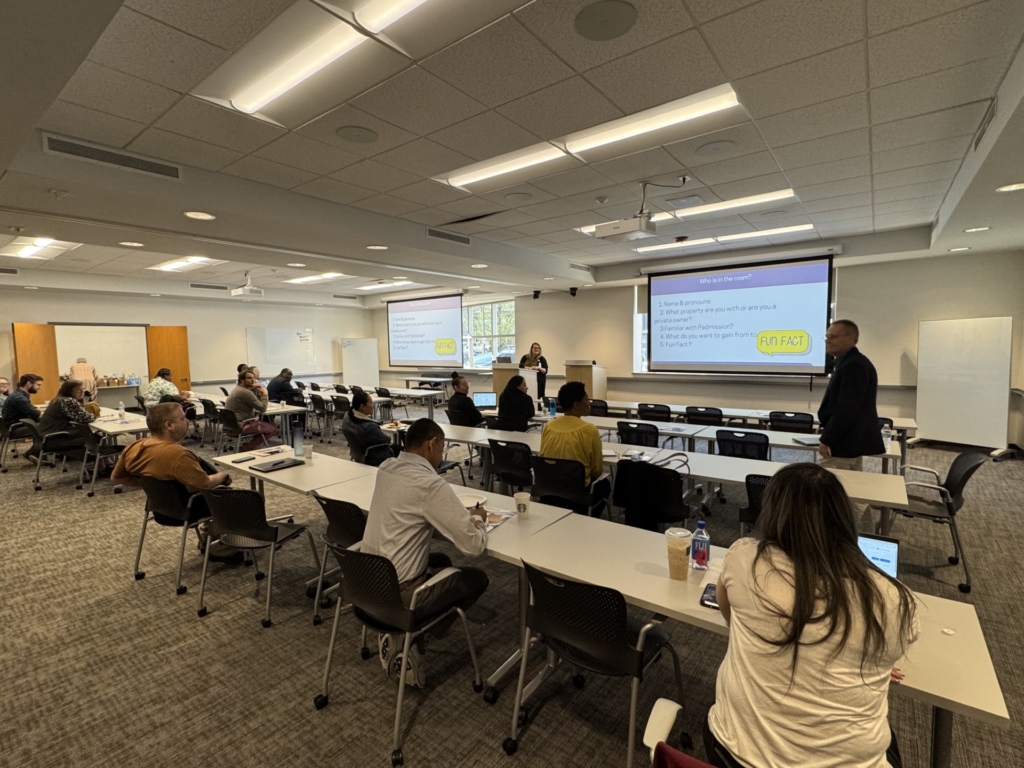
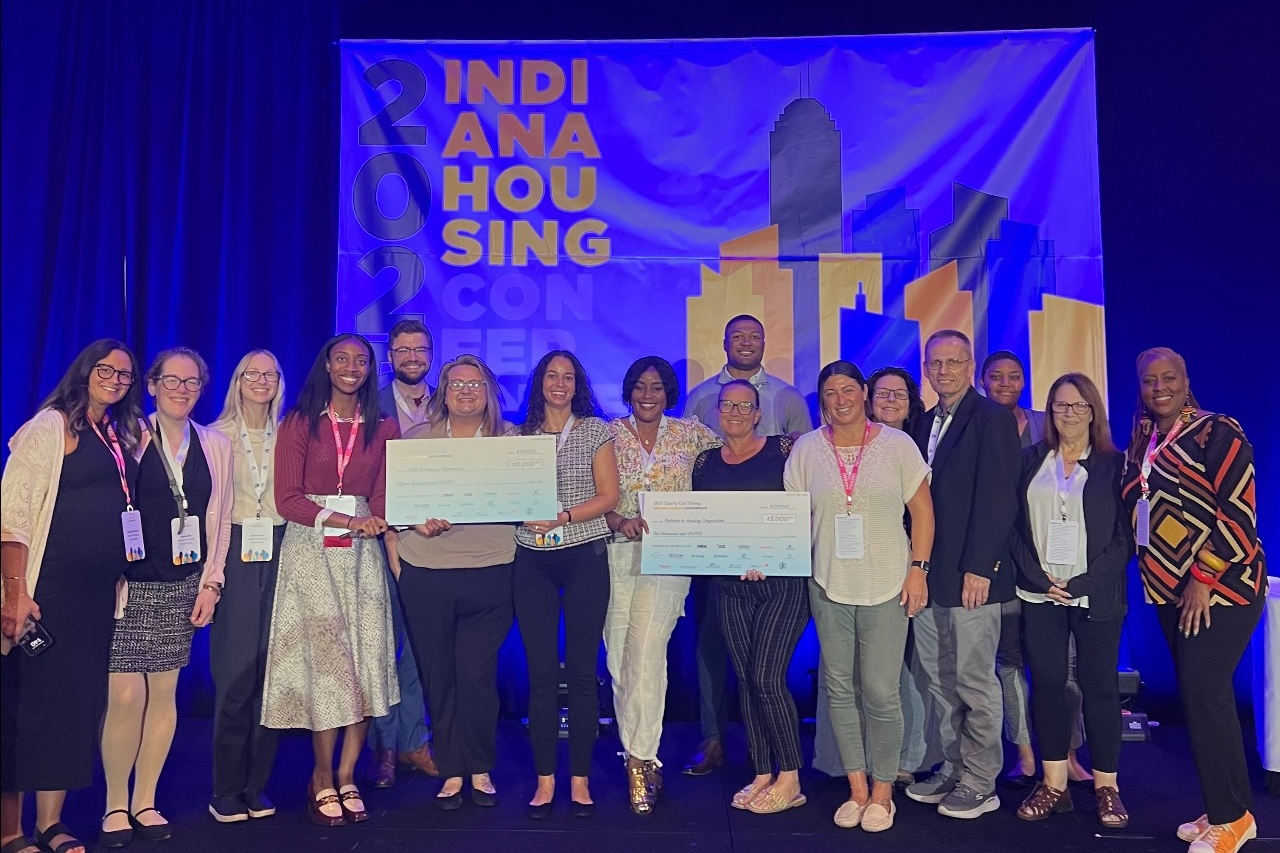
HomeNow Indy Onboards Property Partners
Bringing all stakeholders to the table includes taking time to ensure a shared understanding of programs and supports.
Partnering With Local Real Estate and Apartment Associations
Another key partnership to build is with local real estate and apartment associations.
Local organizations affiliated with the National Apartment Association and similar local groups often represent a large portion of the professional rental housing market within a community, including many property owners and operators the system may not otherwise reach directly. These associations provide direct access to property owners, portfolio operators, property managers, and leasing professionals who collectively manage thousands of units.
Engaging these associations allows CoCs to reach housing providers through trusted professional networks rather than approaching landlords one property at a time. Association meetings, conferences, and educational sessions create opportunities to explain how rental assistance programs operate, address common misconceptions, and establish clear points of contact for future participation.
These partnerships also help establish housing programs as credible partners within the rental housing industry. Participation in association events and informational sessions signals that engagement is organized and coordinated at the system level.
Association partnerships also create valuable channels for ongoing communication. Housing programs can share updates about program supports, respond to policy changes, and highlight success stories that demonstrate how partnerships with housing providers are working in practice. Over time, these relationships help normalize participation in housing programs as part of the broader rental housing ecosystem.
Real estate associations also create space for dialogue about inspections, payment timelines, risk mitigation, and tenant communication. Engaging through these professional forums allows those questions to be addressed transparently while also providing systems with feedback about where operational processes may need improvement.
When approached as long-term partnerships rather than recruitment opportunities, relationships with apartment and real estate associations can become one of the most reliable pathways for expanding housing supply. They connect housing programs to the professionals who operate the rental market and help ensure that landlord engagement efforts remain aligned with how housing providers actually conduct business.
How Centralized Landlord Engagement Changes Day-to-Day Work
When landlord engagement becomes a coordinated system function, the impact is most visible in routine work.
Property owners and operators experience more predictable communication and clearer expectations about participation. Partners interact with a system that communicates consistently and maintains institutional knowledge over time.
For housing navigators and case managers, centralized engagement changes the nature of housing search. Housing search becomes less about chasing information and more about helping participants evaluate real options supported by shared housing inventory and a more coordinated inquiry process.
Participants benefit from fewer dead ends and more transparent housing opportunities. Conversations shift from uncertainty toward informed decision-making about location, timing, and unit type.
Centralization reduces the background friction that forces staff to rely on workarounds to accomplish basic tasks.
Often, the clearest change is what staff no longer have to do.
As Kimberly Doty, Director of Housing at Partnership Home in Tarrant County, TX and recognized landlord engagement expert explained:
“We can pick up where someone else has left off in connecting with a property.”
This structure reduces rework and allows programs and funders to operate from shared information.
Professionalizing Landlord Engagement
Property owners and operators operate businesses. Sustainable landlord engagement acknowledges this reality and responds with consistent business solutions rather than informality.
Professional engagement replaces ad hoc outreach with predictable processes and clear communication.
Many communities strengthen landlord engagement teams by hiring staff with property management or real estate experience. Resources such as the NAEH Center for Learning also highlight the growing importance of specialized landlord engagement roles within homelessness response systems. Professionals who understand property management practices, owner priorities, leasing-staff terminology, and market dynamics are often better positioned to engage property partners effectively.
Property partners understand how onboarding works, what timelines to expect, and how problems will be addressed when they arise.
Over time, consistent communication and reliable follow-through allow trust to compound rather than reset with every interaction.
Understanding the Diversity of Property Partners
Property owners and operators are not a single audience. Ownership structure, portfolio size, and management model shape decision-making and participation.
Independent owner-operators often prioritize simplicity and responsiveness. Mid-size management companies value operational efficiency. Large portfolios emphasize compliance, reputational risk, and consistent processes.
When systems fail to recognize these differences, housing supply tends to concentrate among a small group of properties. Over time, this increases risk and limits participant choice.
Intentional segmentation allows systems to expand participation across the broader housing market.
Identifying and Sustaining Housing Supply
A centralized landlord engagement strategy is only as effective as the housing supply it is able to recruit and sustain over time. Identifying potential property partners is not simply a matter of generating leads; it requires understanding which outreach sources are most likely to produce active housing opportunities and long-term participation.
These dynamics are particularly visible in markets where rental vacancy rates remain historically low, making landlord recruitment an essential system function rather than an optional program activity.
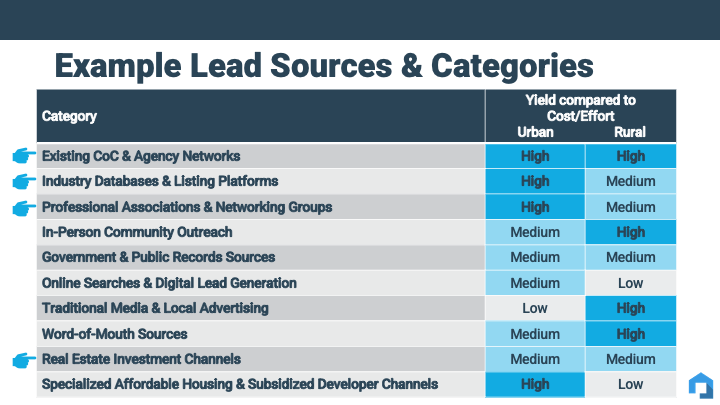
Different housing markets produce different recruitment patterns. In larger urban markets, the volume of potential partners is often high, but the conversion rate from outreach to lease-up can vary significantly depending on how engagement is structured. Rural and smaller markets typically produce fewer leads, but relationships may convert more reliably once trust is established.
Across many CoCs, common recruitment sources include:
- Online rental listings and property platforms
- Property management companies and portfolio operators
- Real estate brokers and leasing agents
- Local property owner associations or apartment associations (see partnership strategy above)
- Referrals from existing property partners
- Community events or landlord information sessions
Each of these channels tends to perform differently depending on market context.
In dense rental markets, online listings and property management companies often generate the highest lead volume, but require disciplined follow-up and coordination to prevent multiple providers from contacting the same properties simultaneously. Broker relationships and property associations can also become valuable entry points for reaching portfolio-level decision makers who manage dozens or hundreds of units.
In rural or smaller markets, outreach tends to rely more heavily on local relationships and community reputation. Leads may emerge through existing landlord networks, referrals from current partners, or connections through local business and civic organizations. The volume of new leads may be smaller, but the long-term stability of these relationships can be higher once established.
Over time, effective landlord engagement programs track which recruitment sources consistently translate into lease-ups, which produce long-term partners, and which consume staff time without yielding housing placements. This allows systems to focus effort where it produces the most housing access rather than relying on anecdotal impressions of what appears to be working.
Understanding recruitment yield is not about eliminating low-performing channels prematurely. It is about learning how housing supply actually enters the system and allocating outreach effort accordingly.
Identifying the Decision Maker
Effective landlord engagement depends less on the number of outreach attempts and more on whether systems are engaging the correct decision maker. Many engagement efforts stall not because property owners are uninterested, but because staff are routed to contacts who do not have the authority to approve participation.
Decision-making authority varies significantly depending on the ownership and management structure of a property. Independent owners often make participation decisions directly, while larger portfolios may distribute authority across multiple roles including regional managers, asset managers, or corporate compliance teams. Leasing agents and site managers may be familiar with day-to-day operations but lack the authority to approve participation in “voucher programs” (which managers often conflate CoC programs with) or partnership initiatives.
When housing programs repeatedly engage staff who cannot make decisions, outreach can appear productive while conversations quietly stall. Follow-ups multiply, timelines stretch, and interest from property partners fades before the system reaches the appropriate level of authority.
High-performing landlord engagement teams invest time early in identifying who actually controls participation decisions. This may involve asking direct questions about approval processes, researching property ownership structures, or tracing management hierarchies within larger portfolios. Over time, this information becomes part of the system’s institutional knowledge, allowing future outreach to begin at the correct level rather than repeating the same discovery process.
Identifying the decision maker also signals respect for how property businesses operate. When conversations occur with the appropriate leadership, discussions can focus on predictable timelines, operational expectations, and long-term partnership rather than repeatedly explaining program details to contacts without decision authority.
Over time, clarity around decision authority reduces stalled conversations, improves conversion rates, and helps landlord engagement efforts scale beyond individual relationships.
Once systems understand where housing supply originates and who has authority to approve participation, the work shifts from recruitment to implementation.
Implementing Centralized Landlord Engagement in Practice
Designing a centralized landlord engagement strategy is only the first step. Implementation succeeds when providers, system leadership, and housing market partners understand how coordination will tangibly change their work. Since centralization reshapes long-standing practices and relationships, deliberate engagement across stakeholders is essential.
The goal during implementation is not to replace the work providers already do. It is to align those efforts so that landlord engagement expands housing access for the entire system rather than remaining fragmented across agencies.
Developing provider buy-in
Provider participation is the most important implementation factor. Housing navigators and program teams have spent years building relationships and navigating difficult housing markets. Any effort to centralize landlord engagement can initially feel like it threatens those relationships or removes tools providers rely on to house participants.
Successful systems address this concern early by showing providers that centralization strengthens existing relationships through shared visibility and reduced competition.
Provider buy-in often grows when staff see how centralized engagement reduces friction in day-to-day work. Shared housing visibility means navigators spend less time verifying whether a unit is truly available. Providers no longer have to compete with each other for the same landlords. Smaller organizations gain access to housing opportunities they may not have been able to secure independently. Over time, the work shifts from chasing leads to preparing participants to evaluate real options.
In many communities, implementation begins with a small group of early-adopter providers who help refine workflows before broader rollout. This approach allows systems to demonstrate practical improvements rather than relying on theoretical promises.
Securing executive support across sectors
Centralized landlord engagement also requires visible support from system leadership. CoC leadership, provider agency executives, public and elected officials, housing and homelessness coalitions, and public housing agencies play a key role in establishing the conditions that allow centralized approaches to operate effectively.
Executive support matters because landlord engagement intersects with multiple systems: housing programs, inspections, payment processes, and compliance requirements. Alignment across these functions helps ensure that property partners experience consistent expectations rather than conflicting procedures.
Engaging leaders from the private sector is equally important. Property management associations, large portfolio owners, and regional housing organizations often influence how property owners evaluate participation in housing programs. When these partners understand the goals of centralized engagement—and see that the system is investing in predictable communication and clear processes—they are more likely to view participation as a credible partnership rather than a temporary initiative.
Leveraging trusted brands and partnerships
Landlord engagement efforts often gain traction when they operate under a recognizable identity rather than as a series of separate program outreach efforts. Many communities establish or strengthen landlord engagement brands that represent the entire system rather than a single agency.
A shared brand allows property partners to understand that they are interacting with a coordinated housing initiative rather than multiple disconnected programs. It also helps reinforce consistency in communication, messaging, and expectations across agencies.
Some communities build new initiatives to support this work, while others leverage existing partnerships or housing initiatives that already have credibility with property owners. Branding is not about marketing in the traditional sense. It is about clarity—making it easier for property owners to understand how the system works and who they are partnering with.
Over time, recognizable initiatives also help systems communicate progress publicly, celebrate participating property partners, and build momentum around landlord engagement as an ongoing system function.
When launching a separate brand, leverage the administering organization’s brand publicly to build momentum and recognition. In Wichita, NEXTenant was launching and had difficulty gaining momentum until its administering organization – United Way of the Plains – boosted the brand across its own social media profiles, leading to news coverage and 15 property operators joining the network the following week.
Implementation succeeds when these efforts reinforce one another. Provider alignment ensures the system uses housing supply effectively. Executive leadership creates the conditions for consistency and accountability. Public-facing initiatives make participation understandable to the housing market. Together, these elements allow centralized landlord engagement to move from concept to sustained practice.
Measuring What Strengthens the System
Effective systems measure outcomes rather than activity. Activity metrics — calls made, events attended, outreach attempts logged — can look productive while housing supply stagnates. Outcome metrics reveal whether the system is actually expanding access, moving people faster, and reaching the parts of the housing market that serve participants best.
The experience of Threshold, the centralized landlord engagement service in Arizona, demonstrates what this looks like in practice. Over a sustained period of centralized landlord engagement, Threshold recruited 611 new property owners and operators, adding 1,648 available units across 118 ZIP codes — creating the conditions for 3,313 households to move off the streets and into housing. The share of households enrolled in programs that successfully converted into leases rose from 67.3% to 84.3%, and unhoused Arizonans moved into homes 27 days faster than in 2021.
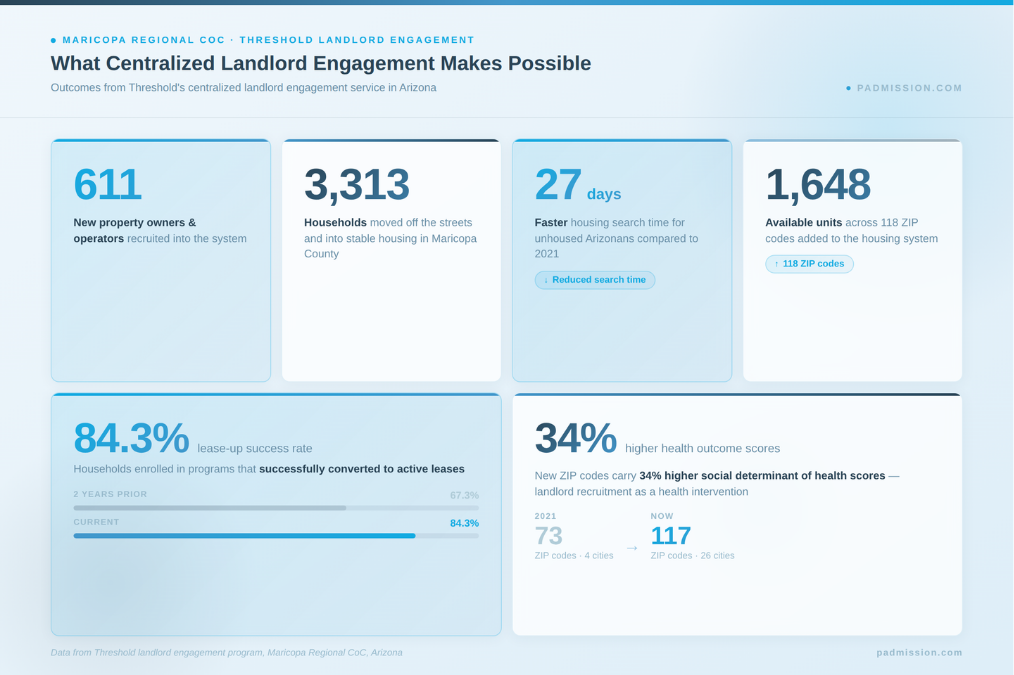
The most consequential measurement, and the one most systems are not yet tracking, is geographic diversification. Public health research consistently identifies neighborhood conditions — access to transportation, employment, food, and community services — as powerful predictors of long-term health and stability. In Maricopa County, funders and elected officials identified expanding the geographic footprint of available properties as a core outcome. Threshold now connects participants to properties across 117 ZIP codes in 26 cities and municipalities, compared to 73 ZIP codes across 4 cities in 2021. The newly added ZIP codes carried 34% higher social determinant of health scores — meaning expanded landlord recruitment became a health intervention, not just a housing one.
Useful measurement frameworks track six indicators: active property partners over time, lead source and recruitment yield, reasons operators accept or decline participation, housing search duration, lease-up success rates against households enrolled, and geographic diversification of placements. When paired with full system metrics tracking movement from unsheltered to sheltered to housed, these indicators connect landlord engagement performance directly to the outcomes homelessness response systems exist to produce.
Building Landlord Engagement as a Permanent System Function
Implementation establishes the conditions for centralized landlord engagement to operate. Over time, the goal is for these practices to move beyond implementation efforts and become a stable, ongoing function of the housing system itself.
Centralized landlord engagement is not a campaign. It is the permanent entry point through which property owners and operators participate in housing programs.
Systems that invest in predictable processes, shared records, and consistent communication shift from reactive scrambling to stable capacity building. Housing access grows more evenly, staff burnout decreases, and property owners and operators experience professionalism rather than chaos.
Over time, these structural changes allow housing systems to operate sustainably even as expectations increase and housing markets tighten.
Landlord engagement does not replace the work of providers. It strengthens the environment in which that work occurs.
When housing supply is coordinated and relationships are sustained, programs can focus on what they were designed to do: helping people move into housing and remain there successfully rather than navigating fragmented access to it.
Threshold - A Meaningful Partnership
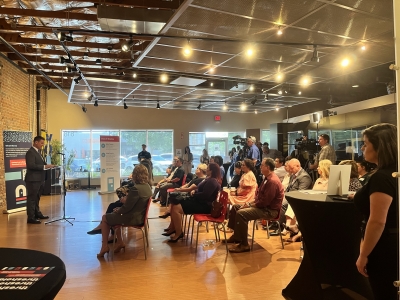
Threshold (www.thresholdaz.com) officially launches in a co-hosted event with the Arizona Multihousing Association. Threshold's success is intertwined with its meaningful partnership with property owners and operators.
How Padmission Connect supports centralized landlord engagement
Padmission Connect helps communities operationalize centralized landlord engagement by giving landlord engagement teams a shared record of property outreach, participation history, available units, and housing search activity across providers. That structure supports coordinated property engagement, broader housing access, and stronger continuity as staff roles change — without shifting local placement decisions or relationship ownership.
Explore how coordinated housing access works in practice.
Key Principles & Take-Aways for Centralized Landlord Engagement
- Landlord engagement is housing infrastructure, not a program activity. When property owner and operator relationships are managed as individual agency resources, housing supply remains fragmented and system performance depends on individual staff. Treating landlord engagement as a system function — with shared records, coordinated outreach, and centralized relationship management — converts it from a variable into a stable foundation.
- Centralization expands access without shifting local decision-making. The goal of centralized landlord engagement is not to determine where participants live or override program placement decisions. It is to ensure that housing opportunities are visible across the system, that relationships persist beyond individual staff tenure, and that smaller providers can access housing supply they could not develop independently.
- Property owners and operators are system stakeholders, not a recruitment target. Sustainable landlord engagement treats property partners as participants in system design. Their operational feedback — on timelines, communication, inspection processes, and payment reliability — directly shapes whether housing programs remain viable partners in the rental market over time.
- The quality of housing supply matters as much as its volume. Expanding the landlord network is not simply about increasing the number of available units. It is about preserving participant choice, maintaining geographic diversity, and preventing the concentration of placements that undermines scattered-site housing models and limits long-term housing stability.
- Effective landlord engagement requires reaching the right decision maker. Outreach volume does not determine whether systems build housing supply — decision-maker access does. High-performing systems invest in understanding ownership structures and management hierarchies early, so conversations begin at the level of authority required to move from interest to participation.
- Measurement should track outcomes, not activity. Useful indicators include active property partners over time, average housing search duration, lease-up success rates, and placement diversification by geography and property type. Tracking these metrics allows systems to understand which engagement strategies produce durable housing access and which consume staff capacity without improving outcomes.
Read more about how Padmission Connect supports centralized landlord engagement as a professional service.
About the Author:
Daniel Davis
Related Posts

Centralized Landlord Engagement for Continuums of Care (CoCs)
A Structural Guide to Building Scalable Housing Access
Landlord engagement is one of the least discussed but most consequential functions inside a homelessness response system. For Continuums of Care (CoCs)— the regional systems responsible for coordinating federal homelessness funding and housing programs — the ability to recruit, maintain, and coordinate relationships with property owners and operators ultimately determines whether rental assistance programs translate into real housing placements. When landlord engagement is fragmented across agencies, housing opportunities remain limited.
When communities implement centralized landlord engagement, housing supply expands, housing search becomes more effective, and lease-up success — the rate households enrolled in a program successfully convert that assistance into an active lease — improves across the system. This guide explains how centralized landlord engagement for Continuums of Care can transform fragmented outreach into a coordinated housing access system for homelessness response systems. As housing supply grows, systems regain the capacity to move people quickly into housing.
Landlord engagement in homelessness systems refers to the structured work of recruiting, supporting, and coordinating relationships with private rental housing providers so people exiting homelessness can access units in the broader rental market. Since most housing programs rely on private landlords rather than publicly owned housing stock, CoCs must treat landlord engagement as a system function rather than an individual provider activity — a structural shift this guide is designed to support.
Why Centralized Landlord Engagement Determines Whether Continuums of Care Can Actually End Homelessness
Housing assistance programs administered in a Housing First framework are the most effective way of ending homelessness, converting public funding into leases and sustained tenancies. These programs enable people experiencing homelessness, sheltered or unsheltered, to move into their own homes and stabilize through supportive services and rental assistance.
In most CoCs the limiting factor is no longer programmatic expertise or supportive service tools but reliable access to units and the structured relationships required to secure them consistently. When landlord engagement is limited or inconsistent, that gap is not a peripheral problem. It is a housing supply problem, and housing supply is the foundation everything else depends on. Homelessness response systems do not operate outside the rental market — they operate inside it.
When housing supply is unstable, the effects move through the system quickly. Search times lengthen. Participants settle for fewer options. Project utilization declines. Programs designed to move households rapidly into stable housing begin to stall. Shelter beds turn over more slowly, and availability decreases for people living unsheltered who are waiting for an opportunity to come inside. As we examine in our analysis of how rental assistance administration becomes structurally fragile under fragmentation, housing search access, funding utilization, and landlord engagement also succeed or fail together.
Landlord engagement sits as the key enabler of housing search, rental assistance utilization, and system coordination, shaping whether providers can operate consistently under funding and performance expectations.
The inverse is equally true: when systems address these structural constraints, the results compound. As TJ Reed, Human Services Assistant Director at the Community Resilience Division in Maricopa County, described the experience after Maricopa Regional CoC centralized landlord engagement:
“We knew finding housing and using the funding that was already available was difficult. Once… there were more properties and units available for our provider partners to use, we knew we could start to dream bigger and fund with more confidence.”
That confidence translates into more funding deployed into housing programs — rather than into shelter capacity that expands only because housing access remains the bottleneck.
That shift — from constrained and reactive to expansive and confident — is what structural landlord engagement makes possible. The rest of this guide explains how to build it.
What Centralization Actually Means
Centralization is often misunderstood as control.
When landlord engagement is centralized, property owner and operator relationships become shared system assets rather than agency-specific resources. Housing opportunities become visible across participating providers, reducing duplicated outreach and internal competition.
Relationship history persists as part of the system itself, not as a function of who currently holds a role.
Smaller providers gain access to housing opportunities they could not develop independently, while larger providers avoid rebuilding the same relationships across multiple teams.
The system becomes more resilient because housing access no longer depends on any single individual or organization.
Landlord Engagement and Housing Search Solve Different Problems
Centralizing property engagement and coordinated housing search are related but distinct functions.
Both are essential. But they solve different problems and require different solutions.
Landlord engagement focuses on recruiting and maintaining relationships with Property Owners and Operators. Its purpose is to expand the housing supply available to the system.
Housing search determines how participants and providers access that supply once it exists.
Put simply:
Landlord engagement creates housing opportunities.
Housing search connects participants to those opportunities.
Centralizing housing search without strengthening landlord engagement simply redistributes a limited supply of units. Centralizing landlord engagement without coordinated housing search can leave new opportunities unevenly distributed across programs.
When Housing Supply Is Limited, Systems Compete Against Themselves
In many communities, landlord engagement was never designed as a system function. It developed organically within individual programs.
Housing navigators built personal networks.
Case managers tracked properties in spreadsheets.
Programs were often forced to pursue placements with any landlord willing to accept rental assistance, even when the partnership was poorly aligned.
These efforts often produce placements. But over time, fragmented landlord engagement limits program scalability and creates structural dynamics that weaken the system as a whole.
When housing supply is limited and outreach is decentralized, providers also begin competing for the same units.
Information about participating landlords becomes guarded rather than shared. Programs maintain private property lists. Some relationships become informally protected because staff fear that introducing a landlord to the broader system may reduce their own program’s access.
Over time, communities develop what practitioners sometimes describe as “pocket landlords” — property owners known quietly by a few providers who are willing to accept higher-barrier applicants.
This dynamic emerges not from unwillingness to collaborate, but from the absence of a reliable system for growing and managing housing supply collectively.
As competition increases, pressure on individual staff grows. Housing navigators are often expected to produce units in a market they cannot control. Under those conditions, providers may feel forced to pursue opportunities with landlords who are poorly aligned with program expectations simply because housing options are scarce.
Even funders feel the constraints as agencies regularly identify a lack of available units as a program performance cap. Maricopa County’s experience, described earlier in this guide, reflects a pattern that appears consistently across communities that have made this transition — the structural conditions that make centralization difficult are often the same ones that make it necessary.
The result is a system that is working harder, producing fewer sustainable outcomes, and depending on unstable housing supply conditions to perform.
Housing Supply Constraints Shape Where Participants Can Live
Limited landlord recruitment also affects where participants ultimately secure housing.
When the same small group of properties – often because they are properties participants previously lived or independently located on their own – placements tend to concentrate in the same neighborhoods and buildings. Participants often return to the same areas because those are the only locations where units are reliably available to their agency.
Over time, a handful of properties may absorb a disproportionate share of placements.
Scattered-site housing programs can begin to resemble de facto project-based models when placements cluster in the same developments simply because those properties accept housing assistance programs.
This pattern is not ideal, though rarely intentional. It is usually the natural outcome of insufficient housing recruitment.
Without deliberate expansion of the landlord network, systems recycle the same housing supply rather than increasing it.
Participant choice narrows.
Geographic diversity declines.
And the placement stability may weaken as properties become oversaturated.
When participants have meaningful access, they are better able to prioritize the conditions that support long-term stability, greatly increasing client choice in housing search. Access to housing near family, employment, transportation, and community services reduces daily strain and increases the likelihood that households remain successfully housed. When housing supply is limited, those choices disappear and participants often accept the few units available rather than the homes that best support their lives.
Expanding the pool of participating property owners and operators is therefore not simply about increasing placement opportunities. It is also about preserving participant choice, protecting scattered-site housing models, and improving lease-up success across the system.
RentConnect Celebrates Key Partners
Celebrating relationship and mutual benefit, RentConnect Manager Tiffany Gerhlich highlights a partner for having the "Most Padmission Units Leased".
Why Landlord Engagement Must Become a System Function
As housing programs expand and expectations around performance increase, landlord engagement inevitably becomes a system-level concern.
Over time, property partners disengage—not because they oppose participation, but because the system becomes difficult to navigate.
As Tiffany Gehrlich, RentConnect Manager at Strategies to End Homelessness, described Cincinnati’s experience before centralization:
“Property providers had some housing program staff contacts and housing program staff had some property provider contacts—but they were trying to find the right fit at the right time with limited connections. If a property provider had open units and their limited contacts couldn’t use them, they went to market renters when we know there were other agencies that could have used them.”
Centralizing landlord engagement is a structural response to these conditions.
Rather than relying on parallel outreach across dozens of providers, communities establish a coordinated function responsible for developing and sustaining property partnerships on behalf of the system.
The goal is not visibility for its own sake. It is reliable housing supply that persists beyond individual staff relationships.
Evaluating Landlord Engagement Approaches That Scale
Not all landlord engagement strategies fail for the same reason. Many fail not because the idea is flawed, but because the approach increases operational weight rather than reducing it. New initiatives are often layered onto already-fragmented systems, asking staff and property owners and operators to absorb additional steps, reporting, or coordination without experiencing meaningful relief in daily work.
This dynamic is familiar to many systems that attempted to scale landlord engagement without changing underlying structure. As one CoC lead agency described their pre-centralization conditions:
“Efforts were siloed, and many service providers were left to handle all tasks related to the rehousing process separately.”
A practical way to evaluate any centralized landlord engagement strategy—whether it is a pilot, a long-standing practice, or a newly proposed initiative—is to ask a simple question:
Does this approach encourage compounding engagement of property owners and operators in our community’s approach to end homelessness or does it rely on providers to recruit units individually?
Across the country, systemwide housing access at scale tends to share common characteristics:
- They increase performance by adding expertise and capacity to their system
- They tailor resources to meet actual business needs by bringing property owners and operators into system design.
- They make limited system resources work harder, enabling small teams to outperform larger systems
- They remove complexity rather than shifting it onto staff or property owners and operators
- They amplify human judgment instead of replacing it with disconnected processes and offerings
- Most importantly, they support consistent housing access over time, not just short-term activity during periods of focused attention or grant pressure.
These characteristics are not aspirational. They are observable in how centralized landlord engagement systems across CoCs behave under stress—during staff turnover, market tightening, audit review, or funding expansion. Approaches that do not reduce burden and increase clarity tend to stall as conditions change, regardless of how promising they appear at launch.
Property Owners and Operators as System Stakeholders
Sustainable landlord engagement involves property owners and operators as stakeholders whose experience helps shape how programs operate.
As Breya Birdsong, Vice President of Rental Assistance Programs at RDOOR Housing Corporation, explained about integrated partnerships with landlords:
“Landlords round out the rehousing team — they are not external to the process.”
High-performing systems seek feedback from participating partners as well as those who have disengaged. Initial and ongoing surveys produce quantifiable and qualitative data points to start from. Listening sessions, advisory groups, and ongoing dialogue surface operational friction that internal teams may underestimate.
These conversations often reveal issues such as unclear timelines, inconsistent communication, duplicative documentation, or unresolved past problems.
Addressing these issues strengthens participation more effectively than recruitment alone and builds resilient relationships.
HomeNow Indy Onboards Property Partners
Bringing all stakeholders to the table includes taking time to ensure a shared understanding of programs and supports.
Partnering With Local Real Estate and Apartment Associations
Another key partnership to build is with local real estate and apartment associations.
Local organizations affiliated with the National Apartment Association and similar local groups often represent a large portion of the professional rental housing market within a community, including many property owners and operators the system may not otherwise reach directly. These associations provide direct access to property owners, portfolio operators, property managers, and leasing professionals who collectively manage thousands of units.
Engaging these associations allows CoCs to reach housing providers through trusted professional networks rather than approaching landlords one property at a time. Association meetings, conferences, and educational sessions create opportunities to explain how rental assistance programs operate, address common misconceptions, and establish clear points of contact for future participation.
These partnerships also help establish housing programs as credible partners within the rental housing industry. Participation in association events and informational sessions signals that engagement is organized and coordinated at the system level.
Association partnerships also create valuable channels for ongoing communication. Housing programs can share updates about program supports, respond to policy changes, and highlight success stories that demonstrate how partnerships with housing providers are working in practice. Over time, these relationships help normalize participation in housing programs as part of the broader rental housing ecosystem.
Real estate associations also create space for dialogue about inspections, payment timelines, risk mitigation, and tenant communication. Engaging through these professional forums allows those questions to be addressed transparently while also providing systems with feedback about where operational processes may need improvement.
When approached as long-term partnerships rather than recruitment opportunities, relationships with apartment and real estate associations can become one of the most reliable pathways for expanding housing supply. They connect housing programs to the professionals who operate the rental market and help ensure that landlord engagement efforts remain aligned with how housing providers actually conduct business.
How Centralized Landlord Engagement Changes Day-to-Day Work
When landlord engagement becomes a coordinated system function, the impact is most visible in routine work.
Property owners and operators experience more predictable communication and clearer expectations about participation. Partners interact with a system that communicates consistently and maintains institutional knowledge over time.
For housing navigators and case managers, centralized engagement changes the nature of housing search. Housing search becomes less about chasing information and more about helping participants evaluate real options supported by shared housing inventory and a more coordinated inquiry process.
Participants benefit from fewer dead ends and more transparent housing opportunities. Conversations shift from uncertainty toward informed decision-making about location, timing, and unit type.
Centralization reduces the background friction that forces staff to rely on workarounds to accomplish basic tasks.
Often, the clearest change is what staff no longer have to do.
As Kimberly Doty, Director of Housing at Partnership Home in Tarrant County, TX and recognized landlord engagement expert explained:
“We can pick up where someone else has left off in connecting with a property.”
This structure reduces rework and allows programs and funders to operate from shared information.
Professionalizing Landlord Engagement
Property owners and operators operate businesses. Sustainable landlord engagement acknowledges this reality and responds with consistent business solutions rather than informality.
Professional engagement replaces ad hoc outreach with predictable processes and clear communication.
Many communities strengthen landlord engagement teams by hiring staff with property management or real estate experience. Resources such as the NAEH Center for Learning also highlight the growing importance of specialized landlord engagement roles within homelessness response systems. Professionals who understand property management practices, owner priorities, leasing-staff terminology, and market dynamics are often better positioned to engage property partners effectively.
Property partners understand how onboarding works, what timelines to expect, and how problems will be addressed when they arise.
Over time, consistent communication and reliable follow-through allow trust to compound rather than reset with every interaction.
Understanding the Diversity of Property Partners
Property owners and operators are not a single audience. Ownership structure, portfolio size, and management model shape decision-making and participation.
Independent owner-operators often prioritize simplicity and responsiveness. Mid-size management companies value operational efficiency. Large portfolios emphasize compliance, reputational risk, and consistent processes.
When systems fail to recognize these differences, housing supply tends to concentrate among a small group of properties. Over time, this increases risk and limits participant choice.
Intentional segmentation allows systems to expand participation across the broader housing market.
Identifying and Sustaining Housing Supply
A centralized landlord engagement strategy is only as effective as the housing supply it is able to recruit and sustain over time. Identifying potential property partners is not simply a matter of generating leads; it requires understanding which outreach sources are most likely to produce active housing opportunities and long-term participation.
These dynamics are particularly visible in markets where rental vacancy rates remain historically low, making landlord recruitment an essential system function rather than an optional program activity.
Different housing markets produce different recruitment patterns. In larger urban markets, the volume of potential partners is often high, but the conversion rate from outreach to lease-up can vary significantly depending on how engagement is structured. Rural and smaller markets typically produce fewer leads, but relationships may convert more reliably once trust is established.
Across many CoCs, common recruitment sources include:
- Online rental listings and property platforms
- Property management companies and portfolio operators
- Real estate brokers and leasing agents
- Local property owner associations or apartment associations (see partnership strategy above)
- Referrals from existing property partners
- Community events or landlord information sessions
Each of these channels tends to perform differently depending on market context.
In dense rental markets, online listings and property management companies often generate the highest lead volume, but require disciplined follow-up and coordination to prevent multiple providers from contacting the same properties simultaneously. Broker relationships and property associations can also become valuable entry points for reaching portfolio-level decision makers who manage dozens or hundreds of units.
In rural or smaller markets, outreach tends to rely more heavily on local relationships and community reputation. Leads may emerge through existing landlord networks, referrals from current partners, or connections through local business and civic organizations. The volume of new leads may be smaller, but the long-term stability of these relationships can be higher once established.
Over time, effective landlord engagement programs track which recruitment sources consistently translate into lease-ups, which produce long-term partners, and which consume staff time without yielding housing placements. This allows systems to focus effort where it produces the most housing access rather than relying on anecdotal impressions of what appears to be working.
Understanding recruitment yield is not about eliminating low-performing channels prematurely. It is about learning how housing supply actually enters the system and allocating outreach effort accordingly.
Identifying the Decision Maker
Effective landlord engagement depends less on the number of outreach attempts and more on whether systems are engaging the correct decision maker. Many engagement efforts stall not because property owners are uninterested, but because staff are routed to contacts who do not have the authority to approve participation.
Decision-making authority varies significantly depending on the ownership and management structure of a property. Independent owners often make participation decisions directly, while larger portfolios may distribute authority across multiple roles including regional managers, asset managers, or corporate compliance teams. Leasing agents and site managers may be familiar with day-to-day operations but lack the authority to approve participation in “voucher programs” (which managers often conflate CoC programs with) or partnership initiatives.
When housing programs repeatedly engage staff who cannot make decisions, outreach can appear productive while conversations quietly stall. Follow-ups multiply, timelines stretch, and interest from property partners fades before the system reaches the appropriate level of authority.
High-performing landlord engagement teams invest time early in identifying who actually controls participation decisions. This may involve asking direct questions about approval processes, researching property ownership structures, or tracing management hierarchies within larger portfolios. Over time, this information becomes part of the system’s institutional knowledge, allowing future outreach to begin at the correct level rather than repeating the same discovery process.
Identifying the decision maker also signals respect for how property businesses operate. When conversations occur with the appropriate leadership, discussions can focus on predictable timelines, operational expectations, and long-term partnership rather than repeatedly explaining program details to contacts without decision authority.
Over time, clarity around decision authority reduces stalled conversations, improves conversion rates, and helps landlord engagement efforts scale beyond individual relationships.
Once systems understand where housing supply originates and who has authority to approve participation, the work shifts from recruitment to implementation.
Implementing Centralized Landlord Engagement in Practice
Designing a centralized landlord engagement strategy is only the first step. Implementation succeeds when providers, system leadership, and housing market partners understand how coordination will tangibly change their work. Since centralization reshapes long-standing practices and relationships, deliberate engagement across stakeholders is essential.
The goal during implementation is not to replace the work providers already do. It is to align those efforts so that landlord engagement expands housing access for the entire system rather than remaining fragmented across agencies.
Developing provider buy-in
Provider participation is the most important implementation factor. Housing navigators and program teams have spent years building relationships and navigating difficult housing markets. Any effort to centralize landlord engagement can initially feel like it threatens those relationships or removes tools providers rely on to house participants.
Successful systems address this concern early by showing providers that centralization strengthens existing relationships through shared visibility and reduced competition.
Provider buy-in often grows when staff see how centralized engagement reduces friction in day-to-day work. Shared housing visibility means navigators spend less time verifying whether a unit is truly available. Providers no longer have to compete with each other for the same landlords. Smaller organizations gain access to housing opportunities they may not have been able to secure independently. Over time, the work shifts from chasing leads to preparing participants to evaluate real options.
In many communities, implementation begins with a small group of early-adopter providers who help refine workflows before broader rollout. This approach allows systems to demonstrate practical improvements rather than relying on theoretical promises.
Securing executive support across sectors
Centralized landlord engagement also requires visible support from system leadership. CoC leadership, provider agency executives, public and elected officials, housing and homelessness coalitions, and public housing agencies play a key role in establishing the conditions that allow centralized approaches to operate effectively.
Executive support matters because landlord engagement intersects with multiple systems: housing programs, inspections, payment processes, and compliance requirements. Alignment across these functions helps ensure that property partners experience consistent expectations rather than conflicting procedures.
Engaging leaders from the private sector is equally important. Property management associations, large portfolio owners, and regional housing organizations often influence how property owners evaluate participation in housing programs. When these partners understand the goals of centralized engagement—and see that the system is investing in predictable communication and clear processes—they are more likely to view participation as a credible partnership rather than a temporary initiative.
Leveraging trusted brands and partnerships
Landlord engagement efforts often gain traction when they operate under a recognizable identity rather than as a series of separate program outreach efforts. Many communities establish or strengthen landlord engagement brands that represent the entire system rather than a single agency.
A shared brand allows property partners to understand that they are interacting with a coordinated housing initiative rather than multiple disconnected programs. It also helps reinforce consistency in communication, messaging, and expectations across agencies.
Some communities build new initiatives to support this work, while others leverage existing partnerships or housing initiatives that already have credibility with property owners. Branding is not about marketing in the traditional sense. It is about clarity—making it easier for property owners to understand how the system works and who they are partnering with.
Over time, recognizable initiatives also help systems communicate progress publicly, celebrate participating property partners, and build momentum around landlord engagement as an ongoing system function.
When launching a separate brand, leverage the administering organization’s brand publicly to build momentum and recognition. In Wichita, NEXTenant was launching and had difficulty gaining momentum until its administering organization – United Way of the Plains – boosted the brand across its own social media profiles, leading to news coverage and 15 property operators joining the network the following week.
Implementation succeeds when these efforts reinforce one another. Provider alignment ensures the system uses housing supply effectively. Executive leadership creates the conditions for consistency and accountability. Public-facing initiatives make participation understandable to the housing market. Together, these elements allow centralized landlord engagement to move from concept to sustained practice.
Measuring What Strengthens the System
Effective systems measure outcomes rather than activity. Activity metrics — calls made, events attended, outreach attempts logged — can look productive while housing supply stagnates. Outcome metrics reveal whether the system is actually expanding access, moving people faster, and reaching the parts of the housing market that serve participants best.
The experience of Threshold, the centralized landlord engagement service in Arizona, demonstrates what this looks like in practice. Over a sustained period of centralized landlord engagement, Threshold recruited 611 new property owners and operators, adding 1,648 available units across 118 ZIP codes — creating the conditions for 3,313 households to move off the streets and into housing. The share of households enrolled in programs that successfully converted into leases rose from 67.3% to 84.3%, and unhoused Arizonans moved into homes 27 days faster than in 2021.
The most consequential measurement, and the one most systems are not yet tracking, is geographic diversification. Public health research consistently identifies neighborhood conditions — access to transportation, employment, food, and community services — as powerful predictors of long-term health and stability. In Maricopa County, funders and elected officials identified expanding the geographic footprint of available properties as a core outcome. Threshold now connects participants to properties across 117 ZIP codes in 26 cities and municipalities, compared to 73 ZIP codes across 4 cities in 2021. The newly added ZIP codes carried 34% higher social determinant of health scores — meaning expanded landlord recruitment became a health intervention, not just a housing one.
Useful measurement frameworks track six indicators: active property partners over time, lead source and recruitment yield, reasons operators accept or decline participation, housing search duration, lease-up success rates against households enrolled, and geographic diversification of placements. When paired with full system metrics tracking movement from unsheltered to sheltered to housed, these indicators connect landlord engagement performance directly to the outcomes homelessness response systems exist to produce.
Building Landlord Engagement as a Permanent System Function
Implementation establishes the conditions for centralized landlord engagement to operate. Over time, the goal is for these practices to move beyond implementation efforts and become a stable, ongoing function of the housing system itself.
Centralized landlord engagement is not a campaign. It is the permanent entry point through which property owners and operators participate in housing programs.
Systems that invest in predictable processes, shared records, and consistent communication shift from reactive scrambling to stable capacity building. Housing access grows more evenly, staff burnout decreases, and property owners and operators experience professionalism rather than chaos.
Over time, these structural changes allow housing systems to operate sustainably even as expectations increase and housing markets tighten.
Landlord engagement does not replace the work of providers. It strengthens the environment in which that work occurs.
When housing supply is coordinated and relationships are sustained, programs can focus on what they were designed to do: helping people move into housing and remain there successfully rather than navigating fragmented access to it.
Threshold - A Meaningful Partnership
Threshold (www.thresholdaz.com) officially launches in a co-hosted event with the Arizona Multihousing Association. Threshold's success is intertwined with its meaningful partnership with property owners and operators.
How Padmission Connect supports centralized landlord engagement
Padmission Connect helps communities operationalize centralized landlord engagement by giving landlord engagement teams a shared record of property outreach, participation history, available units, and housing search activity across providers. That structure supports coordinated property engagement, broader housing access, and stronger continuity as staff roles change — without shifting local placement decisions or relationship ownership.
Explore how coordinated housing access works in practice.
Key Principles & Take-Aways for Centralized Landlord Engagement
- Landlord engagement is housing infrastructure, not a program activity. When property owner and operator relationships are managed as individual agency resources, housing supply remains fragmented and system performance depends on individual staff. Treating landlord engagement as a system function — with shared records, coordinated outreach, and centralized relationship management — converts it from a variable into a stable foundation.
- Centralization expands access without shifting local decision-making. The goal of centralized landlord engagement is not to determine where participants live or override program placement decisions. It is to ensure that housing opportunities are visible across the system, that relationships persist beyond individual staff tenure, and that smaller providers can access housing supply they could not develop independently.
- Property owners and operators are system stakeholders, not a recruitment target. Sustainable landlord engagement treats property partners as participants in system design. Their operational feedback — on timelines, communication, inspection processes, and payment reliability — directly shapes whether housing programs remain viable partners in the rental market over time.
- The quality of housing supply matters as much as its volume. Expanding the landlord network is not simply about increasing the number of available units. It is about preserving participant choice, maintaining geographic diversity, and preventing the concentration of placements that undermines scattered-site housing models and limits long-term housing stability.
- Effective landlord engagement requires reaching the right decision maker. Outreach volume does not determine whether systems build housing supply — decision-maker access does. High-performing systems invest in understanding ownership structures and management hierarchies early, so conversations begin at the level of authority required to move from interest to participation.
- Measurement should track outcomes, not activity. Useful indicators include active property partners over time, average housing search duration, lease-up success rates, and placement diversification by geography and property type. Tracking these metrics allows systems to understand which engagement strategies produce durable housing access and which consume staff capacity without improving outcomes.
Read more about how Padmission Connect supports centralized landlord engagement as a professional service.
About the Author:
Daniel Davis