
Enhanced Unit Reservation and Case Manager Inquiry Process

In many homelessness response systems, housing locators identify and hold units before a household is ready to submit an application. These unit reservations—sometimes called unit holds, or master contracted units—sit at a critical junction between landlord engagement and case manager action. They are time-bound, relationship-sensitive, and often governed by informal norms rather than shared records.
Because of that, reserved units are frequently the most actionable housing options available to case managers. They represent real coordination with a property owner, a defined availability window, and local expectations about timing. At the same time, they are also one of the easiest places for coordination to break down.
Padmission Connect now supports unit reservations as a first-class part of coordinated housing search, allowing communities to determine whether and how reserved units are visible to case managers as part of shared housing inventory.
Reservations Map Search
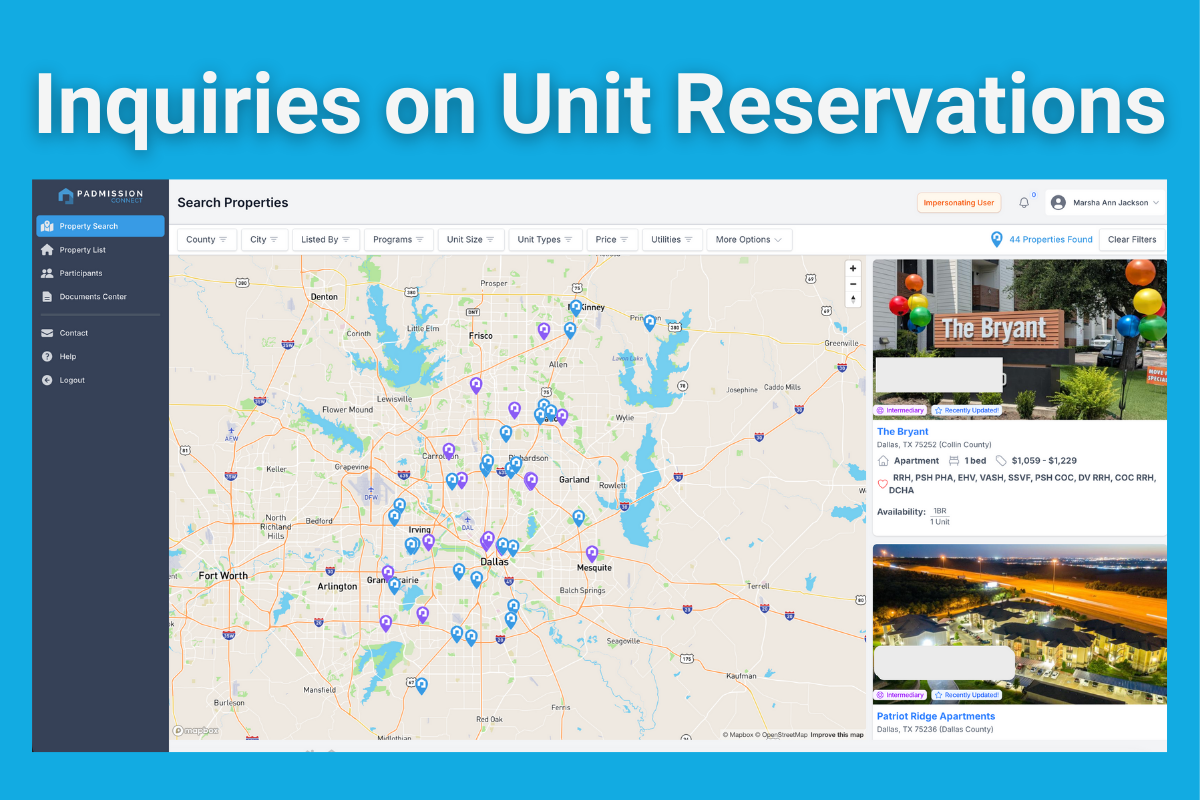
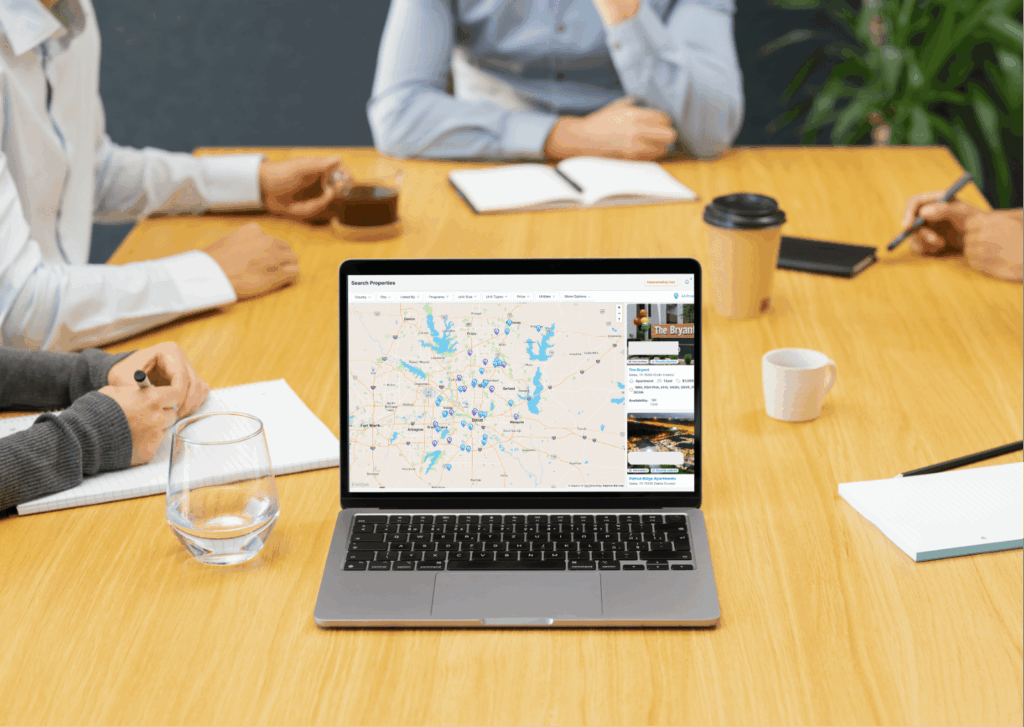
Map Search can now show properties with general availability (light blue) alongside units being held as Reservations (purple)
The Approach — Make Reservations Shareable Without Creating Collisions
Most systems face the same underlying condition: reserved units need to be shared early enough to be useful, but not so loosely that multiple staff unknowingly pursue the same opportunity. When reservations live only in side conversations, spreadsheets, or institutional memory, systems rely on staff effort to prevent collisions—and that effort does not scale well under turnover, workload pressure, or scrutiny.
The design approach is straightforward:
-
Community-controlled visibility: the community can enable or disable reservation visibility to match local practice and governance.
-
Reservations treated as a coordinated inventory: reservations can be reviewed directly by case managers as part of their work.
-
Single-inquiry locking: the moment an inquiry is submitted, the reservation is no longer available for competing inquiries from other case managers.
This capability allows communities to control whether reservations are visible to case managers, aligning the system with local governance and practice rather than imposing a single operating model. When enabled, reservations appear as a distinct type of housing inventory, separate from general availability, so they can be worked intentionally and consistently.
Crucially, the system enforces a single-inquiry rule. The moment a case manager submits an inquiry on a reserved unit, that reservation is no longer available for other case managers to pursue. This establishes a clear, authoritative state for the reservation without changing who makes placement decisions or how prioritization occurs.
Cleaner Coordination Across Roles
When reservations are visible, case managers incorporate them into the same planning they already do: weighing options, matching household needs, and sequencing next steps. The difference is not in decision-making, but in coordination. Reserved opportunities can be worked with shared expectations about who is acting on them and what stage the process is in.
The single-inquiry behavior removes a common source of day-to-day friction: duplicate outreach to the same reserved unit, conflicting updates to housing locators, and uncertainty about whether an opportunity is still viable. Instead of resolving those issues through follow-up calls or internal messages, the reservation itself reflects the current state of work.
Once an inquiry is submitted, housing locators continue to move that inquiry through the community’s configured workflow. As the inquiry progresses, the system updates the reservation’s status accordingly, keeping reservation tracking aligned with local process without requiring parallel tools or reconciliation work.
This supports the human reality of housing search: multiple roles contributing to one outcome, with shared responsibility and limited time to untangle ambiguity.
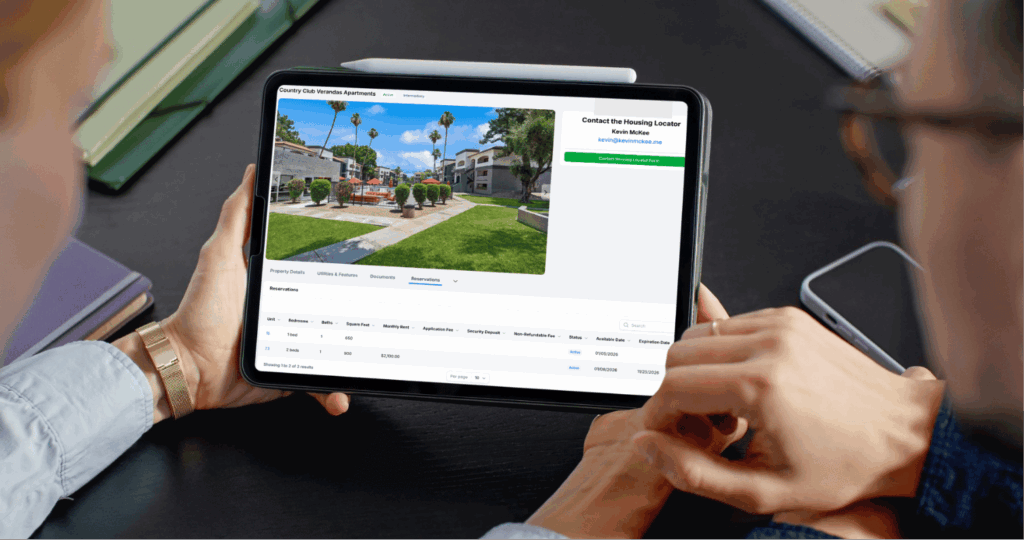
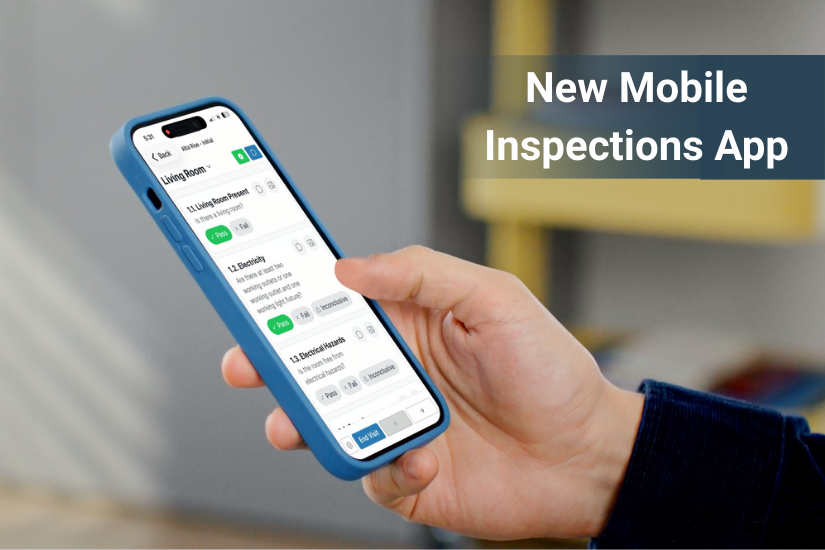
Case managers can view and act on reserved units in the field, with reservation status reflecting real-time inquiry activity so coordination remains clear regardless of where the work happens.
After an inquiry is submitted, the housing locator can move that inquiry through the community’s configurable workflow. As the inquiry progresses, the system updates reservation status to reflect the inquiry’s status—so the reservation remains aligned to the community’s local process without requiring a separate tracking method.
This supports the human reality of housing work: multiple roles contributing to one outcome, with shared responsibility—and limited time for reconciliation work.
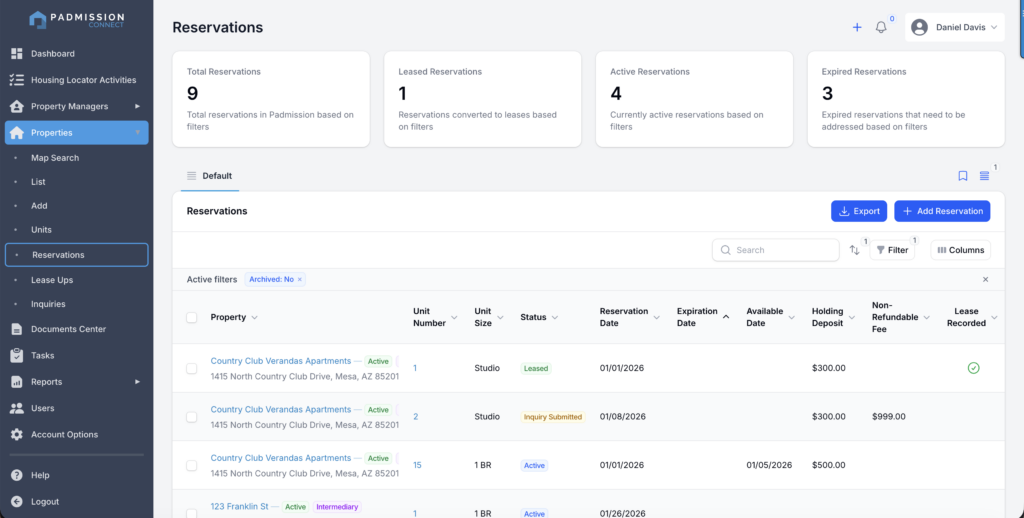
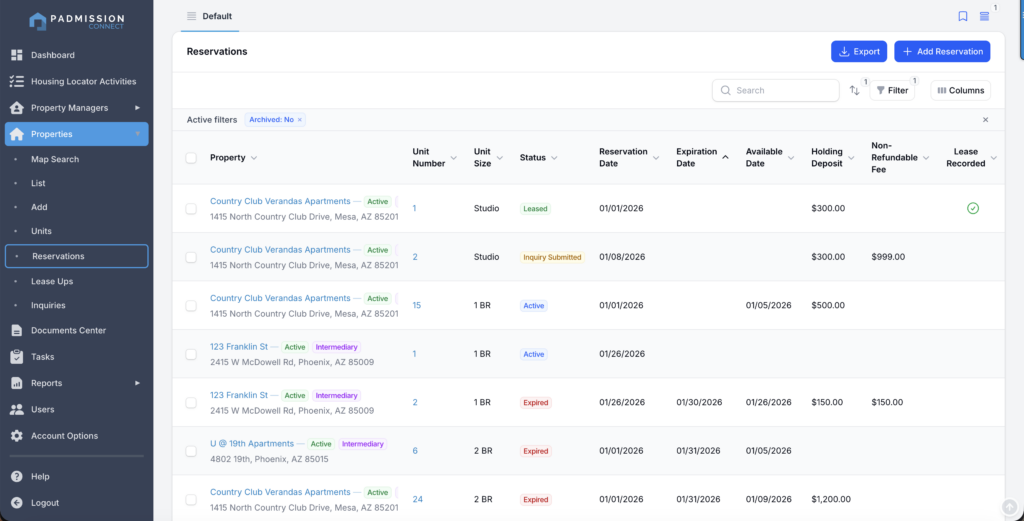
Summary widgets make understanding the current inventory easily accessible on the reservations table.
Why This Approach Works at a System Level
Homelessness response systems depend on coordination across roles, agencies, and external partners who do not share the same day-to-day tools. Small breakdowns—such as two people unknowingly working the same reserved unit—create avoidable confusion for providers and property partners and introduce unnecessary administrative strain.
By capturing reservation state as part of shared housing access infrastructure, the system provides a durable source of truth about “who is working what” at any moment. The single-inquiry rule functions as a governance mechanism as much as a coordination safeguard: it establishes clarity without requiring oversight, escalation, or cleanup after the fact.
This is an example of the systems design maturity in Padmission Connect. The platform reflects real workflow states, makes them shareable when communities deem it appropriate, and reduces coordination friction without shifting authority or decision ownership. The result is more predictable execution under everyday conditions—and under review—without asking staff to carry that burden themselves.
Learning From Reservation Visibility in Practice
For communities formalizing how reserved units move from housing locator work into case manager action, this capability provides a useful reference point for clarifying local expectations—particularly around handoffs, visibility, and when a reserved opportunity should return to the broader pool.
If you’re assessing whether reservation visibility aligns with your system’s governance model, we can walk through common operating patterns and the workflow implications of each. In helping communities around the country implement these programs, we have also gained insight on implementation and change-management, should your community choose to move forward with unit reservations.
Explore guidance on coordinated housing search workflows and how HUD defines reservation governance and handoff expectations.
About the Author:
Daniel Davis
Related Posts


Enhanced Unit Reservation and Case Manager Inquiry Process
In many homelessness response systems, housing locators identify and hold units before a household is ready to submit an application. These unit reservations—sometimes called unit holds, or master contracted units—sit at a critical junction between landlord engagement and case manager action. They are time-bound, relationship-sensitive, and often governed by informal norms rather than shared records.
Because of that, reserved units are frequently the most actionable housing options available to case managers. They represent real coordination with a property owner, a defined availability window, and local expectations about timing. At the same time, they are also one of the easiest places for coordination to break down.
Padmission Connect now supports unit reservations as a first-class part of coordinated housing search, allowing communities to determine whether and how reserved units are visible to case managers as part of shared housing inventory.
Reservations Map Search
Map Search can now show properties with general availability (light blue) alongside units being held as Reservations (purple)
The Approach — Make Reservations Shareable Without Creating Collisions
Most systems face the same underlying condition: reserved units need to be shared early enough to be useful, but not so loosely that multiple staff unknowingly pursue the same opportunity. When reservations live only in side conversations, spreadsheets, or institutional memory, systems rely on staff effort to prevent collisions—and that effort does not scale well under turnover, workload pressure, or scrutiny.
The design approach is straightforward:
-
Community-controlled visibility: the community can enable or disable reservation visibility to match local practice and governance.
-
Reservations treated as a coordinated inventory: reservations can be reviewed directly by case managers as part of their work.
-
Single-inquiry locking: the moment an inquiry is submitted, the reservation is no longer available for competing inquiries from other case managers.
This capability allows communities to control whether reservations are visible to case managers, aligning the system with local governance and practice rather than imposing a single operating model. When enabled, reservations appear as a distinct type of housing inventory, separate from general availability, so they can be worked intentionally and consistently.
Crucially, the system enforces a single-inquiry rule. The moment a case manager submits an inquiry on a reserved unit, that reservation is no longer available for other case managers to pursue. This establishes a clear, authoritative state for the reservation without changing who makes placement decisions or how prioritization occurs.
Cleaner Coordination Across Roles
When reservations are visible, case managers incorporate them into the same planning they already do: weighing options, matching household needs, and sequencing next steps. The difference is not in decision-making, but in coordination. Reserved opportunities can be worked with shared expectations about who is acting on them and what stage the process is in.
The single-inquiry behavior removes a common source of day-to-day friction: duplicate outreach to the same reserved unit, conflicting updates to housing locators, and uncertainty about whether an opportunity is still viable. Instead of resolving those issues through follow-up calls or internal messages, the reservation itself reflects the current state of work.
Once an inquiry is submitted, housing locators continue to move that inquiry through the community’s configured workflow. As the inquiry progresses, the system updates the reservation’s status accordingly, keeping reservation tracking aligned with local process without requiring parallel tools or reconciliation work.
This supports the human reality of housing search: multiple roles contributing to one outcome, with shared responsibility and limited time to untangle ambiguity.
Case managers can view and act on reserved units in the field, with reservation status reflecting real-time inquiry activity so coordination remains clear regardless of where the work happens.
After an inquiry is submitted, the housing locator can move that inquiry through the community’s configurable workflow. As the inquiry progresses, the system updates reservation status to reflect the inquiry’s status—so the reservation remains aligned to the community’s local process without requiring a separate tracking method.
This supports the human reality of housing work: multiple roles contributing to one outcome, with shared responsibility—and limited time for reconciliation work.
Summary widgets make understanding the current inventory easily accessible on the reservations table.
Why This Approach Works at a System Level
Homelessness response systems depend on coordination across roles, agencies, and external partners who do not share the same day-to-day tools. Small breakdowns—such as two people unknowingly working the same reserved unit—create avoidable confusion for providers and property partners and introduce unnecessary administrative strain.
By capturing reservation state as part of shared housing access infrastructure, the system provides a durable source of truth about “who is working what” at any moment. The single-inquiry rule functions as a governance mechanism as much as a coordination safeguard: it establishes clarity without requiring oversight, escalation, or cleanup after the fact.
This is an example of the systems design maturity in Padmission Connect. The platform reflects real workflow states, makes them shareable when communities deem it appropriate, and reduces coordination friction without shifting authority or decision ownership. The result is more predictable execution under everyday conditions—and under review—without asking staff to carry that burden themselves.
Learning From Reservation Visibility in Practice
For communities formalizing how reserved units move from housing locator work into case manager action, this capability provides a useful reference point for clarifying local expectations—particularly around handoffs, visibility, and when a reserved opportunity should return to the broader pool.
If you’re assessing whether reservation visibility aligns with your system’s governance model, we can walk through common operating patterns and the workflow implications of each. In helping communities around the country implement these programs, we have also gained insight on implementation and change-management, should your community choose to move forward with unit reservations.
Explore guidance on coordinated housing search workflows and how HUD defines reservation governance and handoff expectations.
About the Author:
Daniel Davis